


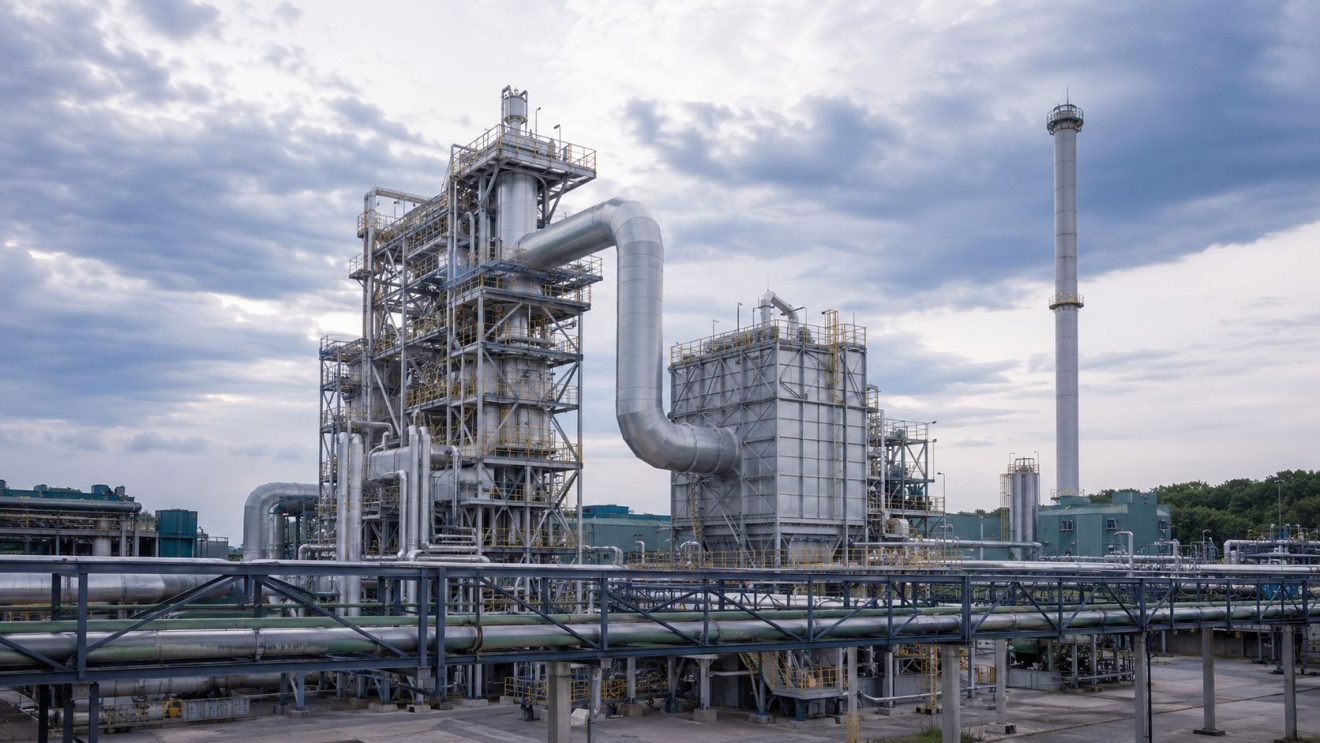
For many industrial plants, the challenge with SCR is not whether the technology can remove NOx. The problem is temperature.
By the time flue gas reaches the DeNOx stage—particularly after particulate removal, desulfurization or heat recovery—its temperature may already be below the preferred operating range of conventional SCR catalysts. Reheating the entire gas stream adds energy consumption, equipment and operating cost.
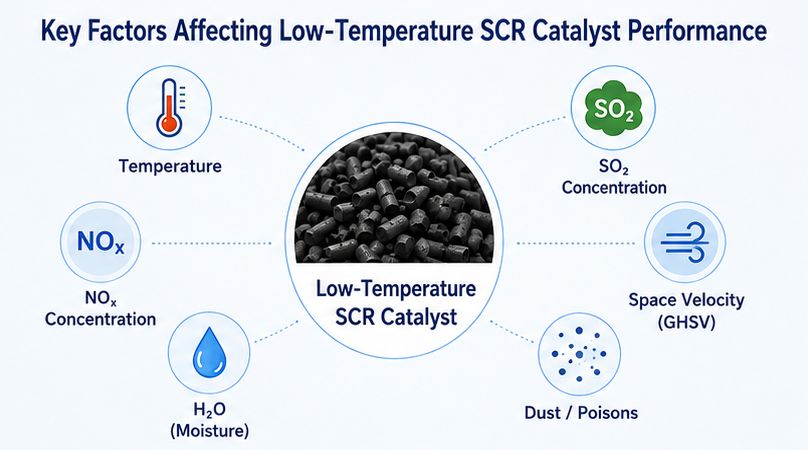
This is where a low-temperature SCR DeNOx catalyst can make a practical difference. The important question, however, is not the highest NOx removal efficiency reported under laboratory conditions. A catalyst must be evaluated against the actual flue gas temperature, NOx concentration, SO₂, moisture, dust loading, space velocity and required outlet emission level.
What Is a Low-Temperature SCR DeNOx Catalyst?
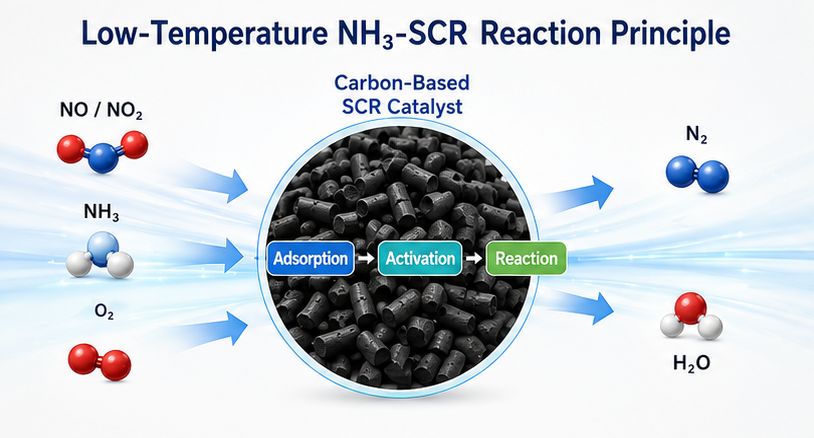
Selective Catalytic Reduction, or SCR, removes nitrogen oxides by reacting NOx with a reducing agent—typically ammonia—over a catalyst.
The principal NH₃-SCR reactions include:
4NO + 4NH₃ + O₂ → 4N₂ + 6H₂O
2NO₂ + 4NH₃ + O₂ → 3N₂ + 6H₂O
NO + NO₂ + 2NH₃ → 2N₂ + 3H₂O
The catalyst provides active sites for NH₃ adsorption, activation and surface reactions with NOx, promoting the selective reduction of nitrogen oxides. The U.S. Environmental Protection Agency identifies SCR as an established post-combustion technology for stationary-source NOx control and provides detailed information in its SCR technical documentation.
There is no single temperature that universally defines “low-temperature SCR.” A 2011 review published in Catalysis Today discusses low-temperature NH₃-SCR in approximately the 100–300°C range and identifies catalyst development below 200°C as particularly challenging.
Why Is Low-Temperature SCR Needed in Industrial Flue Gas?
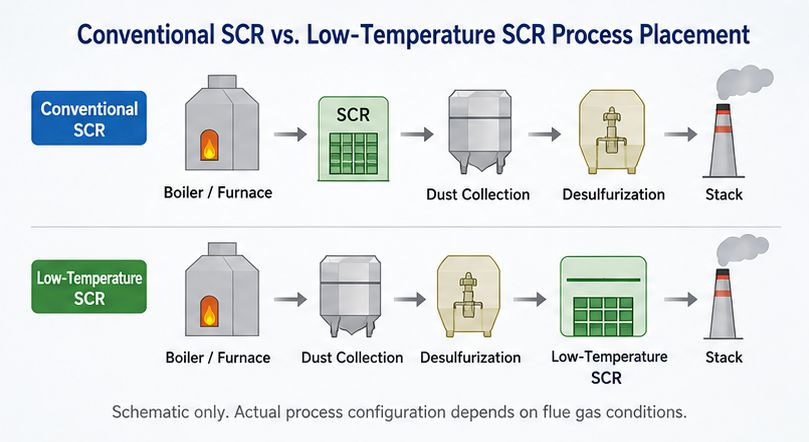
The issue is often a mismatch between the catalyst temperature window and the temperature available at the intended SCR location.
Installing SCR in a hotter part of the process can make use of the existing flue gas temperature, but the catalyst may also be exposed to higher dust loading, sulfur compounds and potential catalyst poisons. Installing DeNOx downstream of particulate and sulfur removal can provide a cleaner gas stream, but the temperature may be substantially lower.
A low-temperature catalyst can therefore provide greater process-layout flexibility and, in suitable applications, reduce the heat that must be added specifically for the SCR reaction.
A 2024 review published in Molecules notes that low-temperature NH₃-SCR remains important for applications where conventional SCR temperature requirements would otherwise increase the need for flue gas reheating.
Potential applications include iron and steel sintering, coke oven flue gas, industrial boilers, chemical process off-gas, industrial furnaces and kilns, non-ferrous metallurgy, waste incineration and other medium- to low-temperature flue gas streams.
These industries should not be treated as a universal application list. Suitability still depends on actual gas temperature, SO₂, moisture, dust loading, NOx concentration and the required emission target.
What Matters Most When Selecting a Low-Temperature SCR Catalyst?
1. NOx Conversion at the Actual Operating Temperature
A headline figure such as “95% DeNOx efficiency” is incomplete without test conditions.
If 95% conversion was measured at 200°C but a plant normally operates between 140 and 170°C, the more relevant question is how the catalyst performs across 140–170°C.
For engineering selection, an effective operating temperature window is generally more useful than a single peak conversion value.
2. SO₂ and H₂O Tolerance
SO₂ and H₂O are major considerations in industrial low-temperature SCR. A 2019 review published in Applied Catalysis A: General specifically examines sulfur and water poisoning mechanisms and strategies for improving the resistance of low-temperature SCR catalysts.
For this reason, short-term catalyst tests in dry, sulfur-free laboratory gas should not automatically be treated as representative of long-term operation in industrial flue gas.
3. Space Velocity and Effective Contact Time
Gas Hourly Space Velocity, or GHSV, represents the gas flow handled per unit volume of catalyst.
Changing GHSV changes the effective contact conditions between the flue gas and the catalyst. Comparing two NOx conversion figures without knowing their respective space velocities can therefore be misleading.
4. Resistance to Poisoning and Long-Term Deactivation
Real flue gas may contain dust, alkali metals, heavy metals, sulfur species and other deposits.
A useful industrial catalyst therefore needs to answer two different questions: how active is it at the beginning of a test, and how much of that performance remains after extended exposure to the actual flue gas?
For industrial applications, long-term stability can be just as important as initial activity.
5. Mechanical Strength and Pressure Drop
Industrial catalyst selection is not only about surface chemistry.
For honeycomb, pelletized or other formed catalysts, mechanical strength, attrition, breakage and system pressure drop directly affect reactor operation and maintenance. A catalyst with strong laboratory activity may still be unsuitable if it causes excessive pressure drop or cannot maintain its physical integrity during operation.
Low-Temperature SCR vs. Conventional SCR Catalysts
| Item | Low-Temperature SCR Catalyst | Conventional SCR Catalyst |
|---|---|---|
| Main application | Medium- to low-temperature flue gas | Relatively higher-temperature flue gas |
| Main design focus | Low-temperature activity and stability | Activity and lifetime within an established temperature window |
| Reheating demand | May be reduced in suitable applications | Low-temperature gas may require reheating |
| SO₂/H₂O challenge | Often requires greater attention | More mature industrial technology |
| Process layout | Potentially greater flexibility | More dependent on available gas temperature |
| Selection focus | Temperature window, sulfur/water tolerance, GHSV and stability | Activity, lifetime, pressure drop and stability |
Low-temperature SCR is not inherently better than conventional SCR.
If sufficient gas temperature is already available, a conventional catalyst may be the more appropriate choice. Low-temperature SCR becomes particularly relevant when the available flue gas temperature is lower and reheating represents a meaningful operating penalty.
For a broader explanation of SCR system design, DAQI Technology’s N-101/N-201 catalysts and operating principles, see our Low-Temperature SCR DeNOx Technology article.
Why Not Simply Increase Ammonia to Improve NOx Removal?
SCR performance depends on an appropriate NH₃/NOx ratio.
Insufficient reductant can limit NOx conversion, but excess ammonia can increase ammonia slip rather than providing a proportional improvement in DeNOx performance.
For example, EU BAT conclusions for common waste gas treatment systems in the chemical sector identify optimisation of the reagent-to-NOx ratio and homogeneous reagent distribution as measures for reducing ammonia slip from SCR/SNCR systems.
Catalyst activity, ammonia injection, gas mixing and reactor design therefore need to be evaluated as one system rather than attempting to improve NOx removal simply by increasing ammonia dosage.
What Information Should Be Provided When Buying a DeNOx Catalyst?
A request that contains only “flue gas flow rate” and “required removal efficiency” is usually not enough for reliable catalyst selection.
| Project Data | Why It Matters |
|---|---|
| Flue gas flow | Determines treatment load |
| Inlet temperature and fluctuation | Defines the required catalyst temperature window |
| Inlet NOx | Determines catalytic load |
| NO/NO₂ ratio | Affects SCR reaction conditions |
| SO₂/SO₃ | Indicates sulfur-related risk |
| H₂O | Indicates moisture exposure |
| O₂ | Confirms reaction conditions |
| Dust and major impurities | Indicates fouling, erosion and poisoning risks |
| NH₃ source / NH₃-to-NOx ratio | Defines reductant conditions |
| Required outlet NOx | Establishes design target |
| Allowable pressure drop | Affects catalyst and reactor configuration |
| Continuous operating period | Helps assess stability requirements |
Why Is “NOx Removal ≥90%” Not Enough for Catalyst Comparison?
A removal-efficiency figure becomes useful only when the test and operating conditions are known.
Two catalysts may both be described as providing “≥90% NOx removal,” but the figures cannot be compared directly if they were measured at different temperatures, inlet NOx levels, SO₂ concentrations, moisture levels, GHSV, NH₃/NOx ratios or test durations.
For industrial projects, catalyst performance should always be evaluated together with the operating conditions.
How Does DAQI Technology Match DeNOx Catalysts to Industrial Flue Gas?
DAQI Technology approaches low-temperature DeNOx catalyst selection from the operating conditions rather than from a single peak laboratory conversion figure.
Its current low-temperature SCR portfolio includes the N-101 and N-201 catalyst series, with recommended operating ranges of 120–180°C for N-101 and 120–240°C for N-201.
These ranges are selection references rather than universal performance guarantees. Actual performance depends on the complete flue gas composition, inlet NOx, SO₂/SO₃, moisture, particulate loading, space velocity, NH₃/NOx ratio, catalyst loading and reactor conditions.
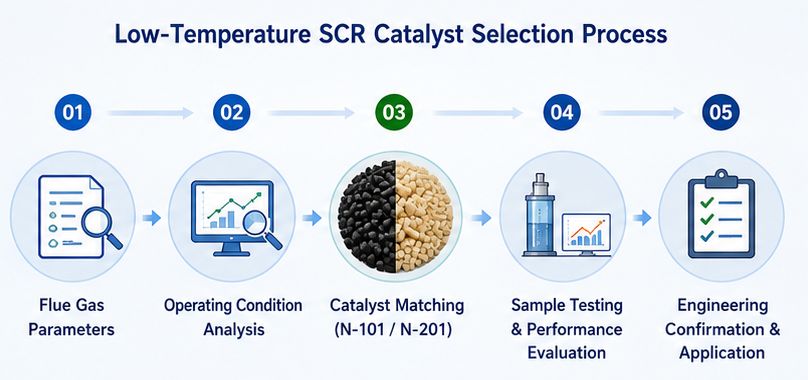
A typical project evaluation follows five steps:
Flue gas data → Operating-condition assessment → Catalyst matching → Sample or condition testing → Engineering parameter confirmation
Where SO₂, NOx and particulate matter are present together, catalyst selection should also be evaluated alongside upstream and downstream desulfurization, particulate-control and heat-recovery processes. In these applications, the desulfurization and DeNOx stages should be considered as an integrated system rather than as isolated treatment steps.
DAQI Technology’s S-1-111 flue gas desulfurization catalyst is used for SO₂ removal in medium- and low-temperature industrial flue gas, while N-101 and N-201 are applied on the low-temperature SCR DeNOx side. The final process arrangement should be determined according to flue gas temperature, sulfur content, NOx concentration, moisture, dust loading and the required emission limits. For more information on the desulfurization stage, see our Catalytic Flue Gas Desulfurization Technology.
Frequently Asked Questions
What is the operating temperature of a low-temperature SCR catalyst?
There is no universal temperature range for every catalyst formulation. Research commonly discusses low-temperature SCR within approximately 100–300°C, while operation below 200°C remains particularly challenging. The actual industrial operating window should be confirmed from catalyst data and project-specific operating conditions.
What NOx removal efficiency can a low-temperature SCR catalyst achieve?
There is no meaningful single value without operating conditions. Temperature, inlet NOx, GHSV, SO₂, H₂O, NH₃/NOx ratio and exposure time can all affect the result.
Can SO₂ deactivate an SCR catalyst?
Yes, it can. SO₂, particularly when combined with moisture at low temperatures, can contribute to catalyst deactivation and deposition phenomena. Sulfur tolerance is therefore an important selection criterion for low-temperature applications.
Why does ammonia slip matter in an SCR system?
Ammonia that does not react with NOx can leave the SCR system as ammonia slip. Excessive slip reduces reagent efficiency and, in sulfur-containing flue gas, may contribute to downstream deposition and operating problems. SCR systems therefore need to balance NOx conversion with controlled ammonia dosage.
What is the difference between SCR and SNCR?
SCR uses a catalyst to promote the reaction between NOx and the reducing agent. SNCR operates without a catalyst. Their operating temperature windows, reactor requirements and typical control performance therefore differ. The appropriate technology depends on the flue gas temperature, required NOx reduction and overall process configuration.
What data should I send to an SCR catalyst supplier?
At minimum, provide flue gas flow, temperature range, inlet NOx, SO₂/SO₃, moisture, O₂, particulate loading and major impurities, ammonia conditions, required outlet NOx, allowable pressure drop and expected continuous operating period.
Final Consideration
For low-temperature industrial flue gas, catalyst selection should not begin with the highest laboratory DeNOx efficiency.
It should begin with a simpler question: Can the catalyst maintain the required NOx emission level under the actual temperature, sulfur, moisture, space velocity and particulate conditions of the plant?
Complete flue gas data is therefore usually more valuable than a single performance number.
DAQI Technology can support catalyst selection, sample testing and operating-parameter matching based on project-specific industrial flue gas conditions.