


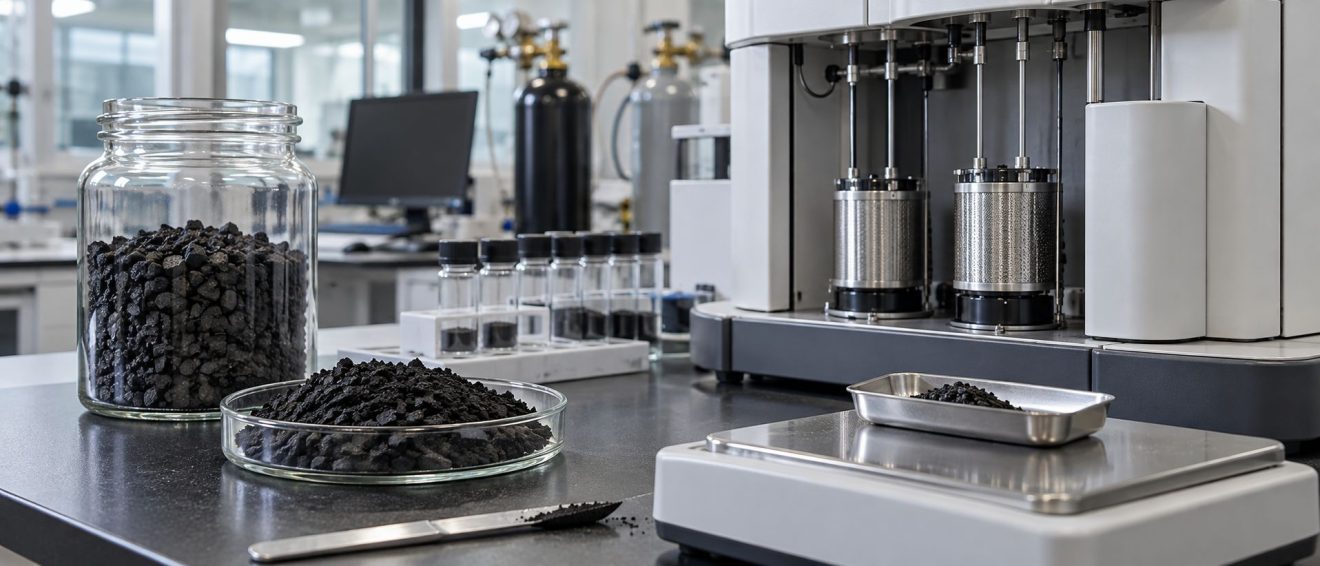
When comparing activated carbon grades, buyers often start with two numbers: iodine number and BET surface area. A carbon with a BET surface area of 1,200 m²/g may appear more attractive than one rated at 900 m²/g. But will it necessarily remove more contaminants or last longer in an adsorption system?
Not necessarily. BET surface area is a useful measure of a carbon’s accessible surface under specified gas adsorption test conditions. It does not, by itself, establish how well the carbon will perform against a particular contaminant.
Pore size distribution, molecular accessibility, surface chemistry and operating conditions all influence adsorption performance. Understanding these factors helps engineers and purchasing teams compare activated carbon grades more effectively.
What Is BET Surface Area in Activated Carbon?
BET stands for Brunauer, Emmett and Teller, the researchers associated with the BET adsorption model. The method estimates the specific surface area of a solid from gas physisorption measurements. Results are commonly reported in square meters per gram (m²/g).
For example, a BET surface area of 900 m²/g indicates an estimated specific surface area of approximately 900 square meters per gram, as calculated using the applicable test method and model.
Most of this area is associated with the carbon’s internal pore structure rather than the visible exterior of each particle. Carbonization and activation create pores of different sizes, producing the internal surfaces that make activated carbon useful for adsorption.
BET measurements commonly use nitrogen adsorption under controlled conditions. The resulting adsorption isotherm is evaluated using the BET model. ISO 9277:2022 provides an international standard for determining the specific surface area of solids by gas adsorption.
One important qualification is that BET surface area is a model-derived value, not a direct measurement of every internal pore surface. Highly microporous carbons require particular care when selecting the BET fitting range and interpreting the results.
Does Higher BET Surface Area Mean Better Adsorption?
A larger accessible surface area can support greater adsorption capacity under suitable conditions. However, higher BET values do not guarantee better performance across different contaminants or treatment systems.
1. Pore accessibility matters
Consider an activated carbon with extensive narrow microporosity. It may have a high BET surface area, but some target molecules may be too large to enter a substantial portion of its pores.
Another carbon with a lower BET value but a more suitable pore size distribution may offer better accessibility and adsorption kinetics for those molecules.
2. Equilibrium capacity and adsorption rate are different
Adsorption capacity measured under equilibrium laboratory conditions does not automatically translate into longer service life in a continuous fixed-bed system.
In practical operation, intraparticle diffusion, contact time, flow rate and mass transfer behavior can strongly influence breakthrough performance.
For industrial gas purification or water treatment, dynamic adsorption capacity, breakthrough time and treated-stream quality may provide more relevant performance information than BET surface area alone.
3. Surface chemistry also influences adsorption
Oxygen-containing functional groups, surface acidity or basicity, mineral content and chemical modification can affect the interaction between activated carbon and target contaminants.
For some polar compounds, aqueous contaminants or reactive purification applications, increasing surface area alone may not produce the desired improvement.
For impregnated or catalytic carbons, BET surface area should not be treated as a direct measure of chemical reactivity or catalytic activity.
Understanding Activated Carbon Pore Structure
Activated carbon contains pores of different sizes. The International Union of Pure and Applied Chemistry (IUPAC) classifies pores into three principal categories: micropores, mesopores and macropores.
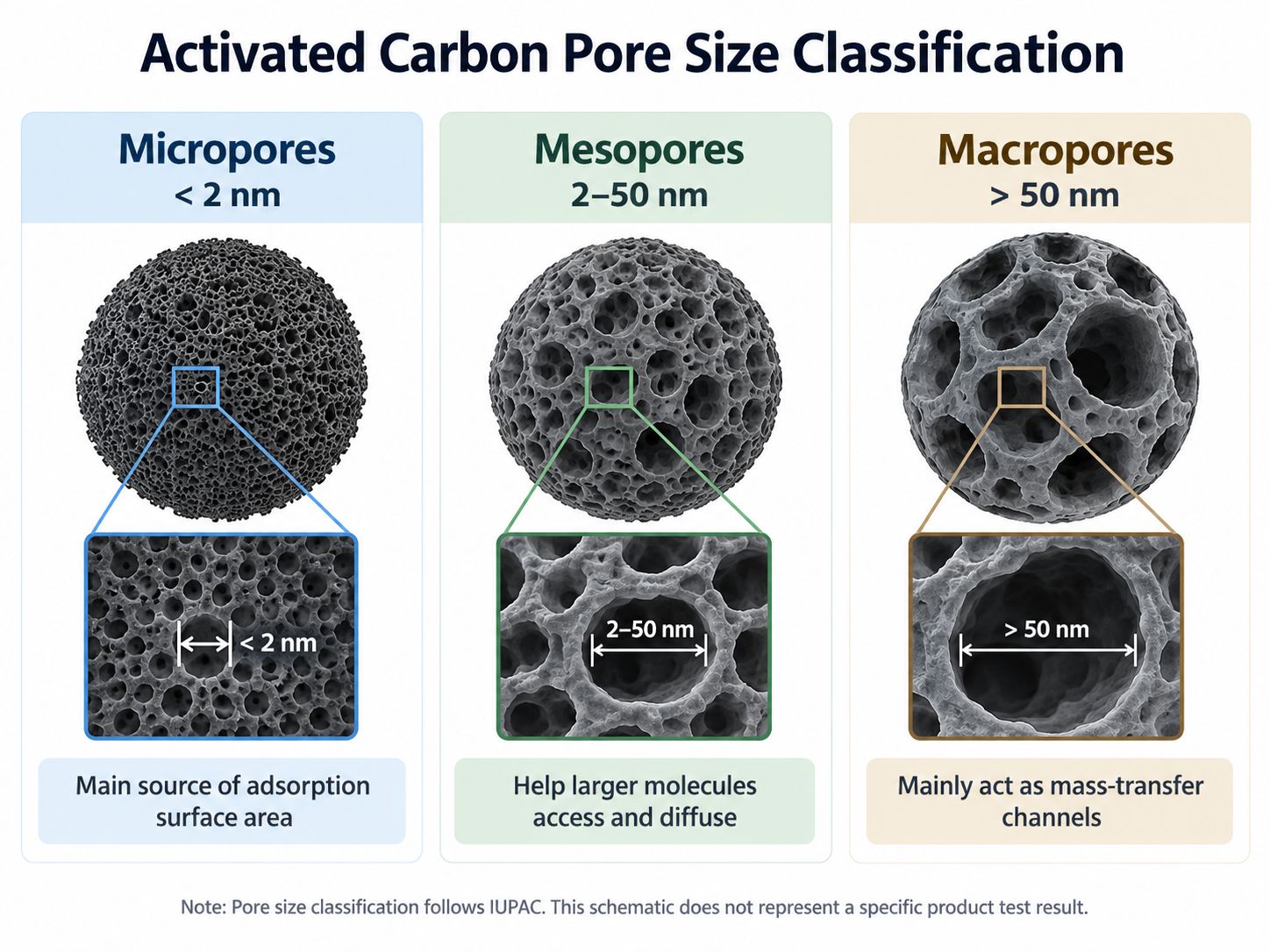
| Pore category | Pore width | Typical characteristics | Selection considerations |
|---|---|---|---|
| Micropores | Below 2 nm | Often contribute substantially to surface area and adsorption capacity | Molecular accessibility and pore width matching |
| Mesopores | 2–50 nm | Provide adsorption space and may facilitate diffusion of larger molecules | Transport and accessibility for larger adsorbates |
| Macropores | Above 50 nm | Often form part of the internal transport network | Pore connectivity and mass transfer |
Micropores: an important source of adsorption capacity
Micropores commonly account for a large portion of the surface area of activated carbon. Overlapping adsorption potentials within narrow pores can favor adsorption of suitable small molecules.
However, pores that are too narrow for the target molecules may contribute little to their effective adsorption capacity. Restricted diffusion can also affect adsorption rates.
Mesopores: accessibility for larger molecules
Mesopores can be particularly relevant when treating streams containing larger organic molecules, certain color-causing compounds or complex mixtures.
A higher mesopore fraction does not automatically guarantee superior decolorization or contaminant removal. Performance still depends on the adsorbate, solution chemistry and operating conditions.
Macropores: pathways for mass transfer
Macropores generally contribute relatively little to total surface area, but they can help connect the external particle surface to smaller internal pores.
This transport function may be important in granular activated carbon systems, particularly when adsorption rates and bed utilization are critical.
For detailed guidance on gas physisorption and pore size analysis, see the 2015 IUPAC Technical Report on surface area and pore size distribution.
BET Surface Area vs. Iodine Number: What Is the Difference?
BET surface area and iodine number are frequently reported together in activated carbon specifications. They provide related but different information.
| Parameter | BET surface area | Iodine number |
|---|---|---|
| Unit | m²/g | mg/g |
| Test principle | Gas physisorption and BET analysis | Iodine adsorption from aqueous solution |
| Main purpose | Specific surface area characterization | Relative indication of activation level and porosity |
| Limitation | Does not directly predict application-specific adsorption | Does not establish adsorption performance for other contaminants |
| Recommended use | Review alongside pore size distribution | Review alongside BET, physical properties and application testing |
According to ASTM D4607-14(2021), iodine number is a relative indicator of activated carbon porosity. Although it may approximate surface area for some carbons, the relationship is not universal.
Feedstock, activation conditions and pore volume distribution can all influence the relationship between iodine number and BET surface area.
There is therefore no reliable universal conversion factor between the two parameters.
For a more detailed explanation of iodine number and purchasing decisions, see our related technical guide: Understanding Iodine Number in Bamboo Activated Carbon. Use the English-language article URL when available.
How to Evaluate BET Surface Area When Buying Bamboo Activated Carbon
For bamboo-based activated carbon, BET surface area is one of several parameters worth reviewing. It should be considered alongside the product grade, manufacturing process, pore structure and intended application.
DAQI Technology offers BAC-001 bamboo activated carbon in different particle size ranges and physical forms for various applications. Product selection should be based on grade-specific technical information and relevant batch test results rather than assuming one specification applies to the entire series.
Six parameters to review before purchasing
- BET surface area: Check the reported value and measurement method.
- Pore size distribution and pore volume: Review micropore and mesopore characteristics where relevant.
- Iodine number: Use it as a supplementary indicator of carbon porosity and activation level.
- Ash, moisture and pH: Assess material characteristics and process compatibility.
- Hardness and particle size: Consider pressure drop, attrition, handling and bed replacement requirements.
- Application-specific adsorption data: Request adsorption capacity, removal efficiency or breakthrough results for the target contaminant.
In gas-phase fixed beds, factors such as inlet concentration, humidity, temperature, empty bed contact time and pressure drop can affect performance.
In water treatment, pH, competing organic matter, contact time and required effluent quality are also important.
For an overview of available material forms and selection considerations, visit our Bamboo Activated Carbon Resource Page.
What Information Should Buyers Provide to an Activated Carbon Supplier?
Instead of requesting the highest possible BET surface area, buyers can obtain more useful recommendations by sharing the operating requirements of their treatment system.
- Target contaminants: Chemical identity, composition and possible competing substances.
- Concentration: Inlet levels and required outlet concentration or removal efficiency.
- Operating environment: Temperature, humidity, pH and relevant process conditions.
- Equipment: Flow rate, bed dimensions, contact time and pressure drop limitations.
- Material requirements: Particle size, mechanical strength, packaging and replacement schedule.
- Validation: Bench-scale testing, breakthrough experiments or field trials where appropriate.
These details help suppliers shortlist suitable grades and provide relevant technical data, test reports and samples. For critical industrial applications, representative performance testing should be completed before finalizing bulk purchase specifications.
Frequently Asked Questions
Is 1,000 m²/g a good BET surface area for activated carbon?
It can indicate substantial specific surface area, but it does not establish whether the carbon is suitable for a particular application. Pore structure, surface chemistry and actual adsorption performance remain important.
Why can activated carbon with a high BET surface area show limited decolorization performance?
Some color-causing molecules may not readily access narrow micropores. Solution chemistry, competing compounds and adsorption kinetics can also affect performance. Pore size distribution and application testing are therefore important.
Can iodine number be converted into BET surface area?
There is no universal conversion formula. The relationship varies with feedstock, activation process and pore structure. Each parameter should be measured and interpreted using its appropriate method.
Does bamboo activated carbon always have a higher BET surface area than coal-based or coconut-shell carbon?
No. Feedstock influences the resulting carbon structure, but activation conditions and product grade are also significant. Comparisons should use consistent testing methods and consider the intended application.
Is BET testing required for every activated carbon purchase?
Not necessarily. Requirements depend on applicable standards, contract specifications and application risk. BET and pore size distribution measurements are particularly useful when comparing pore structures or selecting carbon for pore-sensitive applications.
Conclusion: Select the Right Pore Structure, Not Just the Highest BET Value
BET surface area provides valuable information about activated carbon, but it is only one part of material characterization.
Micropores, mesopores and macropores contribute differently to adsorption and mass transfer. The best material for a particular process is one whose accessible pore structure, surface properties and physical characteristics match the contaminants and operating conditions.
For industrial procurement, BET surface area should be evaluated together with iodine number, pore size distribution, mechanical properties and application-specific performance data.
Looking for Bamboo Activated Carbon for Your Process?
Share your target contaminants, operating conditions and material requirements with DAQI Technology. Our team can discuss suitable BAC-001 options, available technical documentation and sample evaluation requirements.
Technical References
- ISO 9277:2022. Determination of the specific surface area of solids by gas adsorption — BET method.
- Thommes, M. et al. (2015). Physisorption of gases, with special reference to the evaluation of surface area and pore size distribution. Pure and Applied Chemistry.
- ASTM D4607-14(2021). Standard Test Method for Determination of Iodine Number of Activated Carbon.