


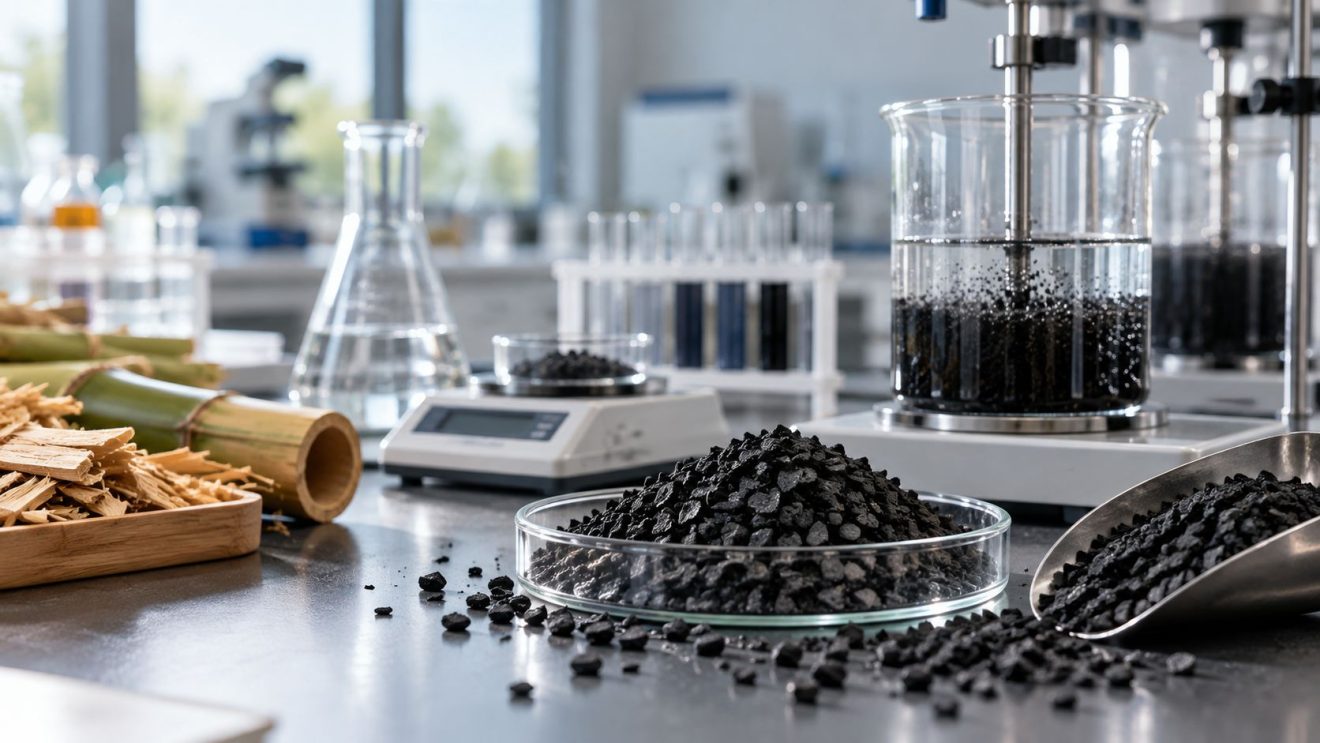
“What is the iodine number?” is one of the first questions many buyers ask when comparing activated carbon.
Values such as 800, 1,000 or 1,200 mg/g are easy to compare, which can create the impression that a higher iodine number automatically means a better activated carbon.
That is not necessarily the case.
Iodine number is an important specification for bamboo activated carbon and other activated carbons. It provides useful information about pore development and adsorption of relatively small molecules, but it is not an overall performance score.
A carbon with a higher iodine number will not automatically deliver better VOC removal, longer bed life or higher working adsorption capacity for every contaminant.
What Is the Iodine Number of Activated Carbon?
Iodine number is normally reported in mg/g.
In simplified terms, it describes the iodine adsorption characteristics of a given mass of activated carbon under specified test conditions.
An iodine number of 1,000 mg/g does not mean that one gram of activated carbon will adsorb 1,000 mg of any industrial contaminant.
It refers specifically to the result obtained under the defined iodine adsorption test conditions.
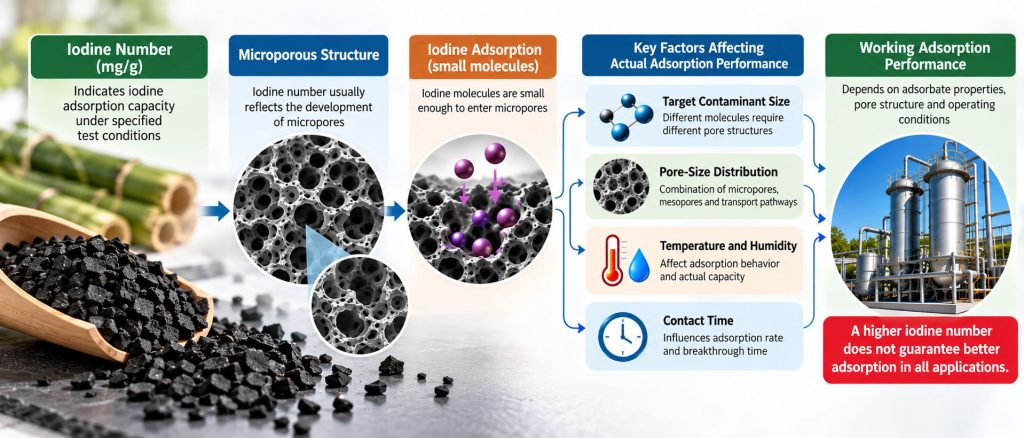
Because iodine is a relatively small molecule, iodine number is widely used as an indicator of pore development, particularly characteristics associated with the microporous structure of activated carbon.
ASTM D4607 describes iodine number as a relative indicator of activated carbon porosity and specifically notes that it does not necessarily provide a measure of the carbon’s ability to adsorb other species.[1]
What Does Iodine Number Tell Us About Pore Structure?
Most of the useful adsorption surface of activated carbon is located inside its pore network rather than on the visible exterior of the particles.
For bamboo activated carbon, carbonization first creates the basic carbon framework. Activation then develops and opens pores within that framework, producing pores of different sizes together with pathways through which adsorbates can move.
Because iodine molecules can access relatively small pores, iodine adsorption provides useful information about the development of microporosity and the relative degree of activation when comparable materials and test methods are being evaluated.
This is why industrial specifications frequently include requirements such as:
- Iodine number ≥800 mg/g
- Iodine number ≥900 mg/g
- Iodine number ≥1,000 mg/g
- Iodine number ≥1,100 mg/g
These values are useful for defining grades, controlling batches and making preliminary comparisons. They are still only one part of the overall performance profile of an activated carbon.
Does a Higher Iodine Number Always Mean Better Adsorption?
No.
This is one of the most important points when interpreting an activated carbon data sheet.
For activated carbons made from similar feedstocks and under comparable manufacturing conditions, a higher iodine number may indicate more developed porosity and a larger amount of accessible internal adsorption surface.
Industrial contaminants, however, are not all the same size or chemically similar to iodine.
Activated carbon may be required to remove VOCs, aromatic compounds, odor molecules, dissolved organics, color bodies or other contaminants with very different molecular dimensions and chemical properties.
If much of the available surface is located in very narrow micropores, a larger adsorbate may not be able to access all of that surface efficiently. A carbon with a somewhat lower iodine number but a more suitable pore-size distribution and transport network can therefore perform better in a particular application.
The better question is not “Which activated carbon has the highest iodine number?” but “Which pore structure is best matched to the contaminant I need to remove?”
Is Iodine Number the Same as BET Surface Area?
No. The two parameters are related to the porous structure of activated carbon, but they measure different characteristics.
Iodine number is obtained through an iodine adsorption test and is commonly used as an indicator of pore development.
BET surface area, normally expressed in m²/g, is derived from gas adsorption measurements and describes the specific internal surface area of a porous material.
There can be a correlation between the two for certain activated carbons, but there is no universal conversion formula.
ASTM D4607 notes that the relationship between iodine number and surface area varies with changes in raw material, processing conditions and pore-volume distribution.[1]
A specification of Iodine Number: 1,000 mg/g should therefore not be converted into an assumed BET value without supporting test data. If BET is important to the project, it should be specified and measured separately.
Why Can Two Carbons with the Same Iodine Number Perform Differently?
Consider two activated carbons with iodine numbers close to 1,000 mg/g.
Carbon A may contain a high proportion of narrow micropores. Carbon B may combine microporosity with a different proportion of mesopores and more accessible transport pathways.
Their iodine numbers can be similar while their adsorption rates, working capacities and breakthrough behavior for a specific contaminant differ.
Actual performance is also affected by factors such as:
- particle size and particle-size distribution;
- ash content;
- hardness and mechanical strength;
- surface chemistry;
- temperature;
- gas humidity or water quality;
- inlet contaminant concentration;
- space velocity and contact time; and
- adsorber design.
This is why industrial activated carbon selection should not be based on a single iodine-number column.
How Should Buyers Interpret 800, 1,000 and 1,200 mg/g?
These numbers are better viewed as specification levels rather than simple low-medium-high quality rankings.
An 800 mg/g carbon is not automatically a low-quality product. If the application does not require highly developed microporosity, increasing iodine number may add material cost without producing a proportional improvement in working performance.
The same principle applies to 1,000 mg/g, 1,200 mg/g and higher grades. A higher value indicates a higher result for this particular test parameter; whether that becomes a practical advantage depends on the adsorbate and operating conditions.
Define the adsorption duty first, then determine the iodine-number range required to meet it.
What Should Be Checked Alongside Iodine Number?
For industrial bamboo activated carbon procurement, iodine number should normally be evaluated together with BET surface area, pore-size distribution, ash, hardness and particle size. For a broader discussion of these parameters, see our bamboo activated carbon selection guide.
BET Surface Area
BET provides additional information about internal surface area. It becomes more useful when interpreted together with pore volume and pore-size distribution, because not every square metre of internal surface is necessarily equally accessible to the target adsorbate.
Pore-Size Distribution
Pore-size distribution helps explain why carbons with similar iodine numbers can perform differently. The balance between micropores, mesopores and transport pathways affects how different molecules enter and diffuse through the carbon structure.
Ash Content
Ash represents the inorganic fraction remaining in activated carbon. It can be particularly important in water treatment, food processing, fine chemicals and applications where inorganic impurities or extractables need to be controlled.
Hardness
Hardness is especially important in granular fixed-bed systems. Weak particles can break during transport, loading, backwashing or long-term operation, increasing fines generation, carbon loss and bed resistance.
Particle Size
Particle size affects both mass transfer and pressure drop. Smaller particles can shorten diffusion distances, but they may also increase resistance through a packed bed. The smallest available particle size is therefore not automatically the best choice.
Reading a Bamboo Activated Carbon Specification: BAC-001 as an Example
BAC-001 bamboo-based activated carbon illustrates why bamboo activated carbon should be treated as a configurable material rather than a single fixed specification.
Iodine number needs to be considered together with BET surface area, ash, hardness, particle size and other application-relevant parameters.
- Gas-phase VOC fixed beds: consider the target VOC, pore structure, mechanical strength, humidity and pressure drop in addition to basic adsorption specifications.
- Water treatment: consider the target organic compounds, liquid-phase mass transfer, pore-size distribution, particle size and water chemistry.
- Decolorization: iodine number alone may be insufficient; methylene blue adsorption or testing with the actual process stream may provide more relevant information.
The same bamboo feedstock can be processed under different carbonization, activation and finishing conditions to produce different pore structures and product forms.
“Bamboo activated carbon” is therefore a material category, not a single performance grade.
When Does a High-Iodine Activated Carbon Make Sense?
A higher iodine number becomes particularly relevant when the target adsorbate is well matched to the carbon’s microporous structure and the process benefits from highly developed internal porosity.
For critical industrial applications, however, laboratory specifications should eventually be connected to application-specific testing. Depending on the project, this may include target-contaminant adsorption tests, breakthrough tests, pilot evaluation or on-site sample trials.
The operational question is ultimately not only “What is the iodine number?” but “How long will this carbon perform under my actual operating conditions while meeting the required outlet specification?”
Where Do ISO 5946 and GB/T 48061-2026 Fit?
Standardized product requirements and test methods become increasingly important as bamboo-based activated carbon moves into wider industrial use.
ISO 5946:2022, Bamboo-based activated carbon — General specifications, establishes general requirements and test methods for bamboo-based activated carbon.[2]
China’s GB/T 48061-2026 Bamboo-based Activated Carbon provides a corresponding national technical framework.
Product standards are valuable because they establish consistent requirements and test methods, but they do not replace a project-specific procurement specification.
A product standard helps determine how an activated carbon is evaluated; a project specification determines whether that carbon is suitable for a particular process.
What Should Be Included in an Activated Carbon RFQ?
Instead of sending a request that simply states “Bamboo activated carbon required, iodine number ≥1,000 mg/g. Please quote,” a more useful RFQ should provide:
- target contaminant and inlet concentration;
- gas-phase or liquid-phase application;
- process flow rate;
- operating temperature and humidity, or liquid-phase pH;
- existing vessel or adsorber dimensions;
- preferred particle size;
- allowable pressure drop;
- required outlet concentration or treatment target;
- required TDS, SDS, COA or third-party documentation; and
- whether sample or pilot testing is required.
The more clearly the operating conditions are defined, the easier it becomes to move from simply comparing specifications to matching the material to the actual process.
Not sure what iodine number your application requires?
Provide the target contaminant, inlet concentration, flow rate, temperature and humidity or water conditions, existing equipment and required outlet specification. These operating details make it possible to evaluate a suitable bamboo activated carbon specification and determine whether sample testing is appropriate.
Conclusion: Buy Performance, Not Just an Iodine Number
Iodine number remains one of the most useful basic specifications for activated carbon. It can provide information about pore development and support product grading, batch quality control and preliminary comparison between activated carbons.
But it is not a universal measure of adsorption performance.
A higher iodine number does not guarantee higher working capacity for every contaminant or longer service life in every adsorption system.
A more reliable selection process evaluates iodine number together with BET surface area, pore-size distribution, ash, hardness, particle size and application-specific adsorption data.
For industrial procurement, the objective is not to find the carbon with the largest number on the data sheet. It is to find the carbon whose pore structure, physical properties and adsorption characteristics match the actual operating conditions.
Frequently Asked Questions
Is an iodine number of 1,000 mg/g considered high?
It is a commonly specified relatively high iodine-number level for industrial activated carbon, but whether it is necessary depends on the application. The number alone does not establish product suitability.
Does a higher iodine number mean a higher BET surface area?
The two can be correlated for some activated carbons, but there is no universal conversion. Feedstock, activation conditions, pore volume and pore-size distribution affect the relationship.
Can iodine number predict VOC adsorption capacity?
Not directly. VOC adsorption also depends on molecular size, concentration, polarity, pore-size distribution, temperature and humidity. Application-specific adsorption or breakthrough data is more useful for critical projects.
Can bamboo activated carbon achieve a high iodine number?
Yes. Controlled carbonization and activation can develop a highly porous structure in bamboo-derived carbon. The final iodine number depends on feedstock, activation conditions, pore development and product specification.
Is iodine number alone enough for an activated carbon RFQ?
Usually not. Industrial specifications should also consider particle size, hardness, ash, pore structure or BET data, the target contaminant and actual operating conditions. Sample testing is recommended for critical applications.
References
- ASTM International. ASTM D4607 — Standard Test Method for Determination of Iodine Number of Activated Carbon.
- International Organization for Standardization. ISO 5946:2022 — Bamboo-based activated carbon — General specifications.