


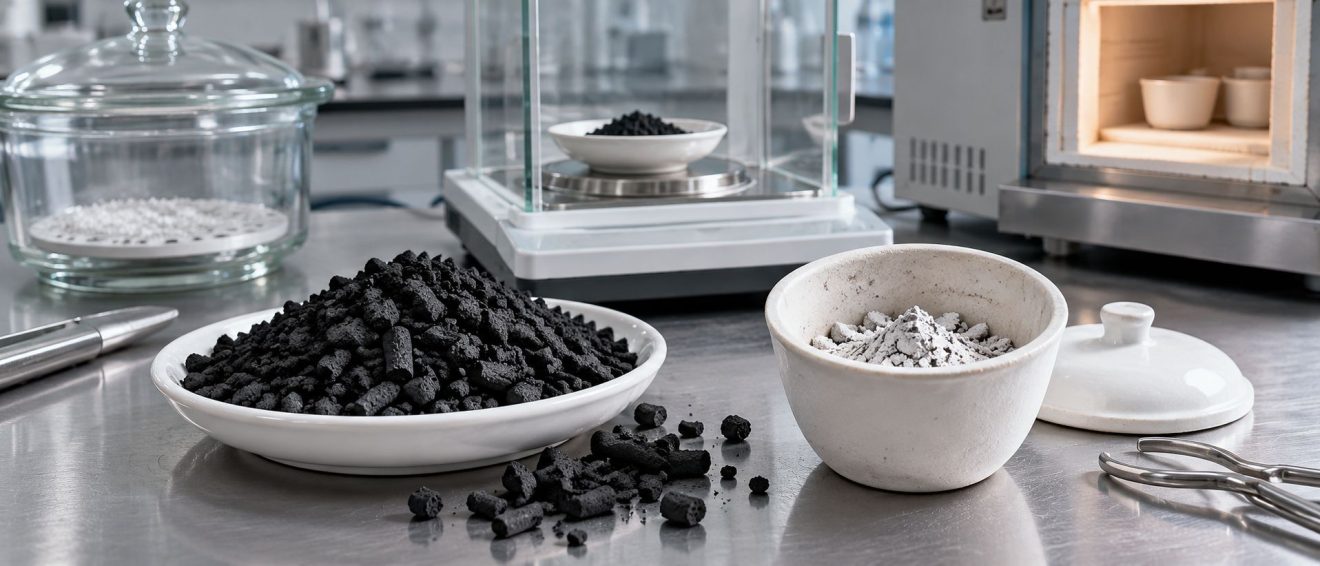
Two activated carbons have the same iodine number of 1,000 mg/g. One has 4% ash; the other has 12%. Which one should an industrial buyer choose?
For high-purity chemical processing, the mineral residue may be a major concern. For a conventional VOC adsorption bed, those two ash values alone cannot tell you which carbon will work better. Ash content is an important quality parameter, but it is not a direct ranking of adsorption performance.
The practical question is what the ash consists of, how it was measured and whether it matters in the intended process.
What Is Ash Content in Activated Carbon?
Ash content is the mass percentage of inorganic residue remaining after an activated carbon sample is ignited under a specified test procedure. It is generally reported as a percentage (%).
The residue can contain mineral components associated with elements such as silicon, calcium, magnesium, iron, aluminum and potassium. Its composition depends on feedstock, activation chemistry, washing and other finishing steps.
Ash is not the same as moisture, soluble salts or heavy-metal content. Total ash measures the overall inorganic residue under the specified test conditions. It does not identify individual elements or establish how much of that residue will leach into water or a process liquid.
As a simple illustration, if a 5.00 g dry-basis sample produces 0.25 g of ash under the relevant procedure, its ash content is 5.0%. This is a calculation example, not a prescribed sample size or a reported result for a particular grade.
How Is Activated Carbon Ash Content Measured?
Ash testing typically involves preparing a representative sample, establishing its mass on the required basis, igniting it under controlled conditions, cooling the residue and determining its mass. The heating temperature, duration, sample preparation and reporting basis must follow the applicable standard.
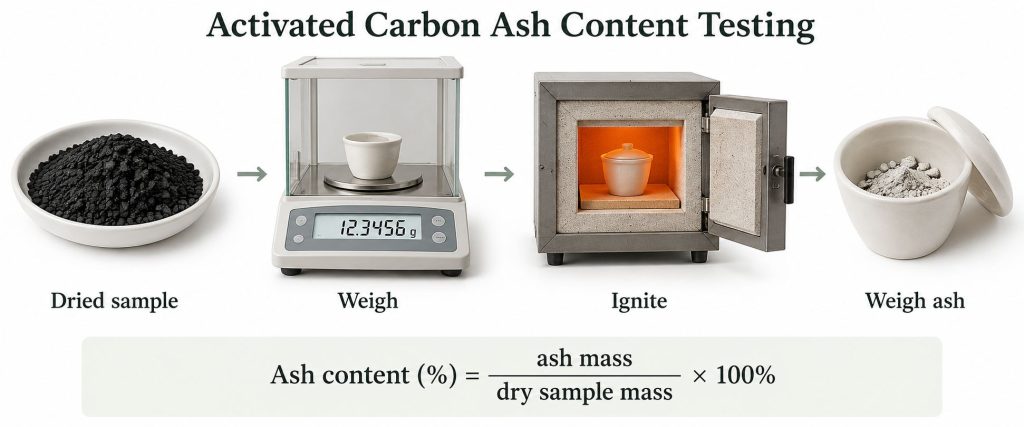
ASTM D2866-11(2025), Standard Test Method for Total Ash Content of Activated Carbon, provides a recognized test method. Its scope covers determination of total ash content, and ASTM notes that both the amount and composition of ash can influence certain end-use properties.
Other published methods include GB/T 7702.15-2008 for coal-based granular activated carbon and GB/T 12496.3-1999 for wood-based activated carbon.
Standards update, as of October 2026: GB/T 12496.3-1999 remains current, but China’s newly published GB/T 12496-2026 will take effect on March 1, 2027 and replace the earlier series of methods, including GB/T 12496.3-1999. Buyers should confirm the applicable version when commissioning tests or drafting supply specifications.
How Does Ash Content Affect Adsorption Performance?
It can affect the amount of active carbon structure per unit mass
For products that rely primarily on physical adsorption in a porous carbon matrix, a larger inorganic fraction means a smaller proportion of that same dry mass is carbonaceous material. Under otherwise comparable conditions, this can influence adsorption capacity expressed per gram of product. Some mineral deposits may also occupy pore space or affect access to internal surfaces.
However, halving ash content does not automatically double adsorption capacity. Pore-size distribution, accessible pore volume, surface chemistry and the properties of the target molecule all matter. Two activated carbons with similar ash content may have very different iodine numbers, BET surface areas and breakthrough curves.
Minerals can change surface chemistry
Inorganic constituents are not always inert contaminants. Some mineral species influence surface acidity or basicity and may alter interactions with certain adsorbates. In impregnated, modified or catalytic carbons, deliberately introduced inorganic components may be essential to the intended function.
This distinction matters: low ash is not a proxy for catalytic activity, and a higher ash result does not necessarily mean a functional carbon is defective. The material must be assessed against its purpose.
For a closer look at pore accessibility and adsorption performance, see BET Surface Area in Activated Carbon: How Pore Structure Affects Adsorption.
Where Does Ash Content Matter Most?
| Application | Main ash-related concern | Additional data to request |
|---|---|---|
| High-purity water and specialty chemical processing | Inorganic carryover and contamination of the process stream | Acid-solubles, water-solubles, relevant metals, pH, target adsorption data |
| Industrial wastewater and decolorization | Water compatibility, possible leaching, and usable adsorption performance | Pore distribution, methylene blue value, actual-liquid trials, pH |
| VOC removal and gas-phase fixed beds | Useful performance per mass of installed carbon and operating stability | Working capacity, breakthrough, humidity tolerance, hardness, size |
| Impregnated and catalytic carbon | Distinguishing feedstock minerals from intentionally added active compounds | Active-component loading, reaction performance, selectivity, service life |
In water treatment, low total ash does not guarantee low extractable metals or low soluble-salt release. If the downstream process is sensitive to individual contaminants, those contaminants need to be tested directly.
Is Bamboo, Coal or Coconut Shell Activated Carbon Lower in Ash?
There is no universal ranking. Natural mineral content varies by feedstock, while carbonization, activation, acid washing, water washing and product finishing can substantially alter the final result. A feedstock label alone is not enough to establish ash content or application suitability.
For example, DAQI Technology’s published BAC-001 bamboo-based activated carbon information lists a typical selectable ash range of 4–6%. This describes a published range within a configurable material family, not a guaranteed result for every grade or production lot. For purchasing and inspection, request the actual grade specification, test method and batch-specific certificate of analysis (COA).
Our article on how bamboo activated carbon is manufactured explains why the same feedstock can produce materials with quite different properties.
What Ash Specification Should Industrial Buyers Use?
There is no single ash percentage that qualifies every type of industrial activated carbon. The appropriate limit should be tied to the application, applicable product standard, process sensitivity and test results. An excessively restrictive ash limit can increase cost without delivering a measurable operating benefit.
- State the method: specify the standard, edition, reporting basis and acceptance rule.
- Check the relevant contaminants: add leachable-ion, soluble-matter or elemental tests where purity is critical.
- Review adsorption data: compare ash with iodine number, BET surface area, pore-size distribution and target-contaminant tests.
- Assess equipment requirements: for granular beds, include hardness, particle-size distribution, pressure drop and abrasion.
- Confirm consistency: request grade-specific TDS and lot-specific COA, followed by lab or pilot testing when needed.
For bamboo-based products, China’s GB/T 48061-2026, Bamboo-Based Activated Carbon, was published in August 2026 and is scheduled to enter into force on March 1, 2027. DAQI Technology is listed among the principal drafting organizations; see our standards announcement. A product specification and an ash test method serve different purposes and should not be treated as interchangeable.
Frequently Asked Questions
Does lower ash always mean better activated carbon?
No. Lower nonfunctional mineral residue may be beneficial for purity-sensitive applications, but adsorption performance depends on pore structure, surface chemistry, the contaminant and process conditions.
What does 5% ash content mean?
It means the tested sample contained 5% ash by mass under the specified procedure and reporting basis. Compare supplier results only after checking that the testing and calculation methods are compatible.
Is ash content the same as moisture content?
No. Moisture measures water associated with the sample, while ash describes the inorganic residue after prescribed ignition. They are separate specifications.
Is low-ash activated carbon always necessary for water treatment?
Not for every application. Low ash can matter where inorganic contamination is tightly controlled. For other water-treatment systems, adsorption capacity, pore distribution, leaching behavior and operational performance may be more relevant.
The Bottom Line: Specify Ash for the Process, Not for the Headline
Ash content gives buyers useful information about the inorganic fraction of activated carbon. It can matter greatly for high-purity processing, while its impact in other applications may depend on the carbon grade and the target contaminant. The number belongs alongside adsorption, physical-property and application-test data—not in place of them.
Explore DAQI’s bamboo activated carbon selection hub, our iodine number guide, and our multi-parameter selection guide to build a more practical purchasing specification.
Standards and Technical References
- ASTM D2866-11(2025), Standard Test Method for Total Ash Content of Activated Carbon. ASTM International.
- GB/T 7702.15-2008, Determination of Ash Content in Granular Activated Carbon from Coal. China’s official standards platform.
- GB/T 12496.3-1999, Determination of Ash Content in Wood-Based Activated Carbon. China’s official standards platform.
- GB/T 12496-2026, Test Methods of Wooden Activated Carbon. Effective March 1, 2027.
- GB/T 48061-2026, Bamboo-Based Activated Carbon. Effective March 1, 2027.
- Characterization of Activated Carbon Adsorbents – State of the Art and Novel Approaches. ChemBioEng Reviews (2019).