


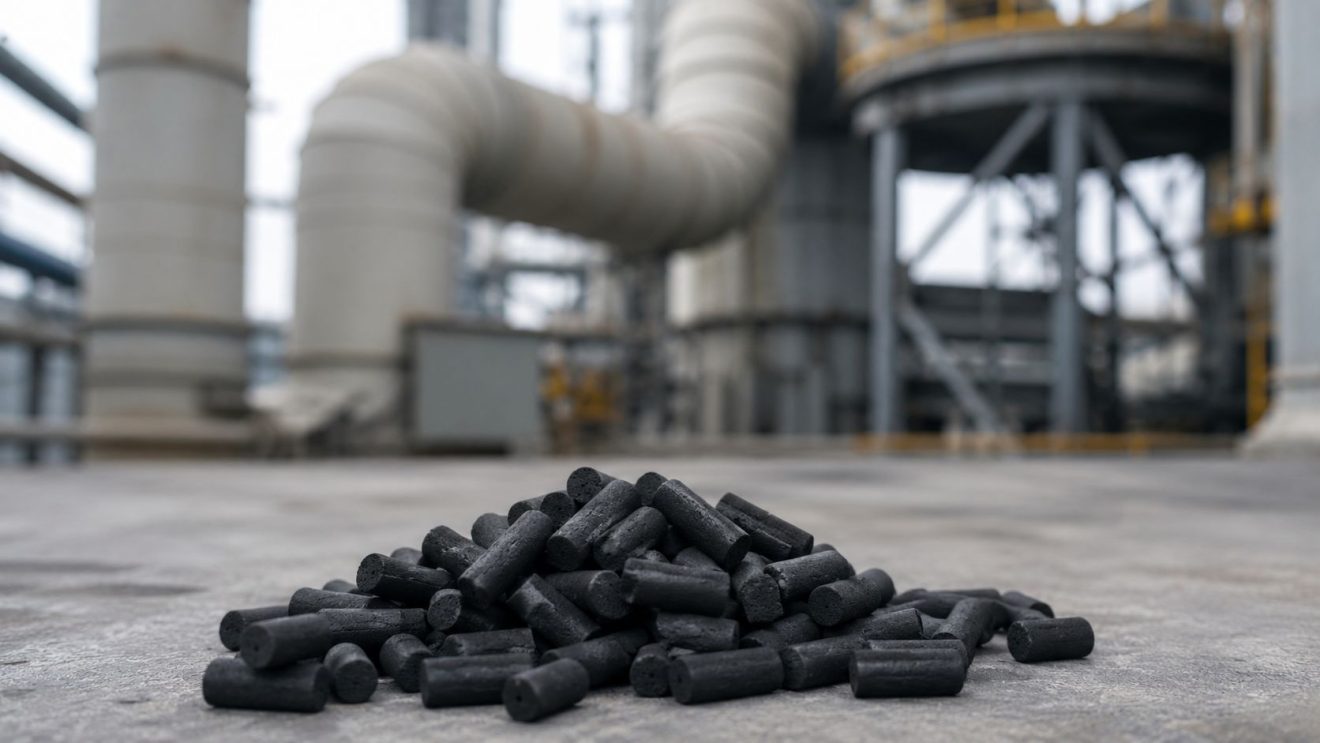
Bamboo-based activated carbon can be used for flue gas desulfurization, but the process involves more than simply trapping SO₂ inside the pores.
Under suitable temperature, oxygen and moisture conditions, SO₂ is transferred into the pore network of the carbon. Part of it is physically adsorbed, while another fraction can be oxidized and converted on active surface sites before being retained as sulfur-containing species.
This is why industrial SO₂ removal cannot be judged by iodine number or BET surface area alone.
For a desulfurization material, pore-size distribution, surface chemistry, catalytic activity, sulfur capacity, mechanical strength and actual flue-gas conditions all matter.
Short answer:
Bamboo-based activated carbon removes SO₂ through a combination of adsorption, catalytic oxidation and hydration. Performance depends strongly on temperature, moisture, oxygen concentration, inlet SO₂ loading, dust, tar, gas velocity and the properties of the carbon itself. For continuous industrial FGD, a purpose-designed desulfurization carbon or carbon-based catalyst is usually more appropriate than general-purpose activated carbon.
How Does Activated Carbon Remove SO₂ from Flue Gas?
SO₂ removal on carbon materials normally involves both physical adsorption and surface reactions.
For practical FGD applications, the objective is not simply to create as much surface area as possible. The carbon needs a pore network that allows SO₂ to enter efficiently while providing enough active sites for continued conversion.
SO₂ First Enters the Pore Network
As flue gas passes through the carbon bed, SO₂ is transferred from the gas phase to the external surface and then diffuses into the internal pore structure.
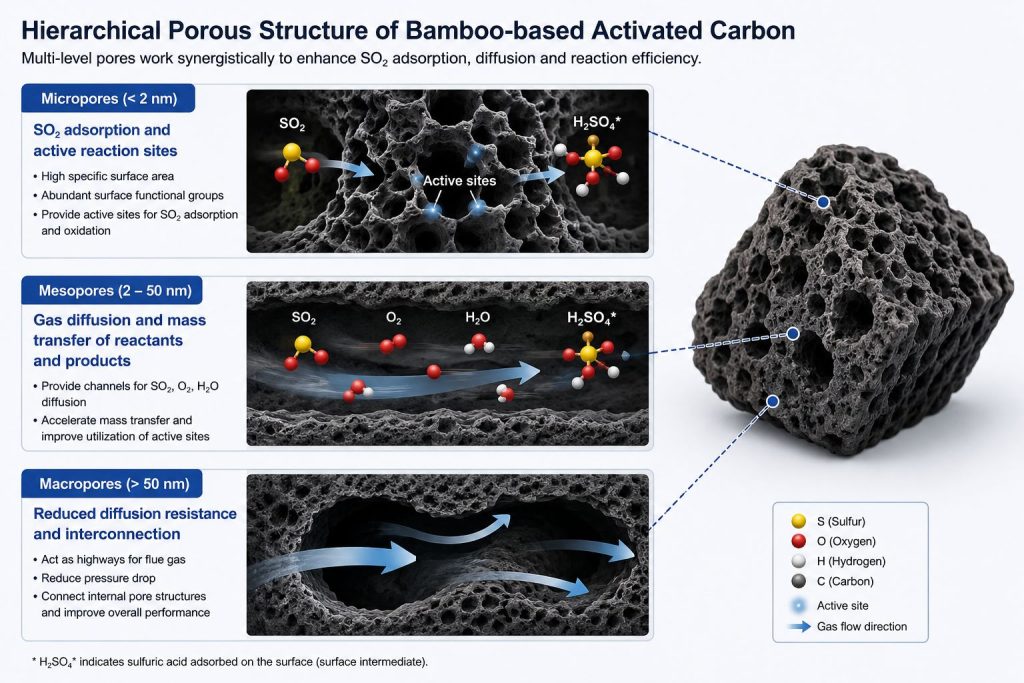
Micropores provide a large number of adsorption and reaction sites. Mesopores and larger transport pores help molecules move through the carbon and provide space for sulfur-containing reaction products.
Studies of hierarchical pore configurations show that SO₂ adsorption is strongly influenced by pore structure, with micropores—especially ultramicropores—playing an important role in SO₂ capture.
This is one reason why a high iodine number alone does not guarantee strong FGD performance.
A carbon may have substantial microporosity, but if mass transfer is poor or reaction products rapidly block the accessible pore network, its effective service time in a real bed can still be limited.
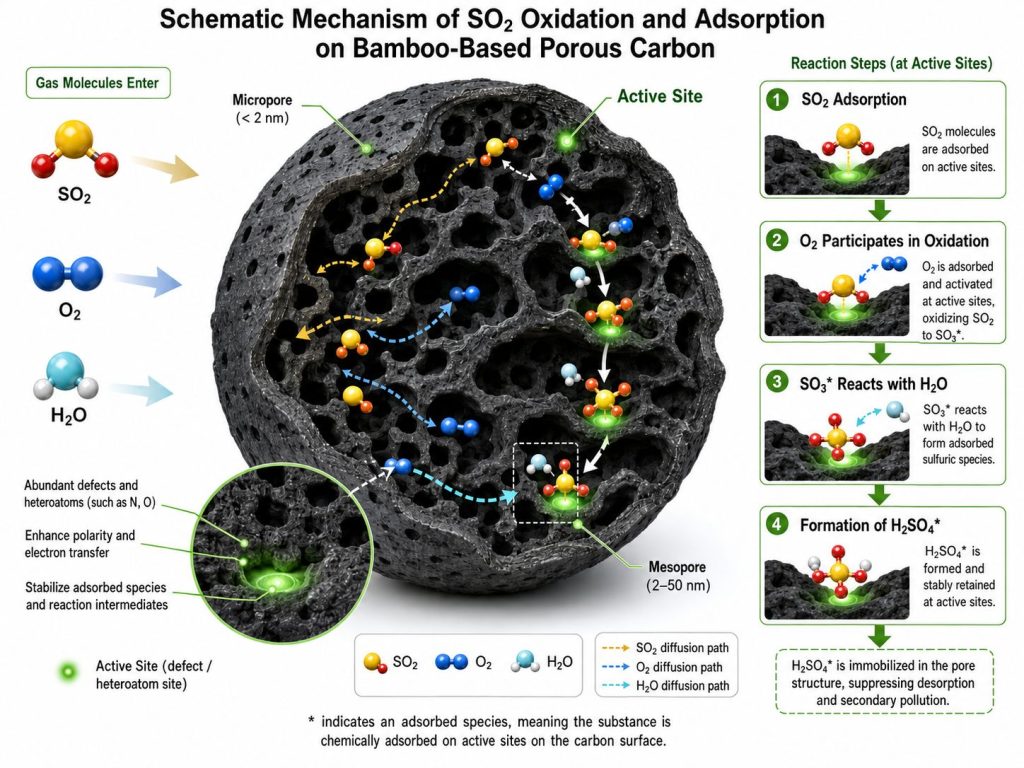
Oxygen Participates in SO₂ Conversion
On a catalytically active carbon surface, oxygen participates in the conversion of adsorbed SO₂.
A simplified representation is:
SO₂ → SO₂*
O₂ → O*
SO₂* + O* → SO₃*
Here, “*” represents a species adsorbed or activated on the carbon surface.
At this stage, the carbon is doing more than acting as a storage medium. Surface functional groups and catalytic sites affect how SO₂ is converted.
Water Is Also Part of the Reaction System
The oxidized sulfur species can subsequently interact with water:
SO₃* + H₂O → H₂SO₄*
Studies of activated-coke desulfurization have shown that the presence of both oxygen and water can be important to SO₂ conversion and sulfur retention.
This does not mean that more moisture is always better.
At unsuitable temperatures or very high humidity, water can also compete for adsorption sites or create condensation and transport problems. Temperature and water content therefore need to be evaluated together.
Why Use Bamboo as the Carbon Feedstock?
Bamboo itself does not automatically make an activated carbon better at removing SO₂.
Its value is that it provides a renewable carbon feedstock that can be carbonized, activated and further functionalized to create a controlled porous material.
The final performance is determined far more by how the carbon is manufactured than by the feedstock name printed on the specification sheet.
The Pore Structure Can Be Engineered for Gas-Phase Treatment
For SO₂ removal, the material needs adsorption sites as well as effective transport pathways.
Too much emphasis on a single micropore-related specification can overlook mass-transfer limitations. A practical FGD material needs a balance between adsorption volume and accessible transport pores.
Recent reviews of carbon-based SO₂ adsorbents similarly emphasize the combined importance of pore-size regulation and the introduction of active surface sites.
Surface Chemistry Matters as Much as Porosity
General-purpose activated carbon primarily relies on adsorption.
A dedicated desulfurization carbon can be further modified so that surface functional groups and catalytic components participate more effectively in SO₂ conversion.
Studies have shown that oxygen- and nitrogen-containing functional groups can change surface polarity and the interaction between SO₂ and the carbon surface.
This is also central to DAQI Technology’s material-development approach: bamboo provides the renewable carbon source, while carbonization, activation, pore engineering and functionalization determine the final industrial performance.
Which Operating Conditions Matter Most?
A carbon that performs well in one flue-gas stream may behave very differently in another.
Before selecting an FGD material, the following parameters should be established.
| Parameter | Why It Matters | What to Evaluate |
|---|---|---|
| Flue-gas temperature | Affects adsorption, surface reactions and water behavior | Validated operating window |
| Inlet SO₂ | Determines sulfur loading on the bed | Sulfur capacity and breakthrough time |
| O₂ concentration | Participates in SO₂ oxidation | Minimum oxygen requirement |
| Water vapor | Participates in hydration but may also compete for sites | Humidity together with temperature |
| Dust | Can cover the surface and block pores | Upstream particulate removal |
| Tar / heavy organics | May cause difficult-to-reverse pore blockage | Pretreatment requirements |
| Gas flow | Determines residence time and pressure drop | Bed depth and superficial velocity |
| Required outlet SO₂ | Defines design margin | Long-term rather than initial efficiency |
What Temperature Is Suitable for Activated-Carbon FGD?
There is no single temperature that applies to every activated carbon.
A Scientific Reports study on activated-carbon flue gas treatment notes that conventional activated-coke adsorbers typically operate at approximately 80–150°C.
Purpose-designed materials can operate over different ranges when their pore structure, surface chemistry and catalytic components are engineered accordingly.
For example, DAQI Technology S-1-111 Bamboo-Based Activated Carbon Desulfurization Catalyst has a recommended operating range of 40–180°C. This is a product-specific operating envelope rather than a universal specification for all activated carbons.
How Much Moisture and Oxygen Are Required?
For catalytic carbon-based SO₂ removal, oxygen and water vapor are part of the reaction environment rather than simple background components.
Current recommended conditions for S-1-111 include:
- Water vapor: >3%
- O₂: >3%
These figures apply to this specific product and should not be treated as universal design limits for every activated-carbon FGD system.
Why Are Dust and Tar Important?
Dust can coat the external surface of the carbon and block pore entrances.
Tar and high-boiling organic compounds can be even more problematic because they may penetrate the pore network and occupy active sites that are difficult to recover during regeneration.
For S-1-111, the currently recommended inlet conditions include:
- SO₂: <6,000 mg/m³
- Dust: <30 mg/m³
- Tar: <0.5 mg/m³
Gas streams outside these conditions should be evaluated individually and may require upstream pretreatment.
How Should an Activated Carbon for Flue Gas Desulfurization Be Selected?
The first question many buyers ask about activated carbon is its iodine number.
For SO₂ control, that is rarely enough.
Start with Desulfurization Performance
More useful parameters include:
- SO₂ removal efficiency
- sulfur capacity or desulfurization activity
- breakthrough time
- breakthrough curve
- performance after regeneration
These measurements are more closely related to how the material will actually behave in a working FGD bed.
Evaluate Pore Structure, Not Just BET Surface Area
A high BET value does not automatically mean better SO₂ removal.
The evaluation should also consider:
- micropore distribution
- mesopore volume
- transport pores
- surface functional groups
- catalytic active sites
A useful desulfurization carbon needs to let SO₂ enter the structure, react effectively and accommodate reaction products.
Mechanical Strength Matters
Industrial carbon beds may remain in service for long periods and can undergo repeated operating and regeneration cycles.
If the pellets gradually break down, the system can experience:
- increasing pressure drop;
- carbon losses;
- dust carryover;
- uneven gas distribution.
For regenerable FGD media, strength after regeneration or washing is therefore a particularly useful specification.
Consider Regeneration in the Operating Cost
The lowest price per tonne does not necessarily produce the lowest cost per unit of flue gas treated.
A more useful comparison includes:
media consumption + replacement frequency + downtime + disposal + pressure drop + regeneration cost.
For continuously operated industrial systems, regeneration capability can therefore be an important economic factor.
Where Does DAQI Technology S-1-111 Fit?
S-1-111 is not simply standard bamboo activated carbon marketed for a new application.
It is a purpose-designed bamboo-based activated carbon desulfurization catalyst that combines a porous carbon support with application-specific catalytic functionality.
Current published specifications include:
| Property | S-1-111 |
|---|---|
| Product type | Bamboo-based activated carbon desulfurization catalyst |
| Form | Black cylindrical pellets |
| Diameter | 3.5–4.5 mm |
| Length | 4–10 mm |
| SO₂ removal | ≥95% |
| Desulfurization activity | ≥35 mg/cm³ |
| Recommended temperature | 40–180°C |
| Water vapor | >3% |
| O₂ | >3% |
| Recommended inlet SO₂ | <6,000 mg/m³ |
| Initial mechanical strength | ≥180 N/cm |
| Strength after acid washing | ≥80 N/cm |
| Regeneration | In-situ regeneration for repeated use |
The material is intended for industrial streams where SO₂ removal, stable packed-bed operation and regeneration are more important than simply purchasing a general-purpose activated carbon with a high iodine number.
What Does a Typical Carbon-Based FGD Process Look Like?
The exact equipment configuration depends on the project, but from the media perspective the process can be summarized as:
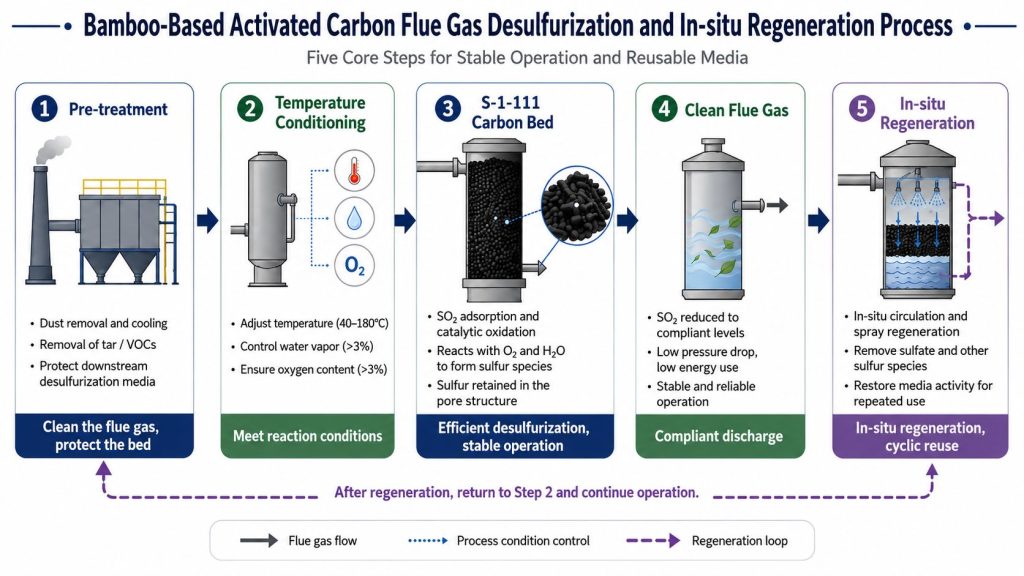
Flue Gas Pretreatment → Condition Adjustment → Carbon Bed → SO₂ Adsorption and Conversion → Clean Gas → Media Saturation → In-Situ Regeneration → Return to Service
Before the Gas Reaches the Carbon Bed
The operator should confirm that:
- gas temperature is within the validated operating range;
- particulate loading is under control;
- tar and pore-blocking organics are sufficiently low;
- oxygen and water vapor meet the process requirements.
During Adsorption
SO₂ enters the pore structure and is progressively adsorbed and converted.
As sulfur-containing species accumulate, available active sites decrease and the outlet SO₂ concentration gradually rises.
For this reason, breakthrough behavior is more meaningful than the initial removal efficiency immediately after start-up.
During Regeneration
A purpose-designed regenerable material can be taken through a defined regeneration procedure once a specified loading level is reached.
S-1-111 uses an in-situ circulation and spraying regeneration procedure. Cooling, purging, washing, draining and restart conditions should follow the project design and the applicable technical operating instructions.
Where Can Bamboo-Based Carbon FGD Be Considered?
Depending on the actual gas composition and process conditions, potential applications include:
- coal-fired and industrial boiler flue gas;
- steel sintering gas;
- industrial furnace and kiln emissions;
- non-ferrous metal smelting;
- sulfuric-acid plant tail gas;
- chemical and petrochemical SO₂-containing off-gas;
- sludge and solid-waste thermal treatment.
The industry name alone, however, is not sufficient for product selection.
Two smelting plants may both describe their stream as “smelter flue gas” while operating at very different SO₂ concentrations, temperatures, dust loadings and flow rates.
For preliminary material selection, it is therefore useful to provide:
gas flow, inlet SO₂, required outlet SO₂, temperature, water vapor, O₂, dust, tar/VOCs and expected continuous operating time.
Frequently Asked Questions
Can Standard Bamboo Activated Carbon Be Used Directly for Flue Gas Desulfurization?
It can physically adsorb some SO₂, but that does not make it equivalent to an industrial desulfurization catalyst.
Continuous FGD normally requires evaluation of sulfur capacity, breakthrough behavior, catalytic activity, mechanical strength, moisture tolerance and regeneration performance.
For demanding SO₂ applications, a purpose-designed and validated desulfurization-grade material is generally more appropriate.
Does a Higher Iodine Number Mean Better SO₂ Removal?
Not necessarily.
Iodine number primarily reflects part of the micropore adsorption capacity of activated carbon. It does not fully represent gas-phase mass transfer, catalytic oxidation, sulfur retention or regeneration performance under actual flue-gas conditions.
Does Moisture Reduce SO₂ Adsorption?
It depends on the system.
Water can compete for adsorption sites during physical adsorption, but it also participates in the reaction pathway of catalytic SO₂ removal.
Humidity should therefore be evaluated together with temperature and surface chemistry rather than treated as a simple “higher is better” or “lower is better” parameter.
Can Bamboo-Based Desulfurization Carbon Be Regenerated?
It depends on how the material is designed.
General-purpose activated carbon is not automatically suitable for repeated on-site regeneration. Dedicated desulfurization media may use washing, thermal treatment or other regeneration approaches depending on the adsorbed sulfur species and process configuration.
S-1-111 is designed for in-situ regeneration and repeated operating cycles.
What Information Should Be Provided Before Requesting an FGD Carbon?
At minimum:
inlet SO₂, target outlet SO₂, gas flow, temperature, water vapor, O₂, particulate concentration, tar/VOCs and expected operating schedule.
A request that only states “we need activated carbon for SO₂” usually does not contain enough information for reliable media selection.
From High Specifications to the Right Material for the Process
Flue gas desulfurization is not a competition for the highest iodine number.
For an industrial project, the more important question is whether the carbon can maintain stable SO₂ removal under the actual temperature, moisture, sulfur loading and contaminant conditions while providing acceptable pressure drop, mechanical durability and regeneration performance.
Bamboo offers a renewable route to the carbon feedstock. Pore engineering and catalytic functionalization are what turn that feedstock into a practical industrial desulfurization material.
DAQI Technology develops bamboo-based activated carbon, modified activated carbon and catalytic carbon materials for industrial purification applications. For FGD projects, media selection can be based on actual SO₂ loading, gas flow, temperature, moisture and contaminant conditions, followed where necessary by sample or pilot-scale evaluation.
Recommended Internal Links: