


When customers first come across bamboo activated carbon, one of the most common questions is simple:
Is activated carbon made from bamboo actually effective?
The answer depends less on the raw material itself and more on how the carbon is produced and where it is used.
For industrial applications, the performance of activated carbon is usually determined by factors such as pore size distribution, ash content, mechanical strength, adsorption capacity and compatibility with the target contaminant.
Coal-based, coconut shell, wood-based and bamboo-based activated carbons all have their own strengths.
Bamboo-based activated carbon is particularly interesting for applications such as industrial air purification, VOC removal, desulfurization, odor control and water treatment, where pore structure and surface chemistry can be tailored to specific operating conditions.
Bamboo Activated Carbon Is Not the Same as Ordinary Bamboo Charcoal
This distinction is important.
Ordinary bamboo charcoal is mainly produced through carbonization and is commonly used for deodorization, moisture control or household applications.
Bamboo activated carbon, on the other hand, undergoes an additional activation process after carbonization.
During activation, the internal pore network is further developed, creating a much larger number of micropores and mesopores. Depending on the intended application, the pore structure can also be adjusted through changes in activation temperature, activation time and process conditions.
In some applications, the carbon may also be chemically modified or impregnated with catalytic components.
This means the real value of bamboo activated carbon does not simply come from bamboo as a raw material.
What matters is how the material is activated, how its pore structure is controlled and whether its surface properties are suitable for the target pollutant.
Pore Structure Is One of the Key Advantages of Bamboo-Based Activated Carbon
In industrial adsorption, iodine number alone does not tell the whole story.
Two activated carbon products may both have an iodine number above 1,000 mg/g, yet perform very differently in VOC treatment or wastewater purification.
The reason is often pore structure.
Micropores provide much of the adsorption capacity for smaller molecules, while mesopores help larger molecules move through the carbon structure more efficiently.
If the pores are too small, some contaminants cannot enter them effectively.
If the pores are too large, part of the available surface area may not contribute efficiently to adsorption.
With the right carbonization and activation process, bamboo-based activated carbon can develop a useful combination of micropores and mesopores.
This pore structure can also be adjusted for different applications.
For example:
- gas-phase adsorption may require a higher proportion of micropores;
- VOC removal often requires a balance between adsorption capacity and mass transfer;
- water treatment and decolorization usually benefit from more developed mesopores;
- H₂S and SO₂ removal may require additional surface modification or catalytic impregnation.
For this reason, the more important question is not simply whether bamboo-based carbon is better than coal-based carbon.
The better question is:
Does the pore structure match the contaminant being treated?
Low Ash Content Can Be an Advantage
Ash content is another important parameter when evaluating activated carbon.
Activated carbon contains not only carbon but also a certain amount of inorganic mineral matter.
Higher ash levels can reduce the proportion of active carbon and may also affect purity, pore accessibility and downstream processing.
Bamboo is a biomass-based raw material, and with appropriate raw material selection and production control, bamboo activated carbon can be manufactured with relatively low ash content.
This can be useful in applications where purity is important, including:
- water treatment;
- fine chemical processing;
- gas purification;
- applications sensitive to inorganic impurities.
However, it would be incorrect to assume that all bamboo activated carbon automatically has lower ash content than coal-based carbon.
Actual ash content depends on many factors, including raw material quality, activation method, washing process and production control.
For industrial purchasing, it is better to review actual product specifications or COA data.
Typical parameters include:
- ash content;
- moisture;
- pH;
- iodine number;
- CTC activity;
- methylene blue adsorption;
- BET surface area;
- pore volume;
- pore size distribution;
- mechanical strength.
A single number rarely gives a complete picture of product performance.
Mechanical Strength Matters in Industrial Equipment
Laboratory adsorption data is important, but industrial performance depends on more than adsorption capacity.
Activated carbon used in fixed-bed systems may be exposed to continuous gas flow, water flow, backwashing, vibration and mechanical handling.
If the carbon is too weak, it may gradually break down and generate fines.
This can lead to several operating problems, including:
- increased pressure drop;
- carbon loss;
- filter bed blockage;
- dust generation;
- reduced operating stability.
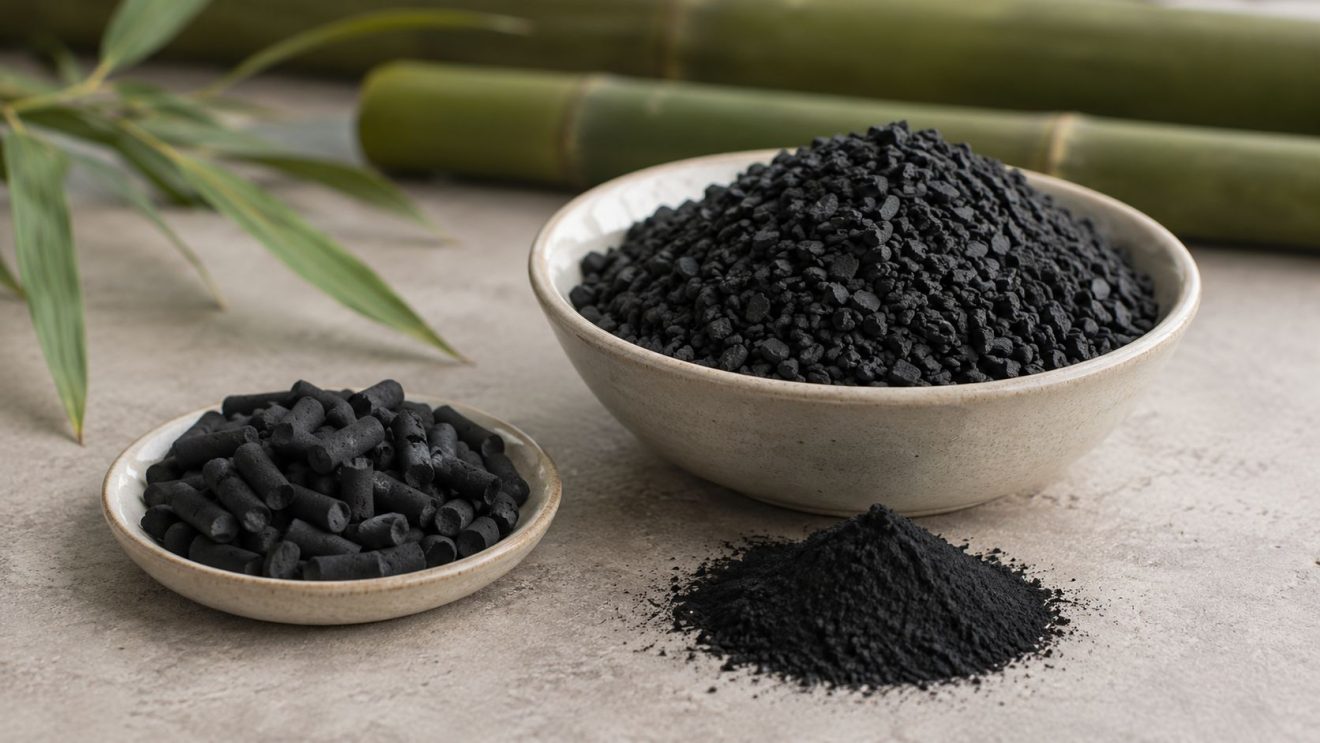
Bamboo-based activated carbon can be produced in different physical forms, including pellets, granules and powder, depending on the application.
For fixed-bed gas treatment and water filtration systems, mechanical strength and abrasion resistance should therefore be considered together with adsorption performance.
In many real projects, a carbon with slightly lower laboratory adsorption data but better mechanical stability can perform more reliably over a longer service period.
Bamboo Activated Carbon vs. Coal-Based Activated Carbon
Coal-based activated carbon remains widely used in industrial applications.
It is mature, available in many grades and often cost-effective for large-volume treatment.
For general-purpose adsorption where purchase price is the main concern, coal-based carbon can still be a practical choice.
Bamboo activated carbon becomes more attractive when other factors are important.
One advantage is the raw material itself.
Bamboo is a renewable biomass resource, while coal is a fossil resource.
This gives bamboo-based carbon a stronger position in projects that place greater emphasis on:
- renewable raw materials;
- low-carbon supply chains;
- sustainability targets;
- ESG-related procurement requirements.
Another advantage is the ability to adjust pore structure and surface properties for specific applications.
This does not mean bamboo activated carbon should replace coal-based activated carbon in every application.
A more realistic approach is to use bamboo-based materials where their pore structure, purity, performance and overall operating cost provide a clear benefit.
Bamboo Activated Carbon vs. Coconut Shell Activated Carbon
Coconut shell activated carbon is well known for its highly developed microporous structure.
For this reason, it is widely used in drinking water purification, high-purity gas treatment and applications involving relatively small molecules.
Bamboo activated carbon does not necessarily need to compete with coconut shell carbon on micropore volume alone.
Its advantage lies more in the ability to create a broader and more adjustable pore structure.
This can be useful in applications involving larger organic molecules, complex VOC mixtures or wastewater contaminants where extremely narrow micropores are not always ideal.
For example, a carbon with very high micropore volume may perform well for small molecules but may be less efficient for larger compounds that cannot easily diffuse into those pores.
The right material therefore depends on the contaminant.
There is no single activated carbon that performs best in every application.
Where Is Bamboo Activated Carbon Used?
VOC Removal and Industrial Air Treatment
Bamboo activated carbon can be used for the removal of volatile organic compounds such as aromatic hydrocarbons, ketones, esters and other organic vapors.
For VOC applications, iodine number should not be used as the only selection criterion.
Other important parameters may include:
- CTC activity;
- adsorption capacity for the target VOC;
- breakthrough time;
- operating humidity;
- gas concentration;
- superficial velocity;
- bed depth.
In high-humidity gas streams, competitive adsorption by water vapor should also be taken into account.
H₂S and SO₂ Removal
Standard activated carbon mainly relies on physical adsorption.
For H₂S, SO₂ and other sulfur-containing gases, the carbon surface can be further modified or impregnated with catalytic components to improve adsorption and conversion.
In these applications, performance should be evaluated using parameters such as:
- sulfur capacity;
- removal efficiency;
- breakthrough curve;
- operating temperature;
- humidity;
- inlet concentration.
For specialized desulfurization applications, these indicators are generally more meaningful than iodine number alone.
Industrial Water Treatment
Industrial wastewater often contains a complex mixture of organic contaminants.
Bamboo-based activated carbon can be used for polishing treatment, COD reduction, color removal and adsorption of certain refractory organic compounds.
For liquid-phase applications, mesopore development is often particularly important because it helps larger organic molecules diffuse into the carbon structure.
Carbon selection should therefore take into account:
- influent COD;
- contaminant composition;
- contact time;
- particle size;
- pH;
- required removal efficiency;
- upstream and downstream treatment processes.
Air Purification and Odor Control
Bamboo activated carbon can also be used in air purification and odor control systems.
For specific pollutants such as formaldehyde, however, standard physical adsorption may not always provide sufficient long-term performance.
Surface-modified or chemically treated activated carbon is often more suitable when a specific pollutant needs to be targeted.
Is a Higher Iodine Number Always Better?
No.
This is one of the most common misunderstandings when buying activated carbon.
Iodine number is useful because it reflects the adsorption capacity of micropores to a certain extent.
But it does not represent the full performance of an activated carbon product.
For example:
For decolorization and larger organic molecules, methylene blue adsorption and mesopore structure may be more important.
For VOC treatment, CTC activity, target-compound adsorption capacity and breakthrough time may provide more useful information.
For desulfurization, sulfur capacity and removal efficiency under actual operating conditions are usually more important.
Two activated carbons with the same iodine number can therefore perform very differently in the same treatment system.
The correct selection process should start with the pollutant and operating conditions, not with a single specification.
Is Bamboo Activated Carbon Worth Using?
If purchasing decisions are based only on price per ton, bamboo activated carbon may not always be cheaper than standard coal-based activated carbon.
But industrial users rarely pay only for the carbon itself.
The more meaningful calculation is the cost of treating:
- a certain volume of gas;
- a certain quantity of wastewater;
- or a certain mass of contaminant.
This calculation may also include:
- adsorption capacity;
- service life;
- replacement frequency;
- pressure drop;
- carbon loss;
- regeneration potential;
- disposal cost.
In applications such as VOC control, industrial water treatment, desulfurization, odor removal and projects that value renewable raw materials, bamboo-based activated carbon can offer a strong technical and commercial option.
The key is not to look for one carbon that can treat every pollutant.
A better approach is to match the carbon properties to the actual process conditions.
For industrial applications, parameters such as iodine number, CTC activity, pore size distribution, particle size, mechanical strength and surface chemistry should be selected together.
In practice, the best activated carbon is not necessarily the one with the highest specification.
It is the one that performs consistently under the actual operating conditions.
Comments