


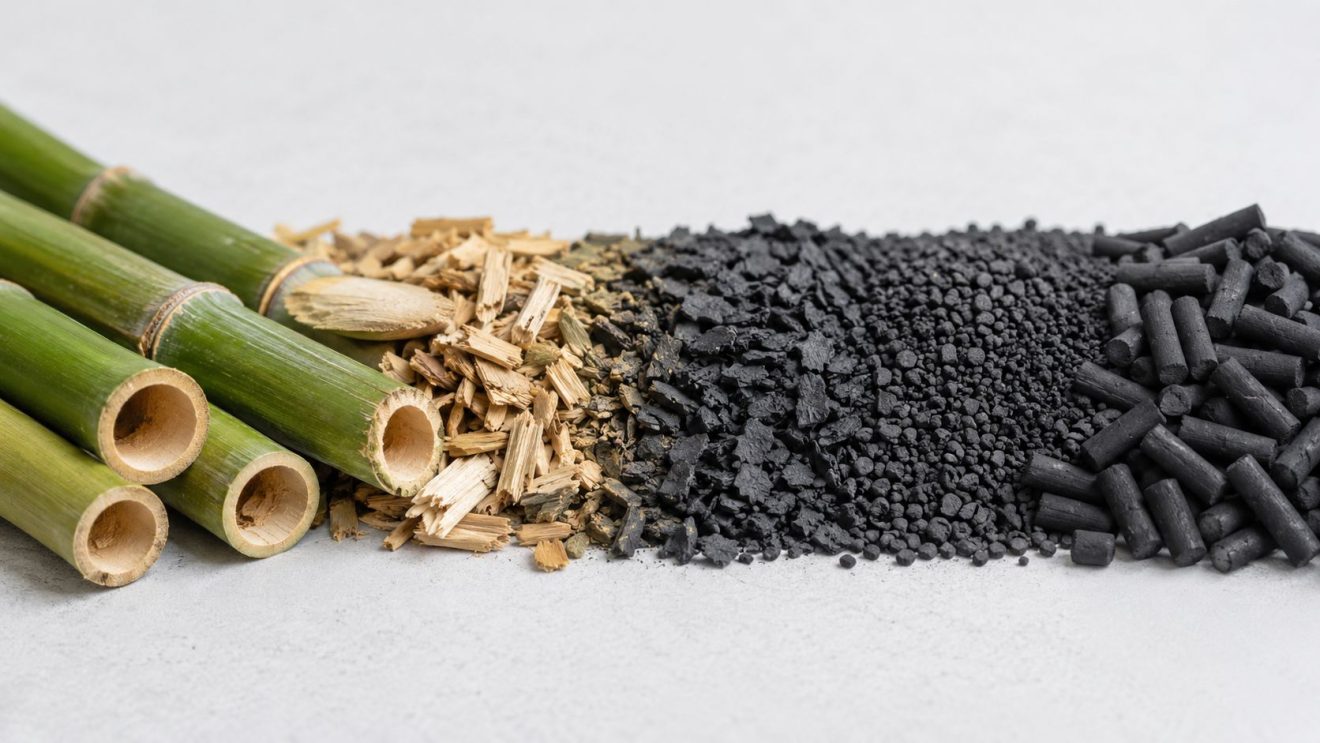
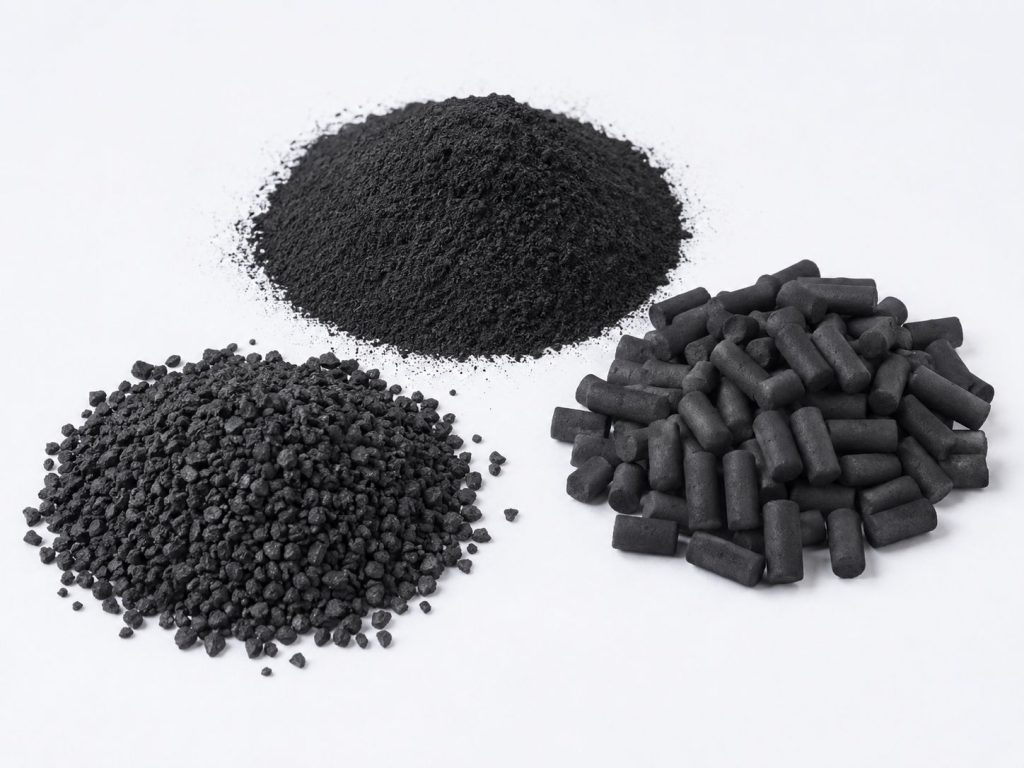
At first glance, bamboo activated carbon does not look particularly complicated. It is black, lightweight and available as powder, irregular granules or cylindrical pellets.
The important part, however, is not what can be seen from the outside.
It is what happens inside the carbon.
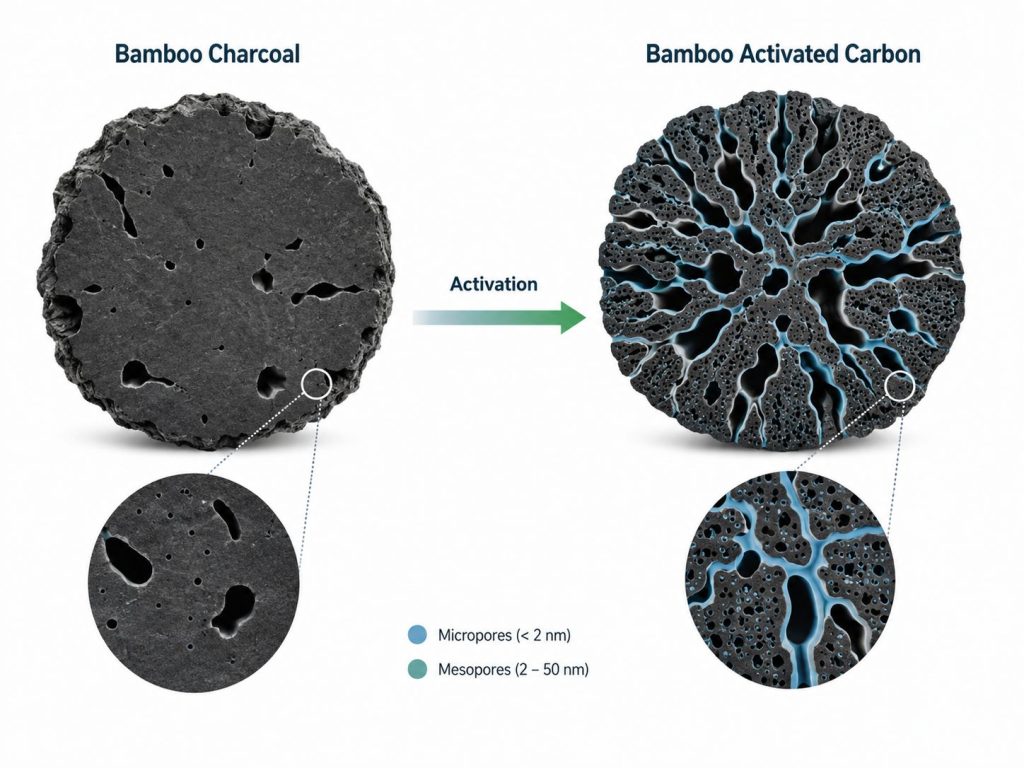
Bamboo activated carbon is a porous carbon material produced from bamboo through carbonization followed by activation. During activation, previously inaccessible pores are opened and developed throughout the carbon structure, creating the internal surface needed for adsorption.
That is also what separates bamboo activated carbon from ordinary bamboo charcoal.
Bamboo charcoal has already undergone carbonization and can have some adsorption capability. Activated carbon goes through an additional activation stage designed specifically to develop its pore structure and adsorption properties. Studies on bamboo-derived activated carbon show that steam activation can significantly change both pore development and surface chemistry.
It Starts With Bamboo, but Carbonization Comes First
Fresh bamboo is not an adsorbent that can simply be loaded into an industrial filter.
The material first needs to be converted into a stable carbon structure.
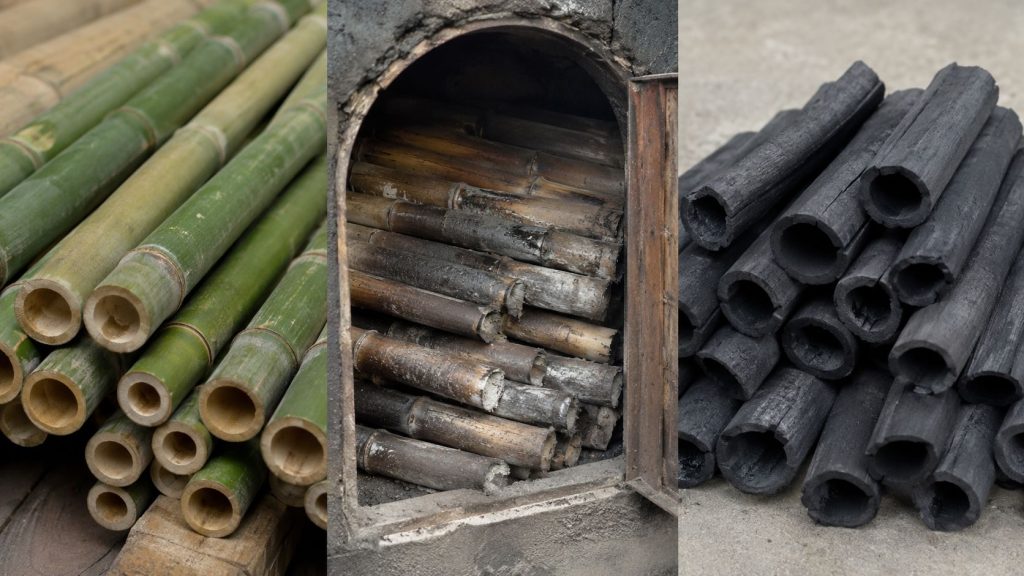
During carbonization, bamboo is heated under oxygen-limited conditions. Moisture and volatile compounds are progressively removed, while the original biomass structure is transformed into a carbon-rich solid.
The result is bamboo charcoal.
At this point, a basic pore network has started to form, but much of the potential internal surface is still inaccessible.
Carbonization creates the framework.
Activation develops the adsorption structure.
Activation Is Where the Pore Structure Develops
The carbonized bamboo is then subjected to an activation process.
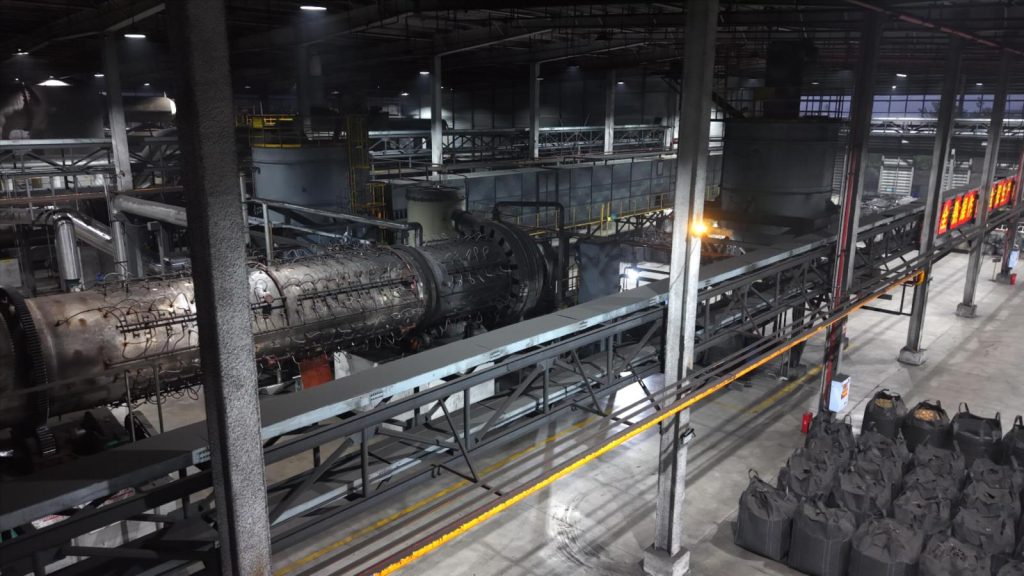
In physical activation, agents such as steam react with the carbon under carefully controlled high-temperature conditions. Part of the carbon matrix is selectively consumed, opening blocked pores and developing new pathways inside the material.
Although the particles may still look almost the same from the outside, their internal structure changes considerably.
Research on steam-activated bamboo carbon has shown substantial development of microporosity, while changes in activation conditions can alter pore volume, pore-size distribution and surface characteristics.
This is an important point when comparing activated carbons:
Two black carbon particles can look almost identical and still behave very differently in an adsorption system.
How Does Activated Carbon Actually Adsorb Contaminants?
A useful way to picture activated carbon is as a solid particle containing an enormous network of microscopic passages.
Gas or liquid flows around and through the particle. Target molecules diffuse into the pore network and become concentrated on the internal carbon surface.
The pore system is generally discussed in terms of three ranges:
- Micropores, which provide much of the adsorption surface for smaller molecules;
- Mesopores, which are important for larger molecules and mass transfer;
- Macropores, which act mainly as transport pathways into the particle.
The proportion of each pore size is not fixed.
Bamboo-based carbons can be engineered toward different pore structures by changing the precursor treatment and activation conditions. Research has demonstrated both highly microporous bamboo carbons and bamboo-derived activated carbons with substantial mesoporosity.
That is why a higher iodine number does not automatically mean better performance in every application.
The more useful question is:
Does the pore structure match the contaminant that needs to be removed?
From Activated Carbon to an Industrial Adsorbent
Activation is not necessarily the final manufacturing step.
Before bamboo activated carbon is ready for an industrial system, it may still undergo crushing, grinding, extrusion, screening, washing, drying and quality control.
A simplified manufacturing route looks like this:
Bamboo → Raw Material Preparation → Carbonization → Activation → Cooling → Crushing or Forming → Screening → Washing and Drying → Quality Control → Finished Adsorbent
For more demanding applications, additional steps may be introduced, including surface modification or the loading of catalytic components.
This is where activated carbon begins to move beyond being a general-purpose adsorbent and becomes a functional carbon material designed around a specific process.
Powder, Granules or Pellets: Why Does the Form Matter?
Bamboo activated carbon can be supplied in several physical forms.
The correct choice depends on how the material will be used.
Powdered Activated Carbon
Powdered carbon has a very small particle size and provides rapid contact with the surrounding liquid.
It is commonly considered for batch treatment, water purification and decolorization processes where the adsorbent can be mixed directly into the treatment stream.
Granular Activated Carbon
Granular activated carbon consists of larger irregular particles.
It can be packed into filters, columns and fixed beds, making it suitable for continuous liquid- and gas-phase treatment systems.
Pelletized Activated Carbon
Pelletized or extruded activated carbon has a relatively uniform cylindrical shape.
For gas-phase applications, this geometry can help provide a balance between adsorption capacity, mechanical strength and pressure drop across a packed bed.
Functionalized Bamboo-Based Carbon
Activated carbon can also be treated beyond conventional physical adsorption.
By modifying its surface chemistry or introducing active components, the carbon can be designed for selected contaminants or catalytic processes.
In these applications, traditional parameters such as iodine number are only part of the specification.
Breakthrough capacity, sulfur capacity, removal efficiency, pressure drop, operating temperature and service stability may become more meaningful than a single adsorption index.
At DAQI Technology, this application-oriented approach is central to our work with bamboo-based carbon materials.
Rather than producing one standard carbon and trying to fit it into every process, the material can be developed around the pollutant, operating conditions and treatment objective.
Where Is Bamboo Activated Carbon Used?
Activated carbon is used across many environmental treatment processes, but the required properties differ considerably from one application to another.
Air and Industrial Gas Purification
Bamboo-based activated carbon can be designed for the adsorption of VOCs, odors and selected gaseous contaminants.
For more demanding industrial conditions, surface modification or catalytic functionality can be introduced for targeted gas purification processes.
Water Treatment
In water treatment, activated carbon is commonly used to reduce dissolved organic contaminants, color, odor and other adsorbable substances.
The appropriate material depends on the water matrix and treatment objective.
Particle size, ash content, pore distribution, pH and surface chemistry can all influence how a carbon performs in a specific system. Bamboo-derived activated carbons have been investigated for the adsorption of dyes, metals and other contaminants in aqueous systems.
Functional Adsorption and Catalytic Materials
A porous carbon structure can do more than provide adsorption capacity.
It can also serve as a support for functional or catalytic components.
This makes bamboo-based carbon a platform for developing materials for sulfur removal, catalytic purification and other pollutant-specific treatment processes.
The important distinction is that the value no longer comes simply from the bamboo feedstock.
It comes from what the carbon structure and surface chemistry have been engineered to do.
Why Use Bamboo as a Carbon Feedstock?
Activated carbon can be produced from coal, wood, coconut shell, fruit shells and several other carbonaceous materials.
Bamboo should not be viewed as a universal replacement for all of them.
Each feedstock has its own characteristics.
The interest in bamboo comes from a different combination of factors: it is a renewable biomass resource, it can be converted into a highly porous carbon structure, and its properties can be further adjusted through activation and functionalization.
Recent research has also begun evaluating bamboo-based activated carbon from a life-cycle and carbon-footprint perspective, highlighting its potential as an alternative to fossil-derived carbon materials.
For environmental applications, this creates an interesting possibility:
adsorption performance and renewable carbon sourcing can be considered within the same material platform.
That is also how DAQI Technology approaches bamboo-based carbon.
The objective is not simply to replace the word “coal” with “bamboo.”
It is to develop a broader family of adsorbent, functional and catalytic carbon materials based on renewable bamboo biomass.
Do Not Select Activated Carbon by Iodine Number Alone
One of the first questions asked when purchasing activated carbon is often:
“What is the iodine number?”
It is a useful parameter.
But it does not tell the whole story.
Depending on the application, a proper technical evaluation may also include:
BET surface area, pore-size distribution, methylene blue adsorption, CTC activity, ash, moisture, pH, particle size, bulk density and mechanical strength.
For contaminant-specific applications, additional performance data may be more important, including breakthrough curves, working adsorption capacity, sulfur capacity or removal efficiency under actual operating conditions.
Two activated carbons can have similar iodine numbers and still perform very differently.
Before selecting the material, it is therefore worth defining:
- What contaminant needs to be removed?
- What is its concentration?
- Is the process gas-phase or liquid-phase?
- What are the temperature and humidity?
- What contact time is available?
- Is the adsorbent used in a fixed bed, filter or batch process?
Once these questions are clear, pore structure, particle form and surface chemistry can be selected much more effectively.
From Bamboo to a Material That Does a Job
The transformation from bamboo to activated carbon is more than simply turning a plant into a black solid.
Carbonization builds the carbon framework. Activation develops the pore structure. Forming determines how the material operates in a treatment system. Functionalization determines what else the carbon can do.
This is why bamboo activated carbon is increasingly relevant as an environmental material.
The story starts with bamboo.
But the real value lies in turning renewable biomass into an adsorbent engineered for air purification, water treatment and industrial pollution control.