


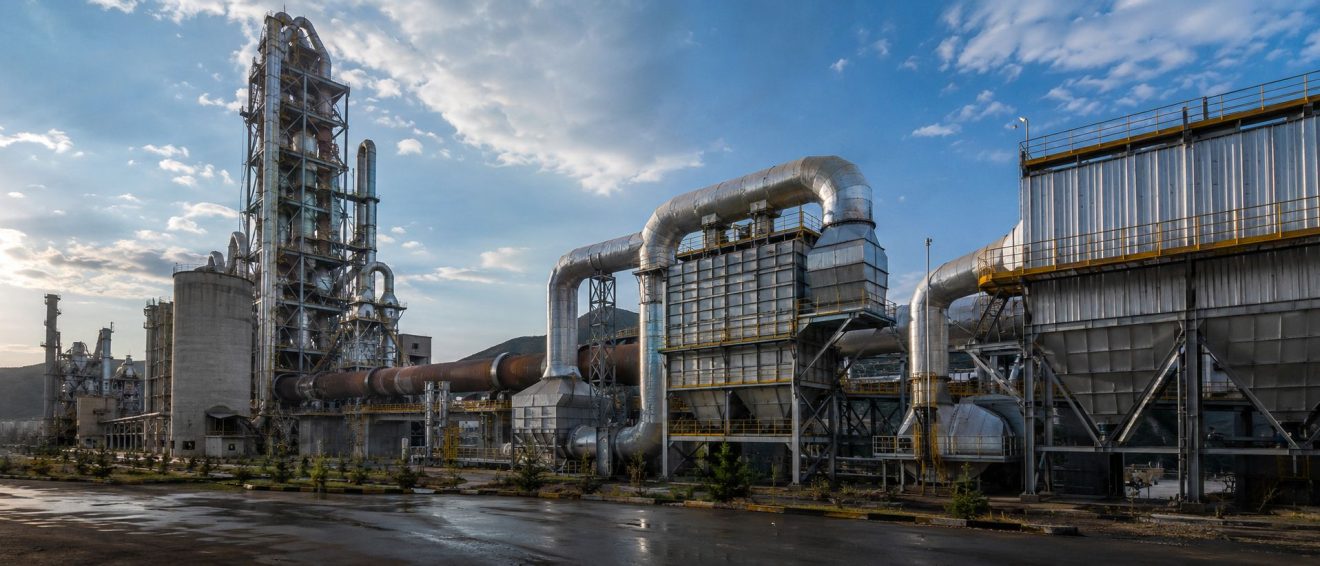
Cement kiln DeNOx projects are often constrained by more than the required NOx removal efficiency. By the time kiln flue gas has passed through heat recovery, raw-mill operation, particulate control and other downstream equipment, the temperature available for the SCR system may be around 150°C or even lower.
For a retrofit project, this creates a practical design question: can the existing gas temperature be used for SCR, or must the entire flue gas stream be reheated before entering the catalyst?
Low-temperature SCR is relevant to cement plants because it can reduce this temperature mismatch. The engineering objective is not simply to operate at the lowest possible temperature, but to match the catalyst operating window to the actual flue gas conditions of the production line.
Why Temperature Is a Key Constraint in Cement Kiln SCR
Conventional SCR catalysts generally operate most effectively at temperatures substantially above those available in many tail-end cement kiln gas streams. If the catalyst requires the flue gas to be heated back into a higher temperature range, the project may need additional burners, heat exchangers, ductwork and control equipment.
For a continuously operating cement plant with a large gas volume, substantial reheating also creates a continuous energy requirement. Where the existing flue gas temperature already falls within the effective window of a suitable low-temperature catalyst, the amount of reheating may therefore be reduced.
The basic NH₃-SCR chemistry and conventional operating-temperature considerations are covered separately in DAQI Technology’s Low-Temperature SCR DeNOx Technology article. The more important issue for a cement application is how the catalyst performs under the actual gas composition over extended operation.
This distinction matters. A field study using actual cement kiln flue gas operated an NH₃-SCR catalyst at approximately 110–140°C, but also identified catalyst sulfation as a major deactivation mechanism. Low-temperature activity alone is therefore not enough to define a suitable cement kiln catalyst.
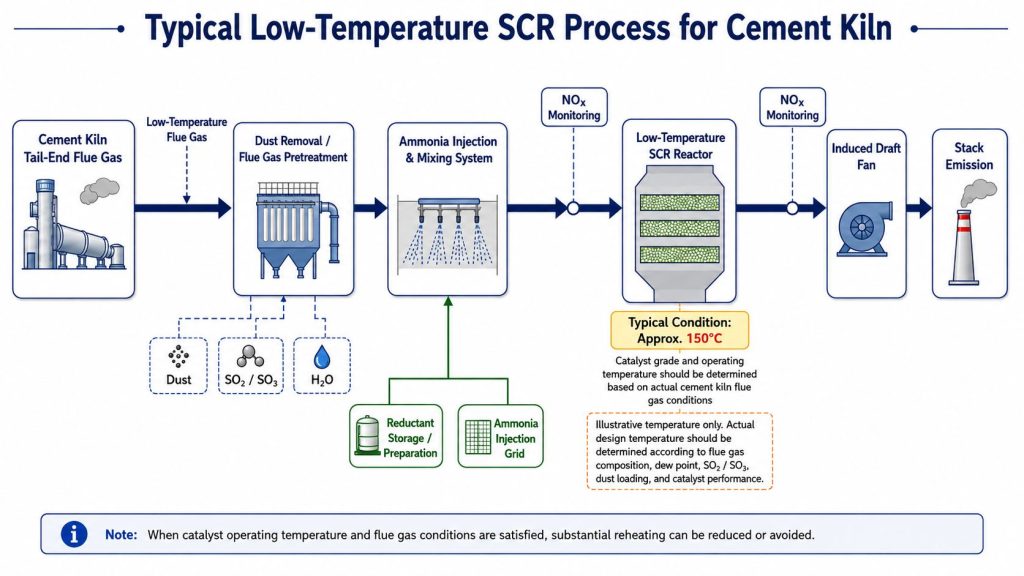
Typical Tail-End Low-Temperature SCR Process
Cement kiln flue gas → particulate removal / gas conditioning → ammonia injection and mixing → low-temperature SCR reactor → ID fan → stack
Particulate Removal and Gas Conditioning
Before entering the SCR reactor, the gas should be evaluated for residual particulate matter, SO₂, SO₃, moisture and other components that may affect catalyst stability. In a tail-end configuration, reducing particulate loading helps limit surface masking, channel blockage and long-term pressure-drop increase across the catalyst layers.
Ammonia Injection and Mixing
The reducing agent must be distributed uniformly across the gas flow. Poor NH₃ distribution can produce insufficient reduction in one section of the reactor and excessive ammonia slip in another. The ammonia injection grid, gas-flow distribution and NOx control strategy should therefore be considered together.
Low-Temperature SCR Reactor
For a cement production line with tail-end flue gas at approximately 150°C, direct entry into a low-temperature SCR reactor may be evaluated when the selected catalyst and flue gas composition are compatible with that condition. This can reduce the amount of temperature lift otherwise required for conventional SCR.
150°C is an example operating condition, not a universal cement kiln SCR design temperature. The actual inlet temperature must be determined against SO₂/SO₃, moisture, acid-dew-point conditions, particulate composition, catalyst characteristics, space velocity and the minimum temperature reached during plant operation.
Why Low-Temperature SCR Can Be Useful in Cement Kiln Retrofits
Many cement kiln DeNOx systems are added to existing production lines rather than designed as part of a greenfield plant. Available space, existing ductwork, particulate-control equipment, heat sources and allowable plant modification all influence the final SCR arrangement.
- Substantial flue gas reheating may be reduced or avoided when the existing temperature satisfies catalyst requirements.
- Tail-end installation can be easier to integrate with existing particulate-control equipment.
- The requirement for large reheating equipment and associated auxiliaries may be reduced.
- Continuous energy consumption associated with reheating can be lowered in suitable operating conditions.
Low-temperature SCR should not be interpreted as a “no-reheat” process. During start-up, low-load operation, winter conditions or process upsets, flue gas temperature may still fall below the stable operating range of the selected catalyst. Supplemental heating or appropriate operating controls may still be required.
What Makes Cement Flue Gas Difficult for an SCR Catalyst?
Cement kiln SCR catalyst selection cannot be based on inlet NOx and temperature alone. Dust composition, sulfur species, moisture and alkali-containing material all influence catalyst activity, service life and reactor pressure drop.
Dust Deposition and Channel Plugging
Particulate deposition can cover catalyst surfaces and restrict flow passages. Over time, this reduces the effective reaction area and increases pressure drop. Residual dust concentration, particle size, catalyst channel geometry and cleaning strategy therefore need to be evaluated together.
Ca, K and Na Poisoning
The Ca, K and Na compounds present in cement kiln dust are more than a physical fouling issue. An industrial cement-dust study published by the American Chemical Society found that alkaline and alkaline-earth components can alter catalyst acid sites and redox properties, resulting in SCR catalyst deactivation.
This is one reason a catalyst that performs well in a boiler or another industrial process cannot automatically be assumed to provide the same service life in cement kiln flue gas.
SO₂, SO₃ and Ammonium Salt Deposition
At low temperature, the interaction between SO₃, moisture and unreacted NH₃ requires particular attention. Ammonium sulfate or ammonium bisulfate deposits can mask active sites, restrict catalyst pores and increase pressure drop.
The U.S. EPA SCR Cost Manual also discusses ammonium bisulfate plugging, particulate fouling and catalyst poisoning by compounds including sodium and potassium as relevant concerns for SCR applications in the cement industry.
Where the same project also requires significant SO₂ removal, desulfurization and SCR should be evaluated as an integrated process sequence rather than as two independent equipment packages. DAQI Technology discusses this configuration in Ultra-Low-Temperature SO₂ and NOx Removal Using Catalytic FGD and SCR.
Moisture and Operating Temperature Variation
A single “normal operating temperature” is not sufficient for catalyst selection. Minimum temperature, maximum temperature, duration of low-load operation and start-stop conditions all need to be understood. These conditions affect catalytic activity, ammonium salt deposition and long-term operating stability.
Data Required for Preliminary Cement Kiln SCR Selection
| Parameter | Information Required |
|---|---|
| Flue gas flow | Normal, minimum and maximum flow rate |
| Inlet temperature | Normal, minimum, maximum and operating variation |
| NOx | Inlet concentration, variation and required outlet level |
| SO₂ / SO₃ | Normal concentration and expected peak values |
| Particulate matter | Concentration, particle size and main composition |
| Moisture | Flue gas water content |
| O₂ | Normal operating concentration |
| Operating profile | Annual hours, load variation and start-stop conditions |
| Existing equipment | Waste heat recovery, raw mill, dust collector, FGD, SNCR, etc. |
| Site constraints | Available space, allowable pressure drop and available heat source |
Together, these parameters determine catalyst formulation, practical operating temperature, design space velocity, catalyst volume, reactor dimensions, ammonia injection arrangement and any additional gas-conditioning requirements.
DAQI Technology’s Approach to Low-Temperature Cement Kiln SCR
DAQI Technology develops low-temperature SCR catalytic materials and process solutions for industrial NOx control. The current low-temperature SCR technology platform can be evaluated for flue gas conditions within an overall temperature range of approximately 90–180°C, providing additional options for industrial gas streams where conventional SCR would otherwise require substantial reheating.
This 90–180°C range describes the broader capability of DAQI Technology’s current low-temperature SCR technology platform. It does not mean that one catalyst grade will operate across the entire range under every cement kiln condition. Individual products, including N-101 and N-201, have their own recommended operating conditions and should not be used to define the full temperature capability of the technology platform.
For an actual cement kiln project, the applicable catalyst and operating window should be confirmed against SO₂/SO₃, moisture, particulate loading, NOx, O₂, space velocity, NH₃/NOx ratio, temperature variation and the required outlet NOx concentration. Where necessary, representative flue gas testing should be used to support the final selection.
From an engineering perspective, reliable low-temperature cement kiln SCR depends on the match between gas conditioning, catalyst characteristics, ammonia distribution, reactor design and actual plant operating conditions. A minimum laboratory reaction temperature on its own does not define whether a catalyst is suitable for long-term operation on a cement production line.
Frequently Asked Questions
Can cement kiln flue gas at 150°C enter an SCR reactor directly?
It can be evaluated, but temperature alone is not sufficient to make the decision. SO₂, SO₃, moisture, particulate loading, NOx, O₂, acid-dew-point conditions, space velocity and the catalyst operating window must also be considered. The 150°C value is a representative process condition, not a universal design temperature.
Does low-temperature SCR eliminate flue gas reheating?
Not necessarily. Where the available gas temperature already meets the catalyst operating requirements, substantial reheating may be reduced or avoided. Supplemental heating may still be required when the flue gas drops below the catalyst’s stable operating range.
Why can’t a cement kiln SCR catalyst be selected only by NOx concentration?
Because cement flue gas may contain particulate matter, Ca, K, Na, SO₂/SO₃ and moisture that affect catalyst activity, fouling, plugging and service life. Catalyst selection therefore needs to consider the complete flue gas composition, operating temperature profile, space velocity, ammonia distribution and allowable system pressure drop.