


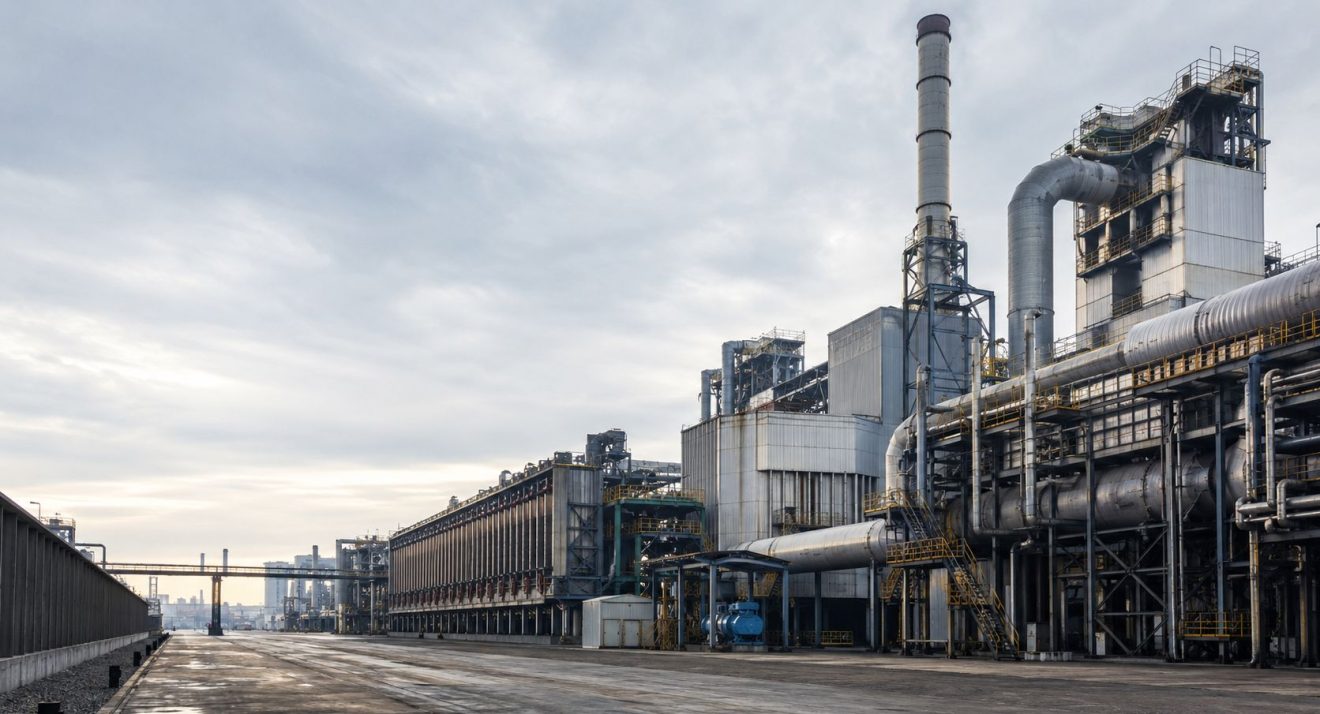
For a coke oven flue gas project, desulfurization and DeNOx should not be treated as two independent equipment packages. The more important engineering question is how SO₂ removal, NOx reduction and the available flue gas temperature can be integrated into one treatment train.
This becomes particularly important when the gas has already passed through heat recovery or other upstream treatment. At that point, the available temperature may be well below the preferred range of a conventional SCR system. Reheating the entire gas stream only to satisfy the SCR catalyst can add a significant and continuous energy load.
For this reason, coke oven flue gas treatment should begin with three practical questions: How much sulfur should be removed before the SCR reactor? What temperature will actually be available at the SCR inlet? And can the DeNOx stage operate without substantial reheating?
Why Coke Oven Flue Gas Requires an Integrated Approach
Coke oven flue gas may contain NOx, SO₂ and particulate matter, while gas temperature varies with furnace operation, fuel composition, production load, heat recovery and the existing environmental control system.
This means that catalyst selection cannot be based on inlet NOx or SO₂ alone. Temperature, sulfur species, moisture, particulate loading and process layout all affect the long-term performance of a low-temperature SCR system.
For projects in China, current engineering design should also be checked against the applicable national and local requirements, including GB 16171.1-2024, Emission Standard of Air Pollutants for the Coking Chemical Industry. Projects in other markets should be designed against the applicable local permit and emission limits.
A Typical Desulfurization and Low-Temperature SCR Arrangement
Where the coke oven exhaust has already entered a medium- to low-temperature range and both SO₂ and NOx require control, one process configuration worth evaluating is:
Coke oven flue gas → heat recovery / temperature adjustment → catalytic desulfurization → low-temperature SCR DeNOx → stack
An illustrative temperature profile could look like this:
Approx. 250°C → heat recovery / temperature control → approx. 150°C → catalytic desulfurization → approx. 130°C → low-temperature SCR → stack
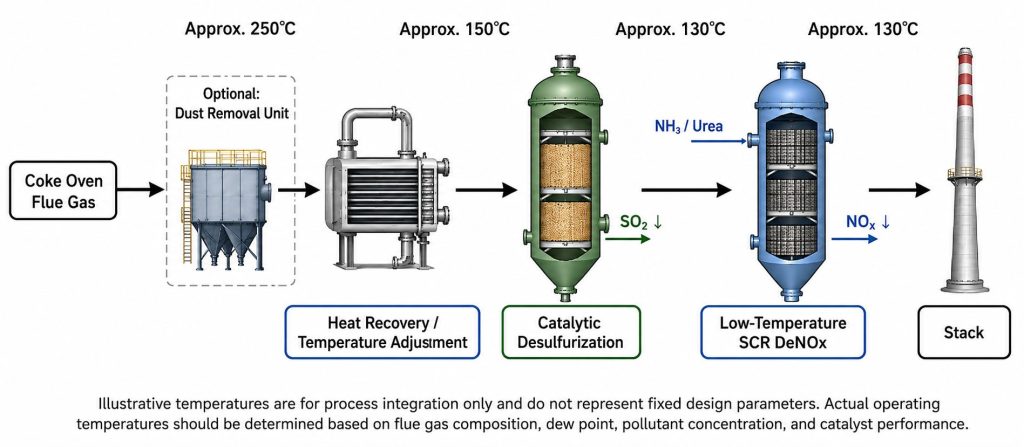
These temperatures are only an example of process integration. They are not fixed coke oven design values. Actual temperatures must be determined from the raw flue gas profile, sulfur and NOx concentrations, SO₃, moisture, acid dew point, heat-recovery arrangement and catalyst performance.
Particulate control may also be required upstream depending on the existing plant configuration and dust loading.
Why Is Desulfurization Often Placed Before Low-Temperature SCR?
One of the main reasons is to reduce the sulfur load reaching the SCR catalyst.
NH₃-SCR uses ammonia, or ammonia generated from a urea system, as the reducing agent. When SO₂/SO₃ remains in the flue gas, the combination of sulfur species, NH₃, moisture and low temperature can increase the risk of ammonium bisulfate and ammonium sulfate deposition.
These deposits can affect catalyst pores, increase pressure drop and make long-term low-temperature operation more difficult. Reducing SO₂/SO₃ upstream can therefore provide a cleaner and more stable environment for the downstream SCR stage.
For the catalytic sulfur-removal mechanism and catalyst regeneration process, see DAQI Technology’s Catalytic Flue Gas Desulfurization Technology article.
This does not mean that every coke oven project must use a desulfurization-first configuration. Plants with existing FGD systems, different sulfur levels, alternative SCR locations or different temperature profiles may require another arrangement. Process order should be determined from the actual gas conditions rather than treated as a universal rule.
Why Consider Low-Temperature SCR for Coke Oven Flue Gas?
In many retrofit projects, the economic issue with conventional SCR is not NOx conversion itself. It is the cost of bringing a large flue gas stream back to the catalyst temperature.
If heat recovery, desulfurization or other upstream equipment has already reduced the flue gas temperature into roughly the 100–180°C region, reheating the full gas flow to a conventional medium- or high-temperature SCR window may require additional heat exchangers, burners, fuel or other energy input.
The practical value of low-temperature SCR is therefore to make better use of the temperature already available in the plant. Where the flue gas composition and catalyst conditions are suitable, the DeNOx reactor can be integrated with substantially less reheating.
DAQI Technology’s current low- and ultra-low-temperature SCR technology platform can be evaluated for industrial flue gas conditions within an overall range of approximately 90–180°C. This is a technology capability range, not a guarantee that every coke oven stream can operate at the lower end of the window. Individual catalyst grades and project conditions must be evaluated separately.
For a broader discussion of catalyst operation and NH₃-SCR fundamentals, see Low-Temperature SCR DeNOx Technology for Industrial NOx Control.
Key Risks in Low-Temperature Coke Oven SCR Operation
- SO₂ and SO₃: sulfur loading should be controlled before the SCR stage, particularly where ammonium salt deposition is a concern.
- Moisture: water affects catalyst surface reactions and interacts with sulfur chemistry at low temperature.
- Particulate matter: excessive dust can increase plugging, erosion and pressure drop.
- Ammonia slip: higher NH₃ dosage should not be used as a substitute for proper catalyst sizing and gas distribution.
- Temperature variation: minimum, normal and maximum operating temperatures are all relevant to catalyst selection.
- Catalyst poisoning and fouling: trace contaminants and accumulated deposits may affect long-term activity even when initial NOx conversion is satisfactory.
For an industrial buyer, this is why the lowest advertised catalyst temperature should never be the only selection criterion. The more useful question is whether the catalyst can maintain the required outlet NOx under the plant’s actual sulfur, moisture, dust, space velocity and temperature profile.
What Data Is Needed Before Process and Catalyst Selection?
A preliminary coke oven flue gas assessment should normally include:
- normal, minimum and maximum flue gas flow;
- normal, minimum and maximum temperature, including operating fluctuations;
- SO₂, SO₃ and NOx concentrations;
- particulate concentration and characteristics;
- moisture and O₂ content;
- required outlet SO₂, NOx and particulate limits;
- coke oven operating load and load variation;
- existing particulate control, FGD, heat-recovery and other gas-treatment equipment;
- available heat sources, installation space and allowable system pressure drop.
These data are generally more useful than asking a catalyst supplier for a single “maximum DeNOx efficiency” figure. They determine catalyst selection, catalyst volume, gas hourly space velocity, ammonia injection design, reactor dimensions and the amount of reheating—if any—that the system will require.
DAQI Technology’s Approach to Coke Oven Flue Gas Treatment
DAQI Technology develops carbon-based catalytic desulfurization materials and low-temperature SCR catalytic materials for industrial flue gas treatment.
For coke oven applications, the preferred starting point is the complete gas-treatment train rather than an isolated catalyst specification: reduce the sulfur load where necessary, preserve a usable temperature window through the treatment system, and then match the SCR catalyst and reactor to the actual NOx, sulfur, moisture, particulate and temperature conditions.
DAQI Technology’s catalytic desulfurization platform can be evaluated at approximately 40–180°C depending on flue gas conditions, while the current low- and ultra-low-temperature SCR platform can be evaluated within an overall range of approximately 90–180°C. Final operating conditions must be confirmed for each project.
For the broader two-stage SO₂ and NOx treatment concept, see Ultra-Low-Temperature SO₂ and NOx Removal Using Catalytic FGD and SCR.
FAQ
Should desulfurization always be installed before SCR on a coke oven?
No. A desulfurization-first arrangement is often attractive for low-temperature SCR because it reduces sulfur loading on the catalyst, but the final sequence depends on the existing FGD system, SO₂/SO₃ concentrations, flue gas temperature and selected catalyst.
Can coke oven flue gas at around 130°C go directly to low-temperature SCR?
Temperature alone is not sufficient to answer this. SO₂/SO₃, moisture, particulate loading, NOx, O₂, space velocity, ammonia slip requirements and the required outlet NOx must also be evaluated. A temperature inside the catalyst’s potential operating range only means that further engineering assessment is justified.
What information should be sent to a catalyst or process supplier?
Provide the full flue gas flow and temperature range, SO₂, SO₃, NOx, moisture, O₂, particulate loading, required emission limits and the existing treatment process. Retrofit projects should also include available installation space, system pressure-drop limits and available heat sources.