


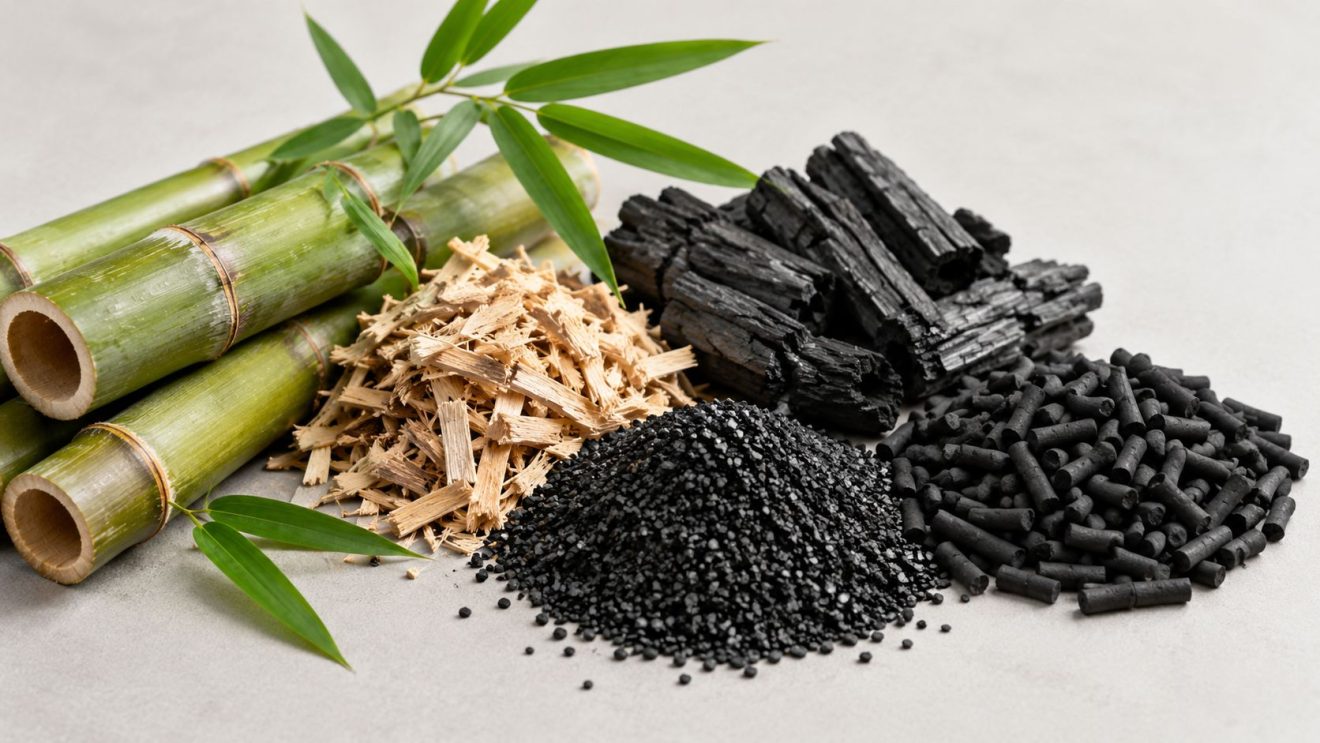
Turning bamboo into activated carbon is not simply a matter of heating it until it turns black.
The useful properties of activated carbon are developed through two distinct stages: carbonization creates the carbon framework, while activation develops the pore structure inside that framework.
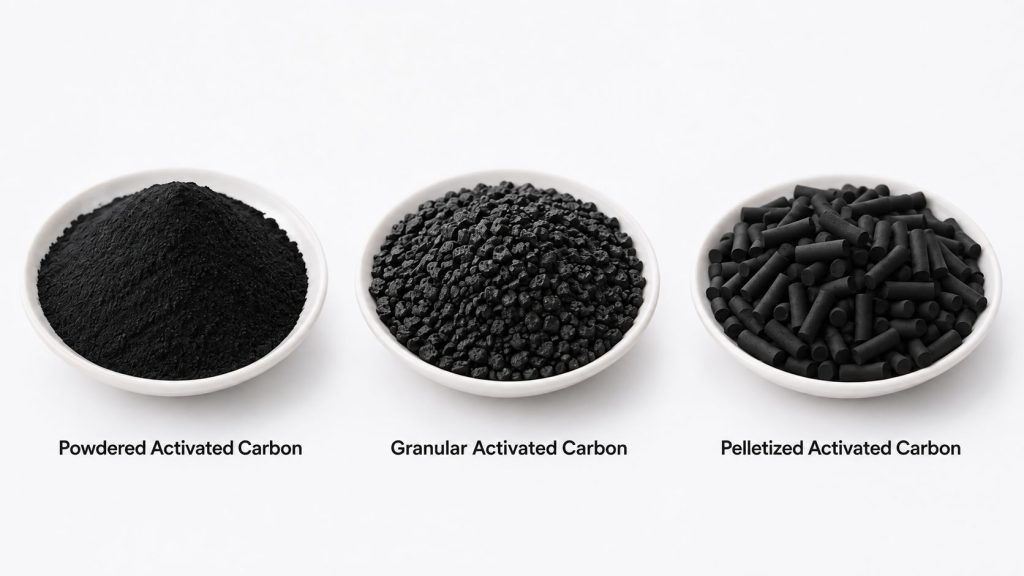
What leaves the production line may look like a pile of black granules, powder or cylindrical pellets. At the microscopic level, however, the material has been transformed into a porous carbon structure containing an extensive internal surface.
Understanding this transformation helps explain why activated carbons made from the same raw material can still perform very differently.
Studies on bamboo-derived activated carbon have shown that activation conditions directly influence micropore formation, pore widening, total pore volume and surface characteristics.
Carbonization Comes First
Fresh bamboo contains cellulose, hemicellulose, lignin, moisture and other volatile components.
Before it can become a useful adsorbent, much of this non-carbon material must be removed and a stable carbon framework must be formed.
This takes place during carbonization.
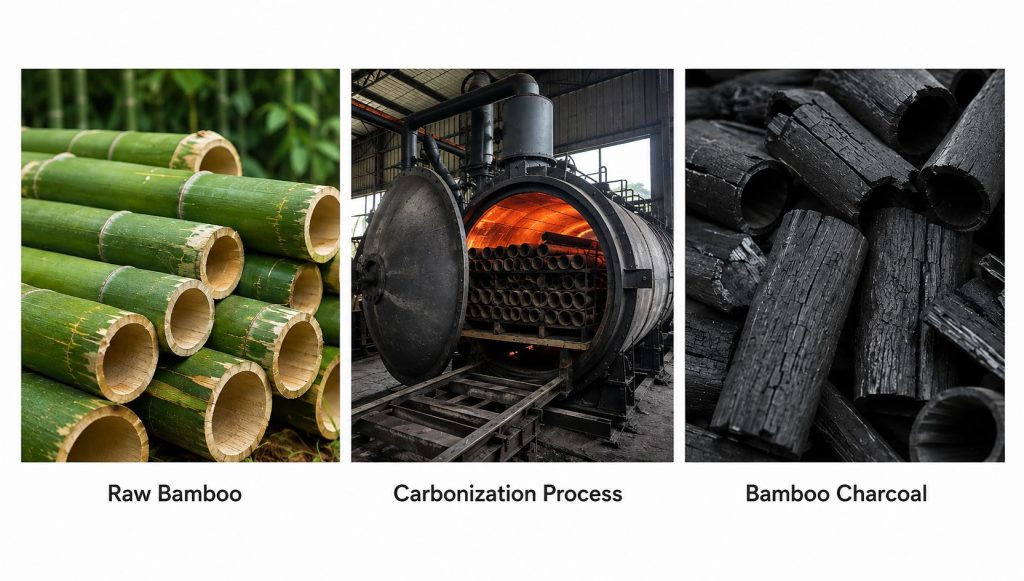
Bamboo is heated under oxygen-limited or controlled conditions. As temperature increases, moisture and volatile compounds are released and the original biomass structure progressively changes into a carbon-rich solid.
A simplified way to describe the process is:
Bamboo → thermal decomposition → volatile release → carbon-rich char
At this stage, the material is bamboo charcoal rather than fully developed activated carbon.
Published bamboo activated-carbon preparation routes commonly include a carbonization stage before subsequent activation.
Why Is Bamboo Charcoal Not Yet Activated Carbon?
Carbonization already creates some porosity.
That does not mean the available pore network is fully developed.
Some pores remain inaccessible, while others are poorly connected or unsuitable for the molecules that the finished adsorbent is expected to capture.
This is why carbonization and activation should not be treated as the same process.
Carbonization builds the carbon framework.
Activation develops usable porosity within that framework.
The distinction matters in industrial applications because adsorption takes place primarily on the internal carbon surface, not simply on the outside of the particle.
Activation: Developing the Internal Pore Network
After carbonization, the char is subjected to activation.
Activated carbon can be produced through several routes. Physical activation commonly uses steam or carbon dioxide at elevated temperature, while chemical activation introduces an activating reagent before or during thermal treatment.
Both approaches have been investigated for bamboo-derived carbon. Bamboo has been activated using steam, CO₂ and chemical agents to produce materials with different pore structures.
Consider steam activation as an example.
Steam reacts with selected parts of the carbon matrix under controlled conditions. As the reaction proceeds, previously inaccessible regions can open and existing pores can grow.
The process can therefore:
open blocked pores → create new micropores → enlarge existing pores → improve access to the internal carbon surface
This is controlled carbon consumption rather than uncontrolled burning.
The distinction is important because stronger activation is not automatically better.
Research on steam-activated bamboo carbon found that higher activation temperature and longer activation time can create new micropores and widen existing ones. As activation continues, pore structure keeps evolving, meaning the highest activation severity does not necessarily produce the best material for every application.
The manufacturing target is therefore not simply “more pores.”
It is the right pore structure for the intended adsorbate and process conditions.
What Happens to the Pores During Activation?
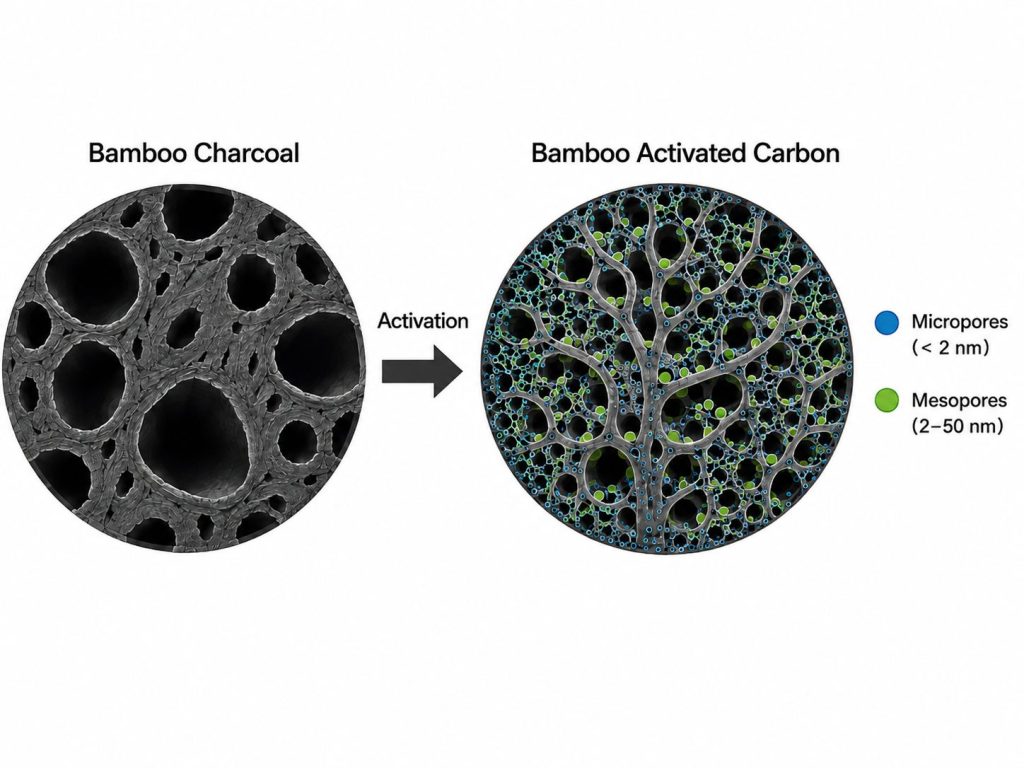
The difference between charcoal and activated carbon is difficult to judge by eye.
At the nanometer scale, it becomes much clearer.
The commonly used IUPAC pore-size classification defines:
- Micropores: below approximately 2 nm;
- Mesopores: approximately 2–50 nm;
- Macropores: above approximately 50 nm.
These different pore ranges do not perform exactly the same function.
Micropores provide a large proportion of the adsorption space for many small molecules.
Mesopores can improve access for larger molecules and contribute to mass transport.
Larger pores often act as transport routes leading molecules deeper into the particle.
A commercial activated carbon therefore should not be pictured as a solid filled with millions of identical holes.
It is better understood as a hierarchical and irregular network of pores with different sizes and levels of connectivity.
Why Pore Structure Matters More Than Appearance
Activated carbon is easy to judge visually and difficult to judge technically.
A customer can see whether a pellet is straight, whether granules contain too much dust or whether the material looks uniformly black.
None of these observations alone tells us what the carbon will adsorb effectively.
Adsorption takes place largely inside the material.
A small gas molecule, a larger organic compound and a colored molecule in industrial wastewater do not necessarily require the same pore environment.
As a result, two activated carbons can come from similar feedstocks and even have similar iodine numbers while behaving differently in a real adsorption system.
This is one reason why material development for air purification, water treatment and industrial gas treatment cannot be reduced to a single specification.
The relevant question is not simply:
“How high is the surface area?”
It is:
“Is the pore structure accessible and appropriate for the contaminant under the actual operating conditions?”
What Happens After Activation?
Activation develops the pore structure, but it does not always produce the final commercial form.
Depending on the product, the carbon may subsequently undergo:
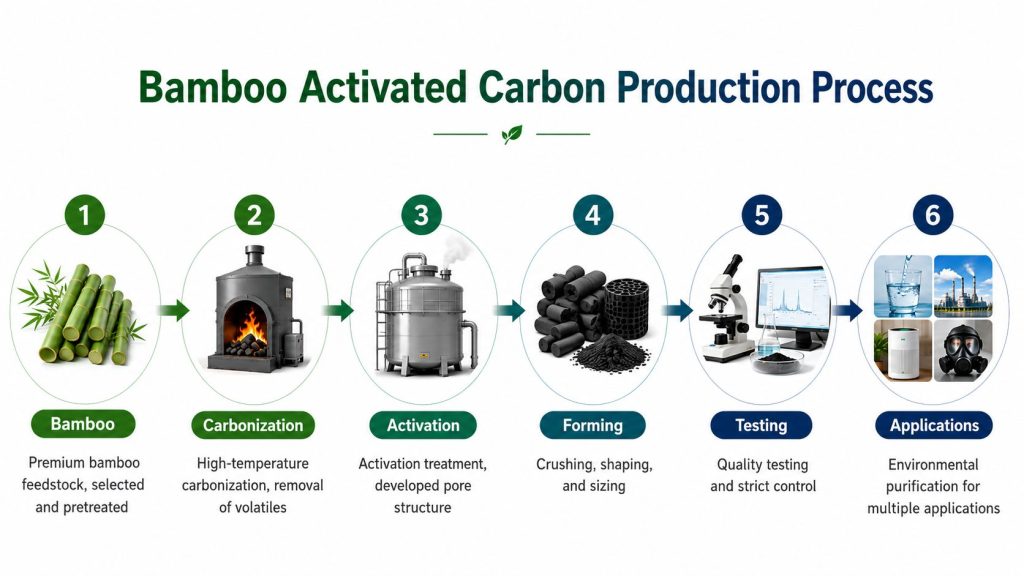
cooling → crushing → milling → forming → screening → washing → drying → testing
A simplified production route can therefore be shown as:
Bamboo
→ Raw Material Preparation
→ Carbonization
→ Activation
→ Cooling
→ Crushing or Forming
→ Screening
→ Washing and Drying
→ Quality Control
→ Finished Product
Why Activated Carbon Is Supplied as Powder, Granules and Pellets
The pore structure determines much of the adsorption behavior.
The physical form determines how the material can be used in equipment.
Powdered Activated Carbon
Powdered activated carbon consists of very fine particles and provides rapid contact when dispersed in a liquid.
It is commonly considered for treatment processes in which the carbon is dosed directly into water or another process stream.
Granular Activated Carbon
Granular activated carbon consists of larger irregular particles.
It can be packed into columns, filters and fixed beds, making particle size distribution, mechanical integrity and pressure characteristics important in addition to adsorption capacity.
Pelletized Activated Carbon
Pelletized or extruded carbon has a relatively uniform cylindrical geometry.
In gas-phase treatment, this form can provide a practical balance among adsorption performance, mechanical strength and pressure drop through the packed bed.
In simple terms:
Pore structure influences what the carbon can adsorb.
Particle form influences how the carbon operates in the system.
Higher Numbers Do Not Automatically Mean Better Carbon
Activated carbon specifications are sometimes treated like a ranking table.
Higher iodine number must be better.
Higher BET surface area must be better.
More porosity must be better.
Manufacturing is not that simple.
Steam-activation studies on bamboo-derived carbon demonstrate that changing activation time and temperature changes not only the amount of porosity but also the distribution and width of the pores. New micropores can form while existing micropores become wider as activation proceeds.
Commercial production therefore involves balancing several properties rather than maximizing one number:
pore-size distribution, surface area, adsorption capacity, particle strength, ash content, bulk density, particle size and process yield.
The appropriate balance depends on what the carbon is expected to do.
A carbon developed for water decolorization does not necessarily require the same structure as one developed for gas purification.
A carbon intended for a packed industrial adsorption bed also needs different mechanical and flow characteristics from a powdered material dosed into water.
From General-Purpose Activated Carbon to Functional Carbon Materials
For a general-purpose adsorbent, carbonization and activation establish most of the basic material properties.
More demanding applications may require another step.
Surface chemistry can be adjusted, pore structures can be targeted more closely, and functional components can be introduced to make the carbon more selective toward a particular contaminant.
At this point, material evaluation also changes.
A conventional activated carbon may be specified by iodine number, BET surface area, ash, moisture and hardness.
A gas-treatment material may need breakthrough data, working capacity, pressure-drop characteristics and performance under specific temperature or humidity conditions.
A functional adsorbent or catalytic carbon may need to be evaluated directly against the target contaminant.
This is the direction in which DAQI Technology approaches bamboo-based carbon development.
The bamboo feedstock is important, but it is only the starting point.
The more useful engineering question is how raw material, pore structure, surface chemistry and operating conditions can be matched to produce a carbon material for a specific environmental treatment task.
What Is Really Being Manufactured?
From the outside, an activated-carbon plant produces black powder, granules and pellets.
From a materials perspective, what is actually being manufactured is a controlled porous structure.
Carbonization builds the framework.
Activation develops the pores.
Forming determines how the material can be handled and operated.
Further functionalization can determine which pollutants the material is particularly suited to treat.
That is the key transformation behind bamboo activated carbon:
not simply turning bamboo black, but converting renewable bamboo biomass into a porous carbon material engineered for adsorption, purification and industrial pollution control.
Comments