


Low-temperature selective catalytic reduction (LT-SCR) is a DeNOx process designed to remove nitrogen oxides (NOx) from industrial flue gas at temperatures below the typical operating range of conventional SCR systems.
Using ammonia (NH₃) as the reducing agent and a dedicated catalyst, NOx is selectively converted into nitrogen (N₂) and water (H₂O).
DAQI Technology has developed low-temperature SCR catalysts and process technology for industrial gas purification applications where flue gas temperatures are too low for conventional SCR without substantial reheating. The N-101 and N-201 catalyst series are designed for different low-temperature operating windows and industrial flue gas conditions.
The main engineering value of LT-SCR is not simply adding another NOx treatment stage. In suitable applications, a lower catalyst operating temperature can reduce the amount of flue gas reheating required before the SCR reactor, helping lower energy demand and simplify retrofit layouts.
Low-Temperature SCR Technology at a Glance
| Parameter | Description |
|---|---|
| Target pollutant | Nitrogen oxides (NOx) |
| Process | NH₃ selective catalytic reduction (NH₃-SCR) |
| Main reaction products | N₂ and H₂O |
| Low-temperature activity | Demonstrated activity at approximately 90–180°C in historical tests |
| N-101 recommended temperature | 120–180°C |
| N-201 recommended temperature | 120–240°C |
| Typical DeNOx efficiency | ≥90% under specified operating conditions |
| Typical applications | Boilers, coking, cement, glass, waste incineration, power generation and other industrial flue gas |
| Engineering focus | Low-temperature activity, reduced reheating demand and integration with industrial flue gas treatment systems |
Actual NOx removal efficiency and operating temperature depend on inlet NOx concentration, flue gas composition, SO₂/SO₃, moisture, O₂ concentration, particulate loading, space velocity, NH₃/NOx ratio and reactor design. Catalyst selection should therefore be based on actual operating conditions.
What Is Selective Catalytic Reduction?
Selective catalytic reduction, commonly referred to as SCR, is a post-combustion NOx control process.
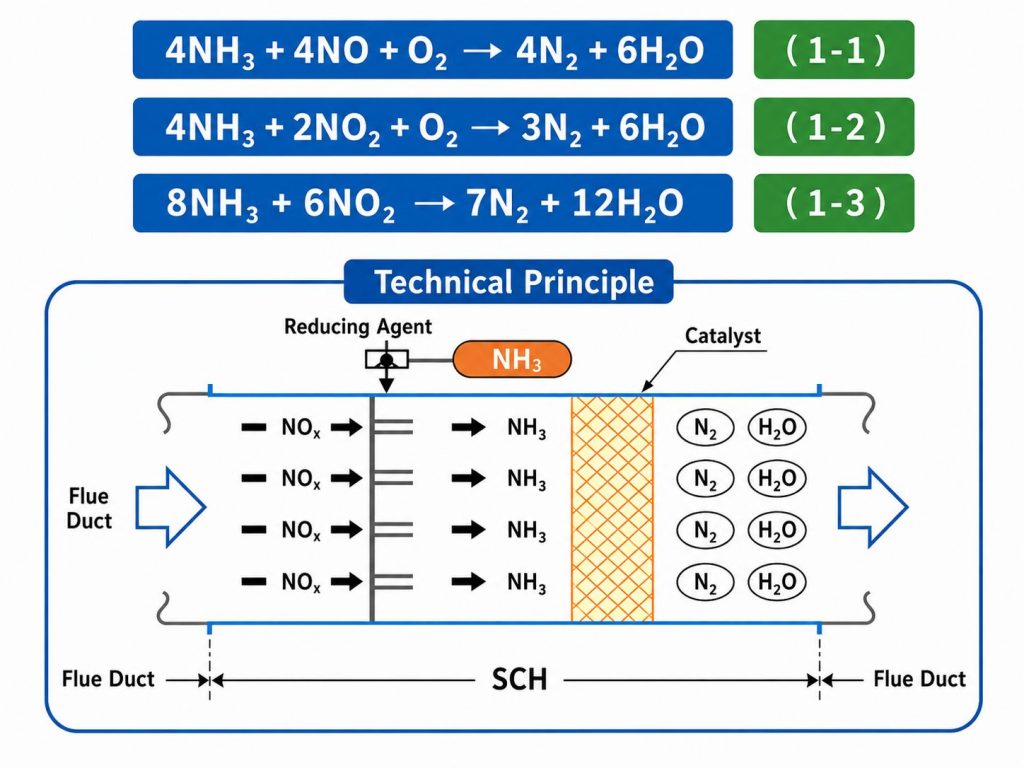
Ammonia, or ammonia generated from a urea system, is introduced into the flue gas upstream of the catalyst. On the catalyst surface, NH₃ reacts selectively with NO and NO₂ to form predominantly nitrogen and water.
Typical reactions include:
4NH₃ + 4NO + O₂ → 4N₂ + 6H₂O
4NH₃ + 2NO₂ + O₂ → 3N₂ + 6H₂O
8NH₃ + 6NO₂ → 7N₂ + 12H₂O
Why Is Low-Temperature SCR Needed for Industrial Flue Gas?
Conventional SCR Requires a Suitable Temperature Window
Catalyst activity in an SCR system is strongly dependent on flue gas temperature.
Commercial metal-oxide SCR catalysts generally operate at substantially higher temperatures than low-temperature SCR systems. U.S. EPA technical guidance gives an operating range of approximately 250–430°C for most commercial metal-oxide catalysts, with typical maximum NOx removal occurring around 370–400°C, depending on catalyst formulation and flue gas conditions.
The challenge is that many industrial exhaust streams are already much cooler by the time they reach the proposed DeNOx stage.
Boiler, coking and industrial furnace exhaust may pass through heat recovery, particulate removal, desulfurization or other upstream processes before SCR treatment. If the gas must then be reheated solely to reach the conventional catalyst temperature window, additional energy and equipment may be required.
Low-Temperature SCR Addresses the Temperature Mismatch
The purpose of low-temperature SCR is to maintain useful NOx reduction activity at a lower catalyst temperature.
For suitable applications, this can reduce the need for substantial flue gas reheating and provide greater flexibility when integrating SCR into an existing industrial flue gas treatment system.
However, LT-SCR should not be evaluated only by a headline removal-efficiency figure. Important engineering factors include flue gas temperature, catalyst lifetime, sulfur and water tolerance, ammonia slip, system pressure drop, outlet NOx requirements and total lifecycle operating cost.
How Does DAQI Technology’s Low-Temperature SCR Process Work?
Low-Temperature Catalytic NOx Reduction
DAQI Technology’s low-temperature SCR process follows the established NH₃-SCR reaction pathway while using dedicated catalytic materials designed to maintain activity at lower temperatures.
After the reducing agent is properly mixed with the flue gas, the gas enters the catalyst bed. NOx and NH₃ interact with active sites on the catalyst surface, where the selective reduction reaction takes place before the treated gas continues to downstream equipment.
Low-temperature NH₃-SCR remains an active field of catalyst research. Recent peer-reviewed research has highlighted catalyst activity below 200°C, together with SO₂ and H₂O tolerance, as important issues for improving the energy efficiency and practical applicability of low-temperature SCR systems.
Catalyst and Process Design Must Be Considered Together
A lower operating temperature does not mean the same catalyst can be used for every flue gas.
Practical LT-SCR design should consider:
Inlet NOx + Temperature + SO₂/SO₃ + H₂O + O₂ + Dust + Space Velocity + NH₃/NOx Ratio + Required Outlet NOx
Sulfur-containing flue gas requires particular attention. At lower temperatures, sulfur resistance, water tolerance and the potential formation or deposition of ammonium sulfate species can affect catalyst activity and long-term operating stability.
For this reason, DAQI Technology evaluates the actual flue gas conditions when selecting a catalyst and defining process parameters rather than using laboratory NOx conversion alone as the basis for engineering design.
N-101 and N-201 Low-Temperature SCR Catalysts
DAQI Technology developed the N-101 and N-201 low-temperature SCR catalyst series for different industrial flue gas conditions and operating temperature windows.
N-101 Low-Temperature SCR Catalyst
N-101 is designed primarily for relatively low-temperature industrial flue gas DeNOx applications.
Its recommended operating temperature is approximately:
120–180°C
Typical technical parameters include:
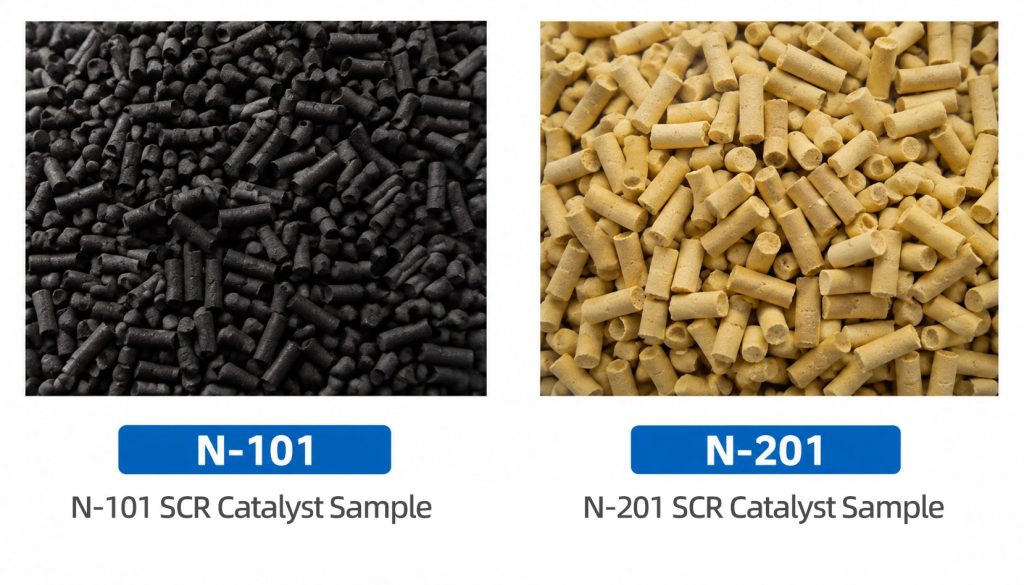
- Appearance: black cylindrical pellets
- Bulk density: 0.45–0.55 t/m³
- Recommended operating temperature: 120–180°C
- Typical DeNOx efficiency: ≥90%
- Moisture: ≤5%
- pH: 8–10
- Ignition temperature: ≥250°C
- Mechanical strength: ≥200 N/cm
N-101 has been commercialized and applied in industrial projects under DAQI Technology’s technical standard for dedicated low-temperature SCR DeNOx catalysts.
N-201 Low-Temperature SCR Catalyst
N-201 is designed for industrial flue gas conditions requiring a wider operating temperature window.
Its recommended operating temperature is approximately:
120–240°C
The catalyst is designed to provide low-temperature catalytic activity together with a broader active temperature range and stable performance under appropriate operating conditions.
Typical parameters include:
- Appearance: yellow extrudates
- Bulk density: approximately 0.9 t/m³
- Recommended operating temperature: 120–240°C
- Typical DeNOx efficiency: ≥90%
- Mechanical strength: ≥120 N/cm
Potential applications include industrial boilers, nitric-acid-related exhaust streams and other industrial NOx sources, subject to detailed flue gas evaluation.
N-101 vs. N-201: Key Technical Parameters
| Parameter | N-101 | N-201 |
|---|---|---|
| Appearance | Black cylindrical pellets | Yellow extrudates |
| Bulk density | 0.45–0.55 t/m³ | Approx. 0.9 t/m³ |
| Recommended temperature | 120–180°C | 120–240°C |
| Typical DeNOx efficiency | ≥90% | ≥90% |
| Mechanical strength | ≥200 N/cm | ≥120 N/cm |
Final catalyst selection should be based on actual operating conditions rather than temperature alone.
NOx Removal Performance at Low Temperatures
Historical test data from DAQI Technology showed increasing NOx removal efficiency as catalyst temperature increased under the corresponding test conditions.
| Flue Gas Temperature | NOx Removal Efficiency |
|---|---|
| 90°C | Approx. 65% |
| 120°C | Approx. 80% |
| 150°C | Approx. 90% |
| 180°C | Approx. 95% |
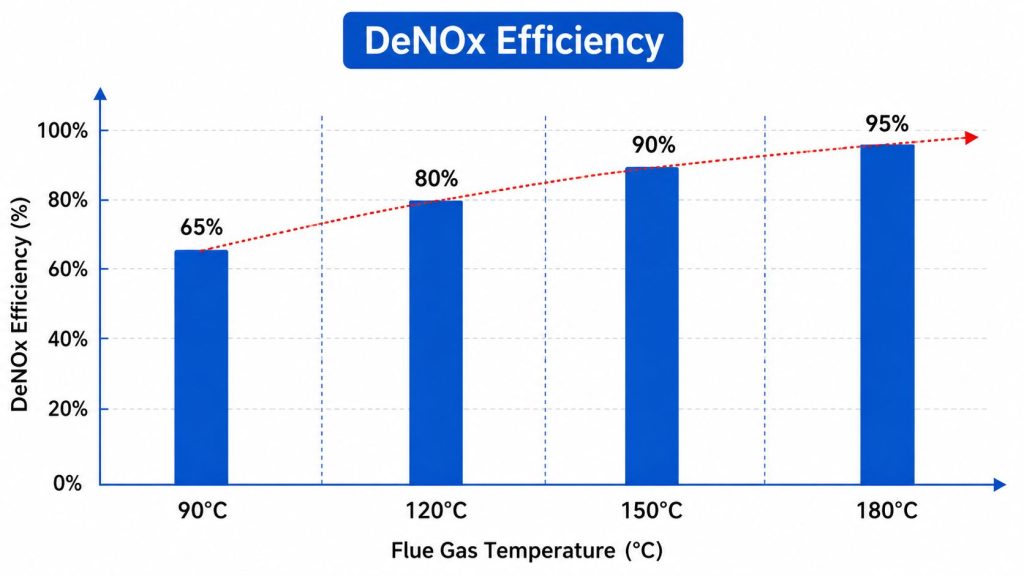
The results demonstrate measurable catalytic activity well below the typical temperature range of conventional SCR catalysts, with higher NOx conversion observed between 150°C and 180°C in these tests.
These figures are historical DAQI Technology test data obtained under specific test conditions. They should not be interpreted as guaranteed performance for every application. Actual performance depends on flue gas composition, temperature, space velocity, inlet NOx concentration and overall system design.
Industrial Application Experience
Laboratory catalyst activity is only one part of evaluating a DeNOx technology. Performance under actual industrial flue gas conditions is equally important.
DAQI Technology has applied its low-temperature SCR technology in industrial projects.
15 t/h Industrial Boiler Low-Temperature DeNOx Project
In 2016, a DAQI Technology low-temperature SCR catalyst was applied to the flue gas treatment system of a 15 t/h industrial boiler.
According to DAQI Technology’s historical project operating records, the system achieved:
Outlet NOx below 30 mg/m³ under the specified project conditions.
The project provided industrial-scale operating experience for low-temperature SCR catalyst application in boiler flue gas.
Coking Flue Gas Desulfurization and DeNOx Project
In 2017, related low-temperature SCR technology was further applied in a large-scale coking flue gas desulfurization and DeNOx project.
According to DAQI Technology’s historical project documentation, the system was used for deep NOx control under low-temperature coking flue gas conditions and was designed to meet the emission requirements applicable to the project at that time.
Emission standards have continued to evolve since these projects were commissioned. For projects in China, current design requirements should be determined according to the latest applicable national, industry and local standards rather than historical project limits.
China’s Ministry of Ecology and Environment has issued GB 16171.1-2024, Emission Standard of Air Pollutants for the Coking Chemical Industry, effective from April 1, 2025.
Where Can Low-Temperature SCR Be Applied?
Low-temperature SCR is particularly relevant when flue gas at the proposed DeNOx location is cooler than the preferred operating window of a conventional SCR catalyst or where substantial reheating would increase operating cost.
Industrial Boilers
LT-SCR may be evaluated for gas-fired, coal-fired and other industrial boiler exhaust streams where the combination of flue gas temperature and required NOx limit makes conventional SCR reheating less attractive.
Important parameters include fuel type, load variation, inlet NOx, flue gas temperature, sulfur compounds, moisture and the applicable emission limit.
For projects in China, GB 13271-2014, Emission Standard of Air Pollutants for Boiler, together with applicable local requirements, should be reviewed during engineering design.
Coking and Iron & Steel Related Flue Gas
Coking and associated industrial processes can generate flue gas requiring deep NOx control.
For these applications, catalyst selection should consider SO₂/SO₃, moisture, dust loading, temperature variation and the interaction between upstream desulfurization, particulate control and downstream SCR operation.
Cement, Glass and Industrial Furnaces
NOx emissions from cement kilns, glass furnaces and other industrial furnaces depend strongly on combustion conditions and process configuration.
The suitability of low-temperature SCR depends on where the catalyst reactor is located in the flue gas treatment train and on the temperature and composition of the gas at that point.
For cement projects in China, GB 4915-2013, Emission Standard of Air Pollutants for the Cement Industry, should be considered together with its latest amendment effective from April 1, 2026, as well as applicable local requirements.
Waste Incineration, Power Generation and Other Industrial Exhaust
Low-temperature SCR may also be evaluated for waste incineration, power generation and selected chemical or process exhaust streams where the catalyst operating conditions can be maintained.
A detailed flue gas analysis is required before final catalyst selection and reactor design.
Low-Temperature SCR vs. Conventional SCR
| Factor | Low-Temperature SCR | Conventional SCR |
|---|---|---|
| Main application | Lower-temperature industrial flue gas | Conventional medium/high-temperature SCR conditions |
| Temperature requirement | Maintains useful catalytic activity at lower temperatures | Commercial metal-oxide catalysts generally require higher temperatures |
| Flue gas reheating | Can be reduced in suitable applications | Low-temperature exhaust may require additional reheating |
| Key catalyst challenges | Low-temperature activity, sulfur/water resistance and long-term stability | Activity, catalyst life, poisoning resistance and operating stability |
| Typical use case | Low-temperature streams and selected retrofit projects | Streams already within a conventional SCR operating window |
Low-temperature SCR is not automatically the better option for every plant.
If a process already provides stable flue gas within the preferred temperature range of a conventional SCR catalyst, a conventional system may remain technically and economically appropriate.
The correct choice should be based on actual flue gas conditions, emission targets and lifecycle cost.
What Flue Gas Data Are Required for LT-SCR Catalyst Selection?
For an initial technical assessment, the following operating data should be provided:
- Flue gas flow rate, Nm³/h
- Normal, minimum and maximum flue gas temperature
- Inlet NOx concentration
- Required outlet NOx concentration
- SO₂/SO₃ concentration
- Moisture content
- O₂ concentration
- Particulate concentration
- Other potential catalyst poisons or contaminants
- Annual operating hours and load variation
- Existing desulfurization, particulate-control and heat-recovery processes
- Available reactor space and acceptable system pressure drop
These parameters are used to evaluate catalyst type, catalyst volume, space velocity, ammonia injection strategy and reactor configuration.
Frequently Asked Questions
What temperature is considered low-temperature SCR?
There is no single temperature threshold that applies to every SCR catalyst.
In practice, low-temperature SCR generally refers to catalyst systems that maintain useful NOx reduction activity substantially below the normal operating range of conventional commercial SCR catalysts.
For DAQI Technology’s current product ranges described here, N-101 is recommended for approximately 120–180°C, while N-201 is recommended for approximately 120–240°C. Actual operating limits depend on the catalyst and flue gas conditions.
Can low-temperature SCR achieve more than 90% NOx removal at 90°C?
Not necessarily.
In DAQI Technology’s historical test data, NOx removal was approximately 65% at 90°C, increasing to approximately 90% at 150°C and 95% at 180°C under the corresponding test conditions.
Temperature alone is not sufficient to predict project performance. Space velocity, inlet NOx, NH₃/NOx ratio, sulfur compounds, moisture and other flue gas components must also be considered.
Does low-temperature SCR eliminate flue gas reheating?
Not in every application.
The lower catalyst temperature requirement can reduce or, in suitable projects, avoid substantial reheating. If actual flue gas temperature remains below the stable operating range of the selected catalyst, temperature adjustment may still be required.
What is the difference between SCR and SNCR?
SCR uses a catalyst to promote the reaction between the reducing agent and NOx and can generally achieve higher and more stable NOx removal at lower temperatures.
SNCR does not use a catalyst and requires the reducing agent to be injected within a specific higher-temperature reaction window.
The appropriate technology depends on required NOx reduction, flue gas temperature, process configuration and overall project economics.
How do I choose between N-101 and N-201?
Catalyst selection should not be based on inlet temperature alone.
DAQI Technology recommends evaluating flue gas temperature, NOx, SO₂/SO₃, moisture, O₂, particulate concentration, gas flow rate and required outlet NOx before selecting the catalyst type and defining the process configuration.
DAQI Technology’s Experience in Low-Temperature Catalytic Materials
DAQI Technology has long been involved in the development and industrial application of catalytic materials, functional purification materials and industrial flue gas treatment technologies.
Low-temperature SCR is part of this technical foundation, covering catalyst development, laboratory testing, pilot-scale validation and industrial engineering application.
For a preliminary LT-SCR assessment, provide your flue gas flow rate, temperature profile, inlet and target NOx concentrations, SO₂/SO₃, moisture, oxygen concentration and particulate loading. These parameters can then be used to evaluate catalyst selection and process feasibility.