


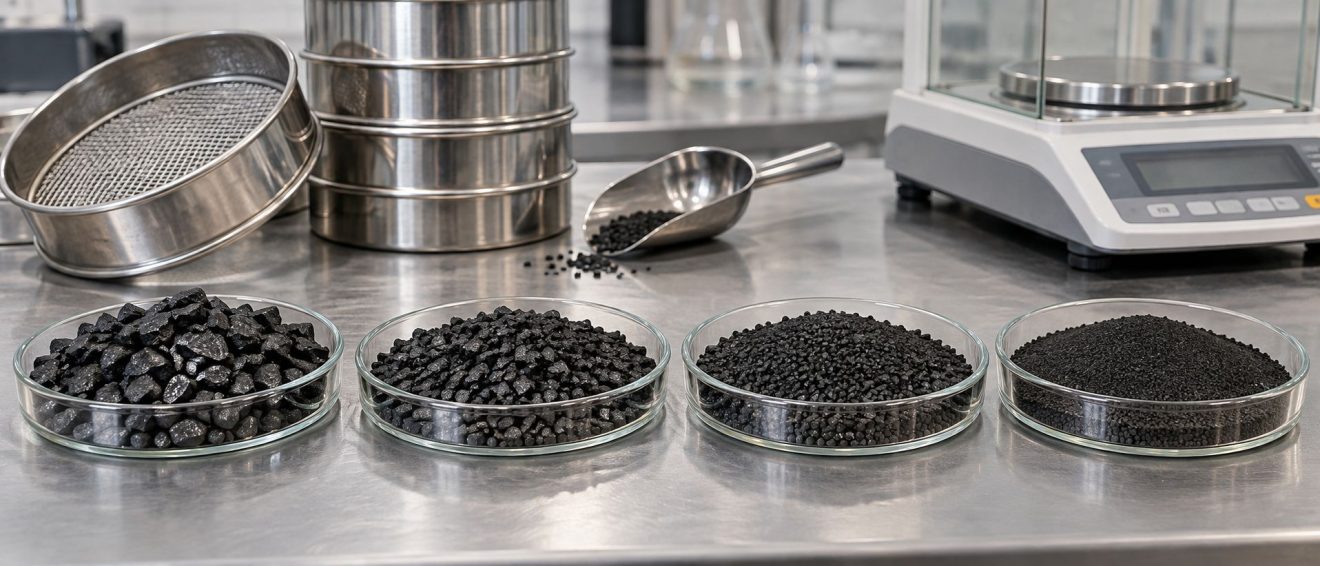
Granular activated carbon is commonly specified as 4×8, 8×16, 12×20 or 20×40 mesh. For an industrial buyer, however, mesh size is more than a number on a data sheet.
Particle size affects mass transfer, pressure drop, bed hydraulics, backwashing behavior and the way carbon performs inside an adsorber or filter vessel. A finer carbon may improve mass-transfer kinetics, but it can also create a higher pressure drop. A coarser carbon can reduce flow resistance, but the longer diffusion path may not be ideal for every process.
There is therefore no universally “best” activated carbon mesh size. The correct choice depends on the contaminant, gas or liquid flow rate, vessel geometry, allowable pressure drop and required contact time.
Quick answer: 4×8 mesh is relatively coarse, 20×40 mesh is considerably finer, and 8×16 and 12×20 fall between them. As particle size decreases, the diffusion path generally becomes shorter, while pressure drop through a packed bed generally increases under otherwise similar operating conditions.
What Does Mesh Size Mean for Activated Carbon?
Mesh refers to the sieve sizes used to classify granular material. An activated carbon grade described as “8×16 mesh” does not contain particles that are 8 to 16 mm in diameter.
Instead, the designation refers to particles classified between two sieve openings. Using commonly referenced U.S. standard sieve openings, No. 8 corresponds to approximately 2.36 mm and No. 16 to approximately 1.18 mm. An 8×16 mesh activated carbon therefore represents a nominal particle-size range of roughly 1.18–2.36 mm.
The same principle applies to 4×8, 12×20 and 20×40 mesh grades.
Mesh should still not be treated as a guarantee that every individual carbon particle has exactly the same dimensions. Procurement specifications may also define the allowable percentage of oversize and undersize material and the particle-size distribution test method.
ASTM D2862-16(2022) covers particle-size distribution testing for granular activated carbon. Requirements for woven-wire test sieves are covered separately by ASTM E11-24.
4×8 vs. 8×16 vs. 12×20 vs. 20×40 Mesh Activated Carbon
| Mesh Size | Nominal Particle Range | Relative Size | Main Selection Consideration |
|---|---|---|---|
| 4×8 | Approx. 2.36–4.75 mm | Coarse | Bed resistance, flow rate and mechanical stability |
| 8×16 | Approx. 1.18–2.36 mm | Medium-coarse | Balance between mass transfer and pressure drop |
| 12×20 | Approx. 0.85–1.70 mm | Medium-fine | Mass transfer, filtration behavior and pressure drop |
| 20×40 | Approx. 0.425–0.85 mm | Fine | Fast mass transfer, pressure drop and fines management |
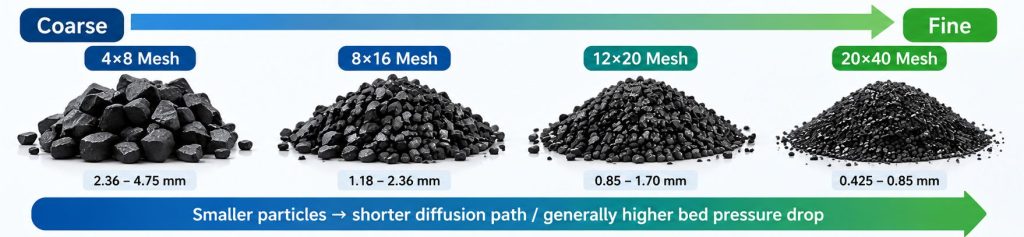
The important point is not to rank these grades from “best” to “worst.” Each represents a different balance between mass-transfer performance and resistance to gas or liquid flow.
4×8 Mesh: Coarser Particles and Lower Flow Resistance
4×8 mesh is a relatively coarse granular activated carbon size. Larger particles generally create a more open packed bed, which can be useful where high flow rates or pressure-drop limitations are important.
The trade-off is a longer diffusion path from the particle surface into the internal pore structure. A coarse carbon should therefore not be selected solely because it produces a lower pressure drop.
8×16 Mesh: A Common General-Purpose GAC Size
8×16 mesh is frequently encountered in fixed beds, filter vessels and industrial adsorption systems.
Its popularity does not mean that 8×16 mesh is automatically the optimum grade. Rather, the size often provides a practical balance between particle strength, mass-transfer distance and bed pressure drop.
For a new adsorber, vessel dimensions, superficial velocity, contact time and allowable pressure drop should still be reviewed before specifying the mesh size.
12×20 Mesh: Finer Particles with Greater Pressure-Drop Considerations
12×20 mesh activated carbon has a smaller nominal particle size than 8×16 mesh. The shorter diffusion distance can support faster mass transfer in some liquid-phase and adsorption duties.
At the same time, smaller particles create narrower flow passages through the packed bed. Pump capacity, blower pressure, bed depth and flow rate therefore become increasingly important.
20×40 Mesh: Finer Does Not Automatically Mean Better
20×40 mesh corresponds to a nominal particle range of approximately 0.425–0.85 mm and is substantially finer than 4×8 or 8×16 mesh.
Fine particles can shorten mass-transfer paths, but they also place greater demands on hydraulic design, pretreatment and bed containment. Suspended solids in water or dust in a gas stream can compound pressure-drop problems when a very fine carbon bed is used.
Particle size should also not be confused with adsorption capacity. Actual capacity depends on pore-size distribution, surface chemistry, iodine number, BET surface area and how well the carbon structure matches the target contaminant.
How Particle Size Affects Mass Transfer and Pressure Drop
A packed activated carbon bed can be viewed as a network of porous particles separated by flow channels. Gas or water moves through the void space between the particles, while contaminants must transfer from the bulk fluid to the carbon surface and then diffuse into the internal pore structure.
Smaller Particles Usually Reduce the Diffusion Distance
When pore structure and other material properties are similar, reducing particle diameter shortens the average distance a contaminant must travel inside the carbon particle. This can improve mass-transfer kinetics.
Smaller Particles Usually Increase Packed-Bed Resistance
The other side of the trade-off is pressure drop. Smaller particles create smaller flow passages in the bed, and pressure drop generally increases when particle size is reduced under otherwise comparable conditions.
ASTM D2862 specifically notes that changes in granular activated carbon particle-size distribution can affect both pressure drop across the bed and adsorption rate.
Particle-Size Distribution Matters Too
Two products can both be sold as 8×16 mesh and still have different distributions of coarse particles, fine particles and dust.
Excess fines, including those generated during transportation and loading, can change the actual hydraulic behavior of a bed. Particle size should therefore be reviewed together with hardness, attrition resistance and handling conditions.
How to Choose Activated Carbon Mesh Size by Application
The most reliable approach is to start with the process conditions and work backward to the carbon specification.
Gas-Phase Fixed Beds
VOC, odor and industrial gas-treatment systems can process large gas volumes. Where blower capacity or pressure drop is limited, an unnecessarily fine carbon may create operating problems.
Useful selection data includes gas flow rate, vessel diameter, bed depth, temperature, humidity, inlet contaminant concentration and maximum allowable pressure drop.
Water-Treatment Adsorbers and Filters
In water treatment, GAC may function as both an adsorbent and a filter medium. Particle size therefore affects not only adsorption kinetics but also filtration, head loss, backwashing, bed expansion and carbon loss.
For municipal or industrial water systems, the filter or adsorber design should be reviewed together with iodine number, pore structure and particle size.
Industrial Wastewater with Suspended Solids
A very fine carbon is not always desirable when the incoming water contains high levels of suspended solids, oil or other material that can foul the bed.
Pretreatment, filtration and bed-cleaning strategy may need to be defined before the final GAC particle size is selected.
Replacing Carbon in an Existing Vessel
For an existing system, the original carbon particle size is an important design reference.
Changing from 8×16 mesh to a much finer 20×40 mesh may alter bed pressure drop, flow distribution and backwashing behavior even if the new carbon has a higher iodine number.
Before changing mesh size, review the current carbon specification, bulk density, hardness, bed depth and operating data.
Why “8×16 Mesh, Iodine 1,000” Is Not a Complete RFQ
A request for quotation that simply states “GAC, 8×16 mesh, iodine number ≥1,000 mg/g” leaves many process variables undefined.
A more useful activated carbon RFQ should normally include:
- gas-phase or liquid-phase application;
- target contaminant and inlet concentration;
- process flow rate;
- operating temperature and humidity, or liquid-phase pH;
- adsorber, filter or vessel dimensions;
- existing carbon particle size and loading quantity;
- maximum allowable pressure drop;
- required outlet concentration or treatment target;
- iodine number, BET, CTC or methylene blue requirements where relevant;
- hardness, ash, moisture and bulk-density requirements;
- TDS, SDS, COA or batch documentation requirements; and
- whether sample or pilot testing is required.
For complex industrial streams, application testing is often more informative than selecting a product only from mesh size and iodine number.
BAC-001: Particle Size as Part of the Overall Carbon Specification
DAQI BAC-001 bamboo-based activated carbon is configured for different gas- and liquid-phase applications rather than supplied as one universal specification.
Published common granular sizes include 4×8, 6×12, 8×16, 12×20 and 16×30 mesh. Particle size is selected together with iodine number, BET surface area, CTC activity, methylene blue adsorption, ash, moisture and mechanical properties.
20×40 mesh is included in this guide because it is a commonly referenced fine GAC size in the wider activated carbon market. Where a project specifically requires 20×40 mesh or another non-standard project size, manufacturing capability, sieve distribution and equipment compatibility should be confirmed before the purchasing specification is finalized.
For a broader explanation of how particle size works with other carbon specifications, see How to Select Bamboo Activated Carbon: Iodine, BET, Ash, Hardness and Particle Size.
You can also review the Bamboo Activated Carbon Guide for information on grades, pore structure, product forms and industrial applications.
Activated Carbon Mesh Size FAQ
What particle size is 8×16 mesh activated carbon?
Using commonly referenced U.S. standard sieve openings, 8×16 mesh corresponds to a nominal particle range of approximately 1.18–2.36 mm. Actual acceptance limits should be confirmed from the supplier’s particle-size distribution specification.
What particle size is 12×20 mesh activated carbon?
12×20 mesh corresponds to approximately 0.85–1.70 mm. It is generally finer than 8×16 mesh, although the nominal particle-size ranges overlap.
Is 20×40 mesh activated carbon better than 8×16 mesh?
Not necessarily. 20×40 mesh is finer and can provide a shorter diffusion path, but it may also create a higher pressure drop. Adsorption capacity depends primarily on pore structure, surface chemistry and the target contaminant rather than particle size alone.
Is finer activated carbon always better?
No. Finer particles can improve mass transfer, but a packed bed must also maintain acceptable pressure drop and hydraulic or gas-flow performance. The optimum mesh size is a system-design decision rather than a simple material ranking.
What information should I provide when selecting GAC particle size?
Provide the target contaminant, inlet concentration, gas or water flow rate, temperature, humidity or pH, vessel size, bed depth, current carbon size, allowable pressure drop and required outlet specification. Existing-system operating data is especially useful when selecting a replacement carbon.
So Which Activated Carbon Mesh Size Should You Choose?
The practical difference between 4×8, 8×16, 12×20 and 20×40 mesh is particle size, and that difference affects both mass transfer and packed-bed flow resistance.
Instead of asking which mesh size is universally best, start with four questions: What contaminant are you removing? What is the process flow rate? How much pressure drop can the system tolerate? How much contact time is available?
Those operating conditions provide a much better basis for selecting GAC particle size than mesh size alone.
Not Sure Which Activated Carbon Mesh Size Fits Your System?
Share your target contaminant, inlet concentration, process flow rate, vessel dimensions, bed depth and allowable pressure drop. Particle size can then be evaluated together with pore structure, iodine number, BET surface area and mechanical properties.