


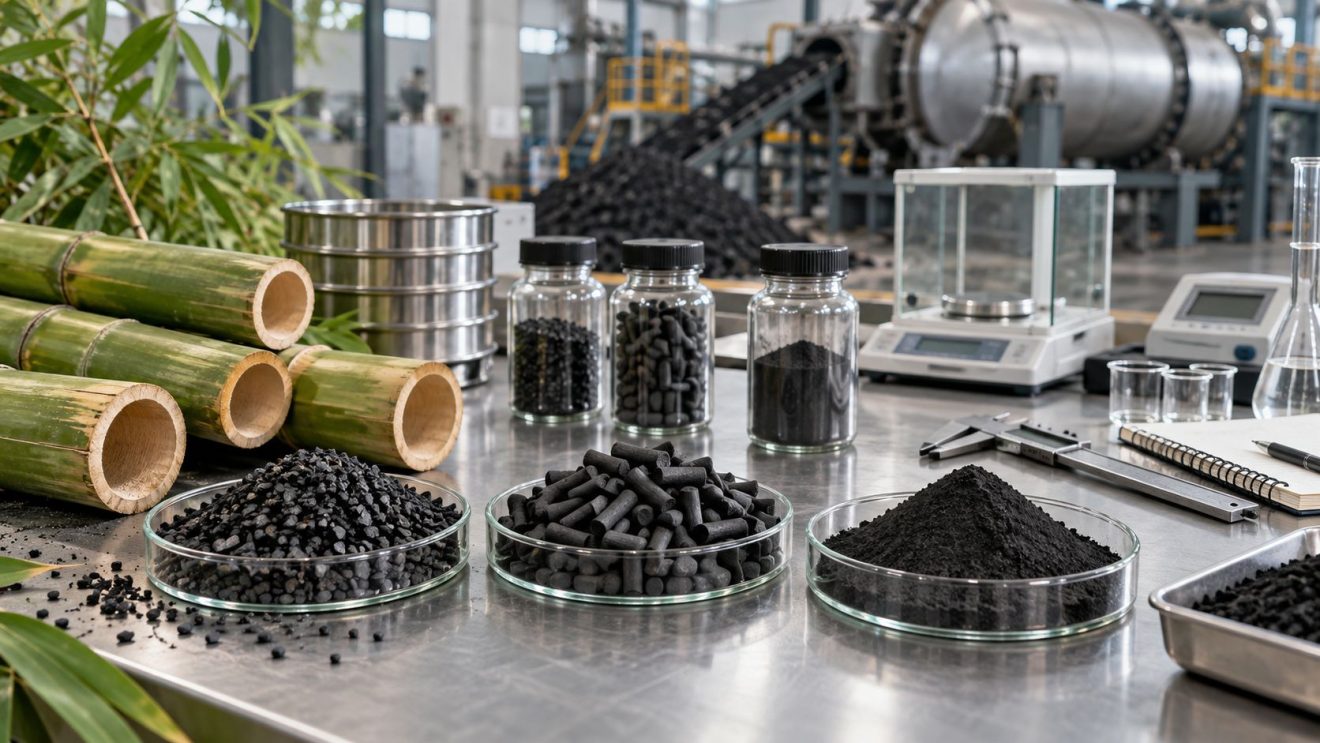
When purchasing bamboo activated carbon, one of the first specifications buyers tend to ask for is the iodine number.
It is an important number, but a specification such as “iodine number ≥1,000 mg/g” is rarely enough to determine whether a carbon will perform well in an industrial system.
Gas purification, VOC adsorption, wastewater polishing, decolorization and fixed-bed filtration can require very different pore structures and physical properties. BET surface area, ash, mechanical strength, particle size, pore-size distribution and application-specific adsorption data therefore need to be considered together.
A better selection process starts with the operating conditions and works backward to the carbon specification.
Start with the Application, Not the Iodine Number
Before comparing activated carbon grades, define the treatment duty as clearly as possible:
- Is the process gas-phase or liquid-phase?
- What contaminant needs to be removed and at what inlet concentration?
- What are the operating temperature, humidity or liquid-phase pH?
- Will the carbon operate in a fixed bed, filter vessel or dosing process?
- Is the priority adsorption capacity, breakthrough time, color removal, pressure drop or service life?
Once these questions are answered, specifications such as iodine value, BET surface area and particle size become much more useful.
What Does Iodine Value Tell You?
Iodine number, normally reported in mg/g, is one of the most widely used specifications for activated carbon. It provides a useful indication of micropore development and adsorption capability for relatively small molecules.
It should not, however, be treated as an overall performance score.
Two carbons can have similar iodine numbers but different pore-size distributions. One may contain a higher proportion of narrow micropores, while another may provide more mesopores and transport pathways. Their performance can therefore diverge substantially when treating complex VOC mixtures, larger organic molecules or contaminants in water.
For procurement purposes, a high iodine value should therefore lead to another question: Are the pores accessible to the contaminant that actually needs to be removed?
How Should BET Surface Area Be Interpreted?
BET surface area measures the internal surface area of a porous material and is an important characterization parameter for activated carbon.
A larger BET value does not automatically translate into higher working adsorption capacity.
If much of that surface area is located in pores that the target molecule cannot efficiently access, the additional surface may contribute little under actual operating conditions.
BET data is therefore more useful when reviewed together with total pore volume, micropore and mesopore distribution, and application-specific adsorption results.
Why Ash Content Matters
Ash represents the inorganic mineral fraction remaining in activated carbon. Feedstock characteristics, activation conditions, washing and downstream processing can all influence the final ash level.
Ash becomes particularly relevant when purity or inorganic carryover matters, including certain water-treatment, food-processing, fine-chemical and high-purity purification applications.
Low ash should nevertheless not be treated as an isolated purchasing target. The appropriate specification depends on the process, and buyers should normally define an acceptable range and verify it through batch-specific COA or test data.
Mechanical Strength Is Critical in Fixed Beds
Strong laboratory adsorption results do not necessarily guarantee stable operation in a full-scale vessel.
Granular and pelletized activated carbon can be subjected to loading stress, gas or water flow, backwashing, handling and, in some systems, repeated regeneration.
Excessive breakage generates fines and can contribute to dust, carbon loss, pressure-drop changes and bed blockage.
For fixed-bed procurement, mechanical strength and abrasion resistance should therefore be evaluated alongside adsorption performance.
Particle Size: The Trade-Off Between Mass Transfer and Pressure Drop
Particle size influences both adsorption kinetics and hydraulic or gas-flow resistance.
Smaller particles shorten internal diffusion distances and can improve mass transfer, but they also tend to increase pressure drop through a packed bed.
Larger particles can reduce flow resistance but may increase diffusion distance and reduce effective utilization under demanding high-flow conditions.
This is why mesh sizes such as 4×8, 6×12, 8×16, 12×20 and 16×30 should be selected against vessel geometry, superficial velocity, allowable pressure drop and required contact time rather than treated as interchangeable grades.
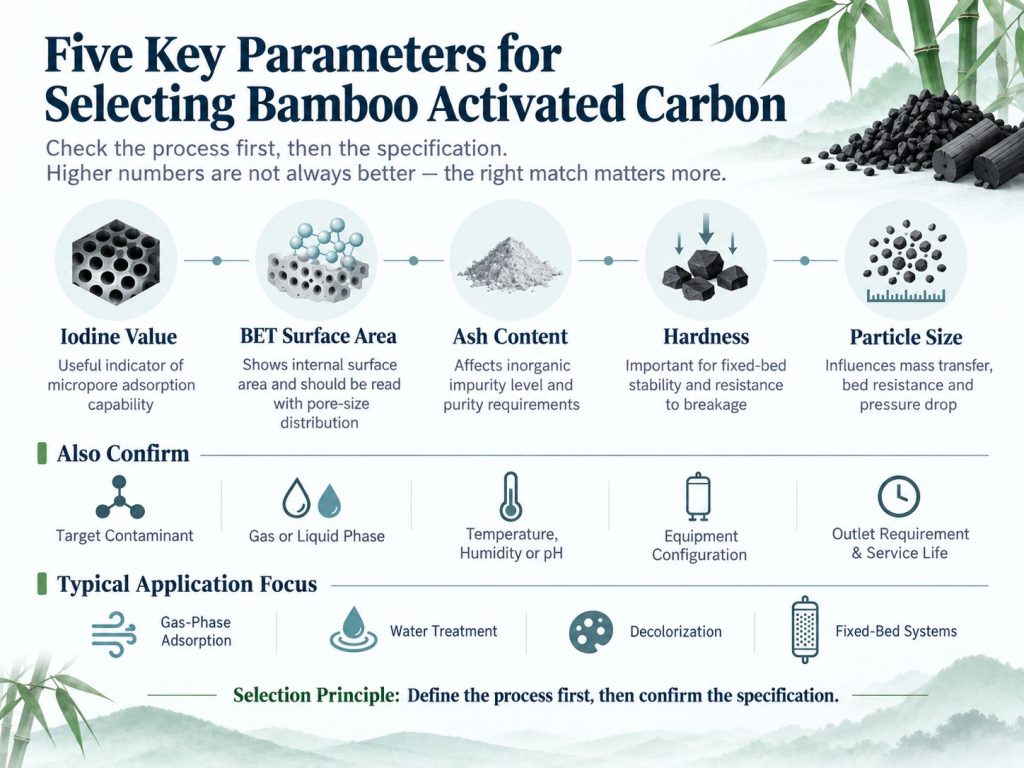
How the Main Specifications Work Together
| Parameter | What It Indicates | What Buyers Should Also Check |
|---|---|---|
| Iodine number | Useful indication of micropore adsorption capacity | Target-contaminant adsorption performance |
| BET surface area | Total measurable internal surface area | Pore-size distribution and accessibility |
| Ash content | Level of inorganic mineral matter | Purity requirements and process sensitivity |
| Hardness / strength | Resistance to breakage during handling and operation | Bed depth, abrasion and regeneration conditions |
| Particle size | Influences mass transfer and pressure drop | Flow velocity, contact time and vessel design |
Depending on the application, buyers may also need moisture, bulk density, pH, CTC activity, methylene blue adsorption, pore volume and detailed pore-size distribution.
For a specific contaminant, breakthrough curves or working adsorption capacity can be more meaningful than any single general-purpose index.
BAC-001 as an Example of a Configurable Bamboo Activated Carbon
BAC-001 bamboo-based activated carbon is designed as a configurable material platform rather than a single fixed specification.
| Published BAC-001 Parameter | Current Range |
|---|---|
| Iodine number | 800–1,300 mg/g |
| BET surface area | 800–1,300 m²/g |
| Ash content | 4–6% |
| Moisture | ≤5% |
| Hardness | ≥90% |
| CTC activity | 40–70% |
| Methylene blue adsorption | 130–250 mg/g |
| Granular sizes | 4×8, 6×12, 8×16, 12×20 and 16×30 mesh, among others |
These figures are better viewed as an available specification window rather than a ranking in which the highest number is automatically the preferred grade.
A gas-phase fixed bed may place greater emphasis on gas adsorption, particle strength and pressure drop. A wastewater or decolorization application may instead require more attention to mesoporosity, methylene blue adsorption and liquid-phase mass transfer.
Bamboo vs. Coal vs. Coconut Shell Activated Carbon
Feedstock influences pore development, ash, physical properties, supply chain and cost, but feedstock alone does not determine which activated carbon is best for a project.
| Feedstock | Typical Procurement Considerations | How It Should Be Evaluated |
|---|---|---|
| Bamboo | Renewable biomass feedstock, tunable pore structure and suitability for further functionalization | Activation process, pore structure and application performance |
| Coal | Mature supply base, broad grade availability and widespread industrial use | Cost, ash, pore structure and actual treatment performance |
| Coconut shell | Often associated with highly developed microporosity and strong granular properties | Especially relevant for small-molecule adsorption and high-purity applications |
The useful procurement question is therefore not “Which feedstock is best?” but “Which pore structure and physical specification best match this contaminant and treatment system?”
For a more detailed feedstock comparison, see Bamboo Activated Carbon: Properties, Uses & Comparison with Coal and Coconut Shell Carbon.
Why Manufacturing Conditions Matter Even When the Feedstock Is the Same
Two activated carbons made from bamboo can still perform very differently.
Carbonization creates the carbon framework, while activation develops and widens the internal pore network. Changes in activation conditions can alter micropore development, mesoporosity, surface area, bulk density, yield and mechanical strength.
Commercial production is therefore not simply about maximizing one specification. It involves balancing pore structure, adsorption capacity and physical durability for the intended application.
For more detail, see How Is Bamboo Activated Carbon Made? Carbonization, Activation and Pore Development.
Where GB/T 48061-2026 Fits into Procurement
China published GB/T 48061-2026, Bamboo-based Activated Carbon, on August 28, 2026. The national standard will take effect on March 1, 2027.
According to China’s National Public Service Platform for Standards Information, the standard is administered by the National Technical Committee on Bamboo and Rattan and is a modified adoption of ISO 5946:2022. Chengdu Daqi Technology Joint Stock Co., Ltd. is listed among the principal drafting organizations.
ISO 5946:2022 provides general requirements and test methods for bamboo-based activated carbon.
For international buyers, these standards provide a useful common technical reference. They do not eliminate the need for application-specific specifications, however.
A product standard helps define how bamboo activated carbon is evaluated. A project specification determines whether a particular grade is suitable for a particular process.
Why Manufacturing and Batch Control Matter
A successful laboratory sample is only the first stage of industrial procurement. Once demand moves into bulk volumes, consistency from batch to batch becomes equally important.
Supplier evaluation should therefore include raw-material control, production control, finished-product testing, batch COA documentation, traceability and the ability to maintain supply.
DAQI Technology’s current manufacturing platform reports a manufacturing site of approximately 65,000 m² and annual supply capacity above 5,000 tonnes, supported by production and finished-product quality control.
Capacity data should not be confused with adsorption performance. Its relevance to procurement is mainly supply continuity, scale-up capability and batch management. Final material selection should still be confirmed through application testing.
What Should Be Included in an RFQ for Bamboo Activated Carbon?
An RFQ containing only “1,000 mg/g iodine activated carbon” leaves too many variables undefined.
A more useful technical RFQ should normally include:
- industry and treatment process;
- gas-phase or liquid-phase service;
- target contaminant and inlet concentration;
- flow rate, temperature, humidity or pH;
- vessel configuration, bed depth and allowable pressure drop;
- required outlet concentration or removal target;
- preferred particle size and loading method;
- regeneration requirements, if any;
- required test standards or test methods;
- documentation requirements such as TDS, SDS, COA and third-party reports.
From Sample Evaluation to Bulk Acceptance
A practical procurement sequence is:
Define operating conditions → shortlist carbon grades → obtain samples → run laboratory or field trials → confirm critical parameters → freeze the technical specification → begin bulk supply → inspect incoming batches against the agreed specification and COA.
This approach is particularly valuable for mixed VOCs, industrial wastewater, decolorization and contaminant-specific adsorption duties, where iodine number or BET surface area alone cannot reliably predict field performance.
The Key Principle for Selecting Bamboo Activated Carbon
Do not start by looking for the activated carbon with the highest specification. Start by defining the contaminant, process and operating conditions that the carbon must handle.
Iodine number provides information about micropore adsorption. BET describes internal surface area. Ash relates to inorganic content. Mechanical strength affects long-term bed stability. Particle size determines the balance between mass transfer and pressure drop.
A robust procurement specification brings these parameters together with pore structure, actual operating conditions, quality control and application-specific testing.
Frequently Asked Questions
Is an iodine number of 1,000 mg/g enough for good bamboo activated carbon?
It can be a useful specification, but it does not determine overall performance. Pore-size distribution, contaminant properties, temperature, humidity and contact time must also be considered.
Does higher BET surface area always mean better adsorption?
No. The target molecule must be able to access the available pore structure. A high surface area located in inaccessible pores may contribute little to working adsorption capacity.
Is smaller activated carbon particle size always better?
Smaller particles can improve mass transfer, but they generally increase packed-bed pressure drop. Particle size should therefore be selected together with flow rate, vessel design and required contact time.
Can GB/T 48061-2026 be used as a purchasing specification?
It provides an important product and testing framework, but a project RFQ should still define application-specific requirements such as particle size, strength, adsorption performance and operating conditions.
Is BAC-001 a single fixed activated carbon grade?
No. BAC-001 is a configurable bamboo-based activated carbon platform covering different iodine numbers, CTC activity, methylene blue adsorption, particle sizes, pore structures and physical forms for gas- and liquid-phase applications.