


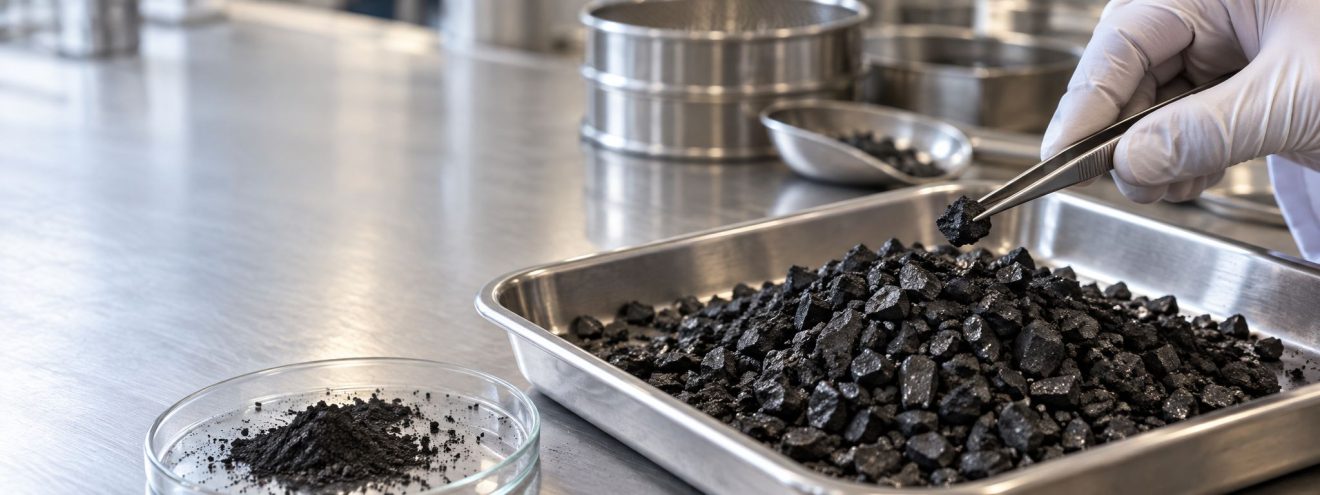
Activated carbon specifications often list hardness, strength or abrasion resistance. These terms describe related but different mechanical properties. For granular activated carbon (GAC), they matter because particles can be stressed during transport, loading, fluid flow, backwashing and replacement.
The key point: a hardness result is useful for comparing materials tested by the same method, but it does not predict service life in a specific adsorber. Buyers should review the test method alongside particle size, fines, pressure-drop limits, bed design and operating conditions.
What Does Activated Carbon Hardness Mean?
Activated carbon hardness is a test-defined measure of how particles withstand mechanical stress such as impact, crushing or rubbing. The exact result depends on the test method and test conditions. A hardness number therefore has limited meaning unless the method, sample grade and reporting basis are also specified.
When reviewing a supplier’s data sheet or certificate of analysis, confirm the standard, test procedure, particle-size range, reporting basis and acceptance limit. Results from different methods should not be treated as directly interchangeable.
Hardness, Crushing Strength and Attrition Resistance
These terms are sometimes used loosely, but they do not describe exactly the same failure mode. A particle may resist compression yet gradually shed fines through repeated friction. A high result in one laboratory test also does not guarantee that the carbon will resist every combination of flow, backwashing and handling in service.
| Term | Main focus | What buyers should check |
|---|---|---|
| Hardness | Mechanical resistance measured under a specified test | Use the method to compare similar grades or lots |
| Crushing strength | Resistance to compressive loading before particles break | Relevant to loading, bed pressure and handling conditions |
| Attrition resistance | Tendency to wear and generate fines through friction | Consider flow, backwashing, abrasion and initial fines |
Why Does Hardness Matter When Buying GAC?
Granular carbon can experience mechanical stress during manufacturing, shipping, transfer, loading and operation. If particles break down, fines may be generated. Depending on the vessel design and operating conditions, those fines can add to filtration or maintenance demands and may affect bed flow or carbon loss.
- Handling and loading: helps assess the risk of breakage during repeated transfers or installation.
- Operation and backwashing: supports evaluation of particle stability when carbon moves or rubs against neighboring particles.
- Bed maintenance: helps identify a potential source of fines, which may affect pressure drop or downstream filtration depending on the system.
- Lot comparison: when the method is consistent, results can be used as one quality-control measure for nominally similar grades.
How Can Attrition Affect a Fixed Bed?
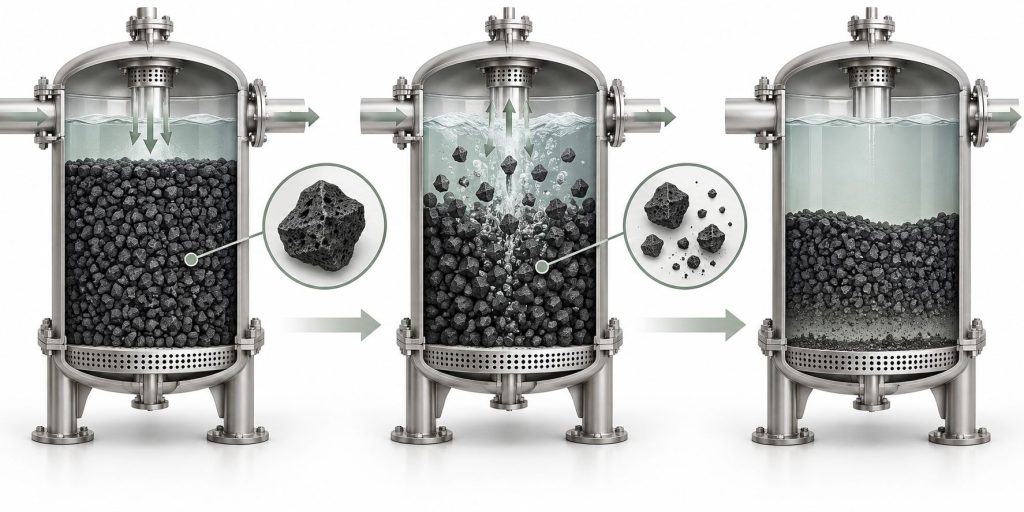
Particles in a fixed bed experience loading, contact with one another and fluid flow. Some systems also include backwashing or periodic carbon replacement. If a portion of the media breaks down, the resulting fines may collect in the bed or be carried downstream. Whether this increases pressure drop or causes carbon loss depends on flow rate, screens, distributors, pretreatment and vessel design.
Hardness alone does not determine pressure drop or service life. Particle size and size distribution matter too. See our granular activated carbon mesh-size guide for more on particle size, bed resistance and equipment fit.
How Is Activated Carbon Hardness Tested?
Common approaches include Ball-pan Hardness testing and separate evaluations of dusting or attrition. ASTM D3802-23 covers determination of the ball-pan hardness number for granular activated carbon. ASTM D5159-21 provides a guide for evaluating dusting attrition. These methods address different aspects of mechanical degradation and their results should not be substituted for one another.
ASTM notes that D3802 does not directly measure in-service resistance to degradation. The test provides a measurable characteristic and can help compare lots that are ostensibly the same grade. ASTM D5159 discusses impact, crushing and attrition as mechanical degradation forces and focuses on dusting attrition. Choose the test based on the project’s acceptance objective.
For coal-based granular activated carbon in China, GB/T 7702.3-2008 is the current standard for determination of hardness. Its stated scope is granular activated carbon from coal. For bamboo-based or other feedstocks, confirm the applicable test method and agreed acceptance criteria instead of assuming that a similar-sounding standard automatically applies.
How Should Buyers Specify Hardness?
A purchase order that says only “high hardness” or “good strength” is difficult to verify. A useful specification should include:
- Carbon type, feedstock category and physical form;
- particle-size grade and limits for oversize, undersize or fines;
- hardness or strength standard, test method and reporting basis;
- whether dusting attrition or initial fines need a separate limit;
- sampling, lot acceptance and test frequency;
- vessel type, flow rate, bed depth, operating temperature and humidity or water conditions;
- backwashing, regeneration, frequent start-stop cycles or long transport, where applicable.
There is no single hardness target that is best for every application. For a fixed bed or a system with repeated backwashing, particle integrity and fines control may deserve more attention. For short-term or one-time dosing, the importance of hardness should be judged against the actual handling and process conditions.
Hardness Is Only One Part of Carbon Selection
Hardness concerns mechanical performance; it does not replace adsorption testing or process matching. It is best reviewed alongside other material properties:
- Iodine number: a test-specific indicator of iodine adsorption characteristics;
- BET surface area and pore structure: information about surface area and pore-related properties;
- Ash content: relevant when inorganic residue matters to the process;
- Particle size and distribution: relevant to mass transfer, bed flow and pressure drop;
- Application testing, breakthrough data or pilot results for the target contaminant.
For a broader selection framework, see our bamboo activated carbon selection guide. Iodine number, BET, ash, hardness and particle size answer different questions; none should be used as a substitute for the others.
BAC-001: Confirm Hardness Against the Grade and Application
DAQI Technology’s BAC-001 bamboo-based activated carbon is available in different particle-size grades and application configurations. Buyers can define the requested hardness or strength together with the target contaminant, vessel type, particle size and adsorption requirements. The available specifications depend on the selected grade, production lot and mutually confirmed purchase requirements; selectable options should not be read as a guarantee that every listed value applies to every grade.
For a project under evaluation, prepare the process medium, target contaminant, inlet concentration, flow rate, bed dimensions, allowable pressure drop and current media data. This helps determine whether sample testing is needed. Learn more about BAC-001 bamboo-based activated carbon and DAQI’s manufacturing and supply capabilities.
Frequently Asked Questions
Is higher activated carbon hardness always better?
Not necessarily. A higher result under the same test method may help compare similar grades, but actual wear also depends on particle size and shape, flow, backwashing and equipment design. Evaluate the result against the applicable method and operating requirements.
Does a hardness number predict activated carbon service life?
No. A laboratory test under specified conditions cannot be converted directly into years of service or a replacement interval for a particular adsorber. If service life is critical, assess the target contaminant, working capacity, breakthrough behavior and actual operating conditions.
Is a hardness requirement enough for a GAC purchase specification?
No. Specify particle size and distribution, fines, adsorption performance, ash, moisture and process conditions as needed. For fixed-bed applications, review mechanical properties together with flow rate and allowable pressure drop.
Conclusion: Use Hardness as Part of a Complete Specification
Activated carbon hardness is a useful mechanical-property indicator, particularly when comparing similar grades or production lots using the same test method. It can help buyers assess breakage and dusting risks, but it is not a direct measure of adsorption performance or service life.
For GAC procurement, define the test and acceptance criteria first, then review particle size, fines, bed pressure drop, target contaminant and operating mode together. For a new or demanding application, sample testing or a pilot evaluation can provide evidence that a laboratory number alone cannot.
Standards and Technical References
- ASTM D3802-23, Standard Test Method for Ball-Pan Hardness of Activated Carbon.
- ASTM D5159-21, Standard Guide for Dusting Attrition of Granular Activated Carbon.
- GB/T 7702.3-2008, test method for hardness of coal-based granular activated carbon; scope is limited to coal-based granular carbon.