


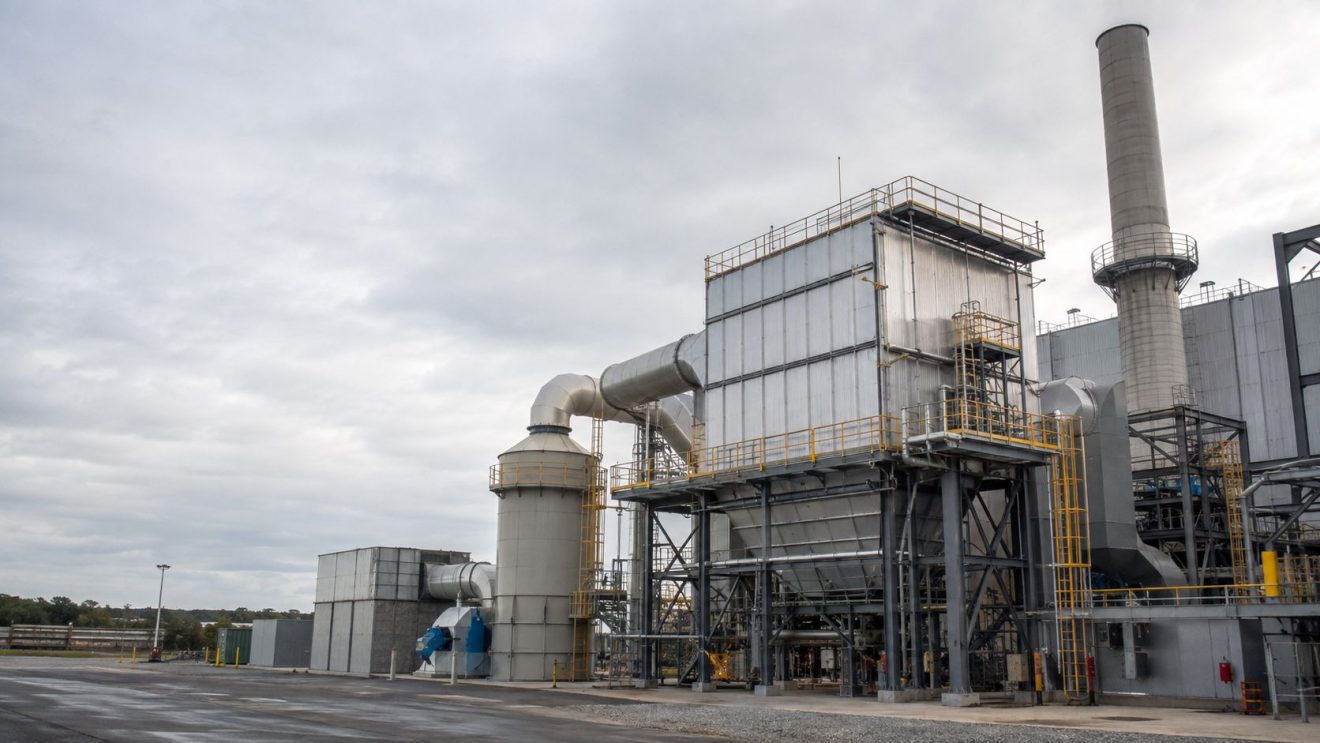
For many industrial boilers, the main SCR design constraint appears after heat recovery rather than inside the furnace. By the time the flue gas reaches the downstream emission-control section, its temperature may already be well below the preferred operating range of a conventional SCR catalyst.
If the SCR reactor is installed at the tail end of the boiler system, substantially reheating the entire gas stream solely for DeNOx can add fuel consumption, equipment and retrofit complexity. Where the actual flue gas conditions are suitable, a low-temperature SCR system can therefore be evaluated to reduce the amount of reheating required.
This does not mean that every low-temperature SCR installation can operate without supplemental heat. Minimum load temperature, flue gas composition and the stable operating window of the selected catalyst still determine whether reheating is required.
Typical Low-Temperature SCR Process for Industrial Boilers
A typical tail-end boiler SCR arrangement can be summarized as:
Boiler flue gas → Particulate removal / necessary gas conditioning → Ammonia injection and mixing → Low-temperature SCR reactor → Stack
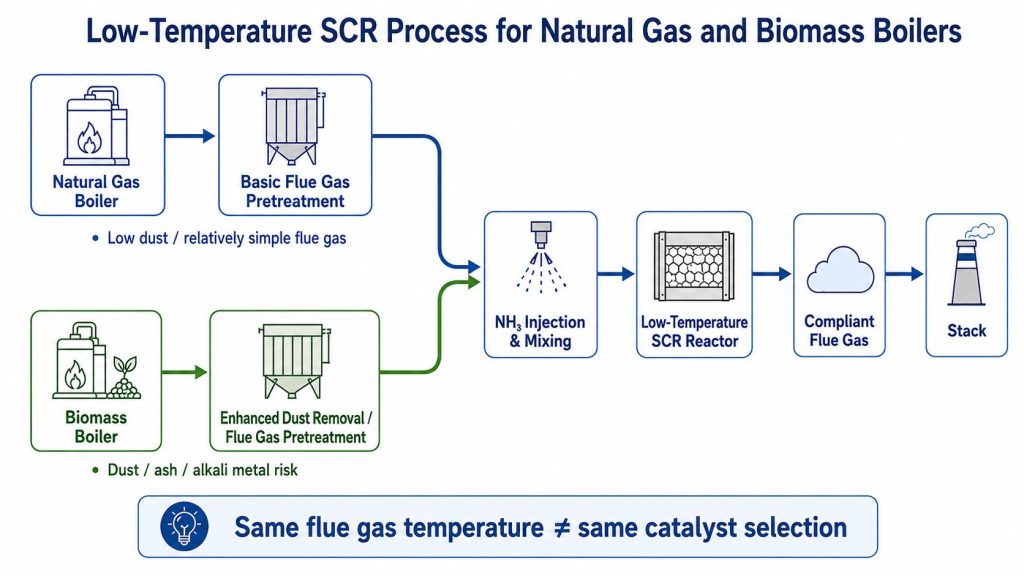
This configuration supports downstream emission control and can be integrated into existing boiler plants using a relatively modular layout. When the available flue gas temperature falls within the effective catalyst window, substantial reheating demand may be reduced while limiting additional thermal impact on the existing boiler system.
For a detailed explanation of NH₃-SCR chemistry and low-temperature catalyst fundamentals, see DAQI Technology’s Low-Temperature SCR DeNOx Technology. This article focuses on boiler applications and catalyst selection.
Natural Gas and Biomass Boilers Should Not Be Treated as the Same Flue Gas
A natural gas boiler and a biomass boiler may both deliver approximately 150°C flue gas to an SCR reactor. That does not mean they require the same catalyst or upstream treatment strategy.
| Selection Factor | Natural Gas Boiler | Biomass Boiler |
|---|---|---|
| Particulate loading | Generally relatively low | Ash and fine particulate loading require greater attention |
| SO₂ | Typically low with conventional pipeline-quality natural gas | Can vary with biomass type and composition |
| Flue gas composition | Generally more consistent | More dependent on fuel source, ash and moisture |
| Alkali metals | Normally not a primary catalyst-selection issue | K, Na and other ash constituents may be important |
| SCR focus | Low-temperature activity, NOx control and load variation | Activity plus fouling, poisoning resistance and long-term stability |
These are general engineering characteristics rather than universal rules. Final boiler SCR design should always be based on measured flue gas data and actual fuel information.
Catalyst Selection for Natural Gas Boiler SCR
Because natural gas is a gaseous fuel, particulate and sulfur loading are generally lower than in many solid-fuel applications. As a result, a natural gas boiler SCR project is often driven primarily by NOx reduction requirements, available flue gas temperature and boiler operating profile.
The first step is to establish the normal, minimum and maximum SCR inlet temperatures rather than relying on one nominal design value. Inlet NOx, oxygen concentration, flue gas flow, required outlet NOx and boiler turndown should then be evaluated together.
Load variation is particularly important for boilers that operate below design capacity for extended periods. Lower load can reduce exhaust temperature, affecting NOx conversion and ammonia slip. A catalyst that performs well at full load therefore still needs to be assessed against minimum-load operation.
Why Biomass Boiler SCR Requires More Flue Gas Conditioning
Biomass boiler DeNOx presents a different catalyst environment. Wood chips, bark, agricultural residues, bamboo residues and other biomass fuels can differ considerably in moisture, ash and inorganic composition. Changes in fuel supply can therefore change the conditions entering the SCR reactor even when the boiler itself remains unchanged.
Particulate Loading and Catalyst Fouling
Higher particulate loading can lead to catalyst surface deposition, channel blockage and increased pressure drop. For a tail-end biomass boiler SCR system, upstream particulate control is therefore closely linked to catalyst life and reactor reliability.
Alkali Metals and Catalyst Deactivation
Some biomass fuels and fly ash contain significant potassium, sodium and other alkali compounds. These species can interact with catalyst acid sites and active components, reducing NH₃ adsorption and SCR activity. Biomass boiler catalyst selection should therefore consider fuel and ash chemistry rather than simply adopting a catalyst used on a natural gas boiler.
SO₂ and Moisture
Sulfur content and moisture can also vary with biomass type and operating conditions. At low SCR temperatures, interactions among SO₂/SO₃, NH₃ and water need to be considered when evaluating catalyst stability and deposit formation.
Where sulfur removal is also required, the relationship between desulfurization and SCR should be evaluated at the process level. See DAQI Technology’s Ultra-Low-Temperature SO₂ and NOx Removal Using Catalytic FGD and SCR for one combined treatment approach.
Why SCR Catalyst Selection Cannot Be Based on Temperature Alone
Two boilers can both deliver 150°C flue gas and still require very different SCR catalysts.
Temperature only describes one part of the catalyst operating environment. It does not describe particulate loading, sulfur compounds, moisture, alkali metals, NOx concentration, space velocity or load variation.
For practical boiler SCR engineering, the relevant match is therefore:
Catalyst × Flue gas composition × Temperature profile × Reactor design × Process control
A laboratory minimum reaction temperature alone is not enough to define long-term suitability for an industrial boiler.
What Data Are Required for Boiler SCR Catalyst Selection?
- Actual and design flue gas flow
- Normal, minimum and maximum SCR inlet temperature
- Inlet NOx concentration
- Required outlet NOx level
- SO₂/SO₃ concentration
- Particulate loading and relevant ash data
- Flue gas moisture
- O₂ concentration
- Fuel type and composition
- Fuel-source variation
- Boiler load range, operating hours and start-stop profile
For biomass boilers, fuel-ash data and information on key inorganic constituents such as potassium and sodium are useful where available. Better operating data allow catalyst volume, gas hourly space velocity, ammonia dosing and reactor configuration to be evaluated more realistically.
DAQI Technology Low-Temperature SCR Materials for Boiler DeNOx
DAQI Technology develops low- and ultra-low-temperature SCR catalytic materials and process solutions for industrial boilers, coking plants, furnaces and other medium- to low-temperature flue gas applications.
DAQI Technology’s current catalyst development platform can be evaluated for low-temperature flue gas conditions of approximately 40–180°C, providing an additional DeNOx option where downstream boiler gas temperatures are difficult to match with conventional SCR operating windows.
The specific catalyst grade and actual operating temperature must be determined from the flue gas composition and project conditions. NOx, SO₂/SO₃, moisture, particulate loading, oxygen, space velocity, ammonia slip and continuous operating conditions should all be considered before final catalyst selection.
For natural gas boilers, the selection process can often place greater emphasis on low-temperature activity, load response and NOx control. For biomass boilers, particulate removal, alkali-metal exposure, sulfur and moisture tolerance, catalyst fouling and poisoning risk require additional attention.
The same low flue gas temperature does not mean the same catalyst should be used. Flue gas composition remains a fundamental part of SCR catalyst selection.
Frequently Asked Questions
Can a boiler with 150°C flue gas use low-temperature SCR directly?
It can be evaluated, but 150°C alone is not enough to make the decision. NOx, SO₂/SO₃, moisture, particulate loading, O₂, flue gas flow, load variation and the required outlet concentration must also be matched with the catalyst and reactor design.
Does low-temperature SCR eliminate flue gas reheating?
Not necessarily. It can reduce substantial reheating where the available flue gas temperature already falls within the stable catalyst operating range. Supplemental heat may still be required during low-load or other low-temperature operating conditions.
Why is particulate removal more important for biomass boiler SCR?
Biomass combustion can generate more complex fly ash and inorganic constituents. Deposits may foul catalyst surfaces, block flow channels and increase pressure drop, while certain alkali metals can contribute to catalyst deactivation. Upstream particulate control and fuel-ash characterization are therefore important parts of biomass boiler SCR design.