


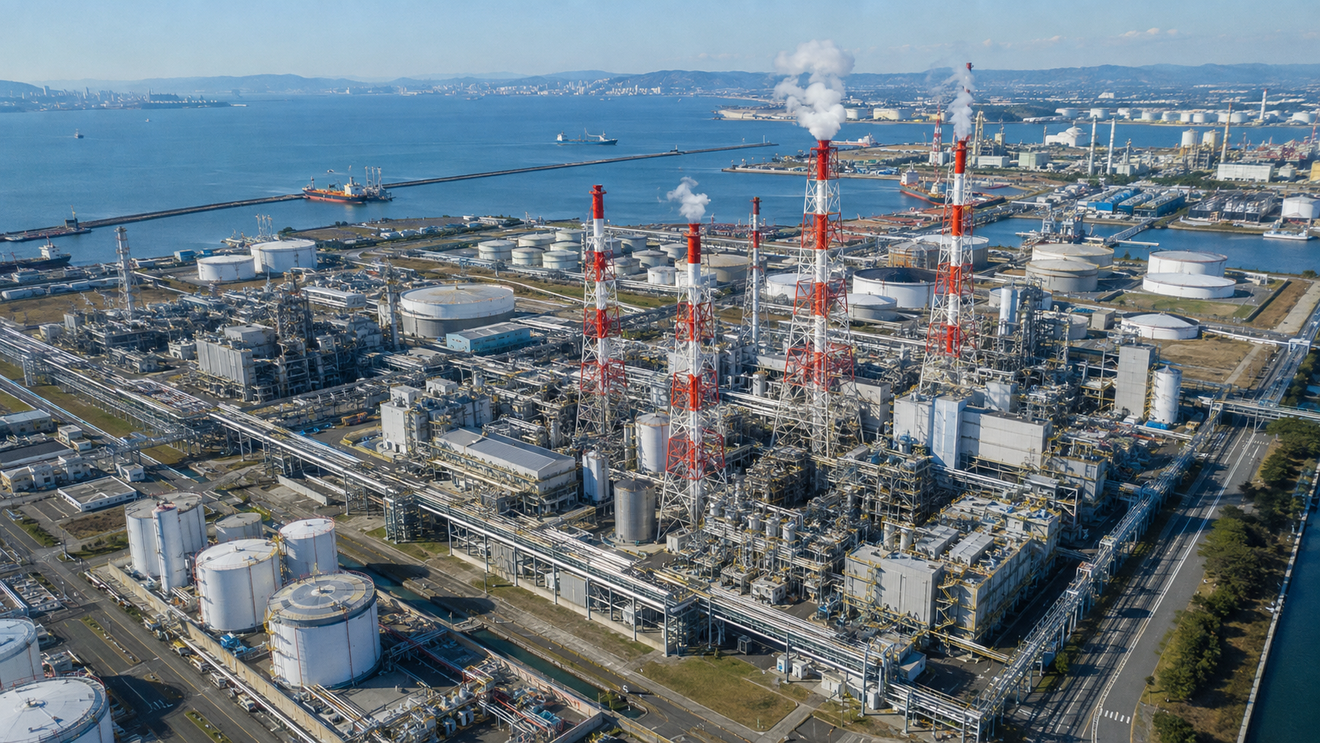
Overview
Catalytic flue gas desulfurization is a carbon-based catalytic technology developed and industrialized by DAQI Technology for the treatment of sulfur dioxide in industrial flue gas.
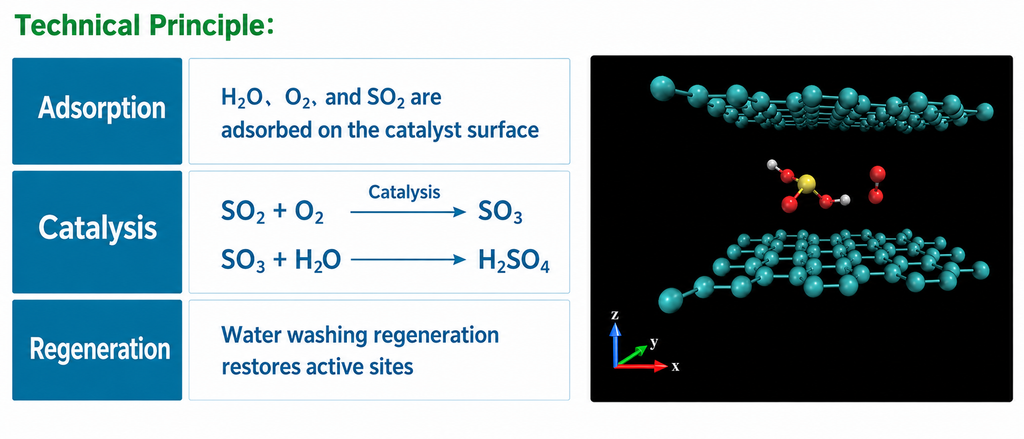
The process uses a carbon-based catalyst to adsorb SO₂, O₂ and H₂O from the gas stream and catalytically convert SO₂ into sulfuric acid at relatively low temperatures, typically around 40–180°C.
As sulfuric acid accumulates inside the catalyst pores, the catalyst is regenerated by water washing. This removes the accumulated sulfuric acid, restores active sites and allows the catalyst to be returned to service.
The technology therefore combines:
SO₂ adsorption → catalytic oxidation → sulfuric acid formation → water-washing regeneration → sulfur recovery
It has been developed for applications including sulfuric acid tail gas, coking, steel, non-ferrous smelting, industrial boilers, furnaces and selected chemical and petrochemical processes.
1. What Is Catalytic Flue Gas Desulfurization?
Catalytic flue gas desulfurization is a low-temperature SO₂ removal process based on a porous carbon catalyst.
Unlike conventional activated carbon systems that primarily rely on physical adsorption, the catalyst provides both adsorption capacity and catalytic active sites.
When flue gas passes through the catalyst bed, SO₂, oxygen and water vapor are first concentrated on the internal surface of the porous material. The adsorbed SO₂ is then oxidized and ultimately converted into sulfuric acid.
Once the catalyst reaches a defined sulfuric acid loading, it is washed with water to remove the reaction product and restore the catalytic sites.
The regenerated catalyst can then be reused in the next operating cycle.
This combination of adsorption, catalytic conversion and regeneration is one of the main differences between catalytic FGD and conventional adsorption-based sulfur removal.
2. How Does Catalytic SO₂ Removal Work?
2.1 Adsorption of SO₂, O₂ and H₂O
Carbon-based catalysts contain a developed pore network with a large internal surface area.
As the flue gas enters the catalyst bed, SO₂, O₂ and H₂O are adsorbed on the internal pore surface:
SO₂(g) → SO₂*
O₂(g) → O₂*
H₂O(g) → H₂O*
where “*” represents an adsorbed species.
The carbon material does more than provide physical adsorption space. Its pore structure, surface functional groups, heteroatom sites and defect structures can influence adsorption, oxygen activation and the subsequent oxidation of SO₂.
2.2 Catalytic Oxidation of SO₂
DAQI Technology’s research on carbon-based catalytic materials has focused on factors including carbon vacancies, nitrogen doping, surface functional groups and confinement effects inside micropores.
Computational simulation and experimental research indicate that carbon defects and confined pore environments can provide active regions for SO₂ adsorption and oxidation.
A simplified reaction pathway can be expressed as:
SO₂* + O* → SO₃*
followed by:
SO₃* + H₂O* → H₂SO₄*
The sulfuric acid formed during the reaction remains temporarily inside the catalyst pore structure until regeneration.
2.3 Role of Nitrogen Doping and Surface Functional Groups
Catalytic desulfurization performance depends not only on surface area, but also on the chemical structure of the catalyst surface.
Nitrogen doping can modify the electronic structure of neighboring carbon atoms, improving oxygen adsorption and activation at selected catalytic sites.
Oxygen-containing functional groups, including hydroxyl groups, can also participate in surface electron-transfer processes and facilitate the oxidation of adsorbed SO₂.
The overall performance of a carbon-based desulfurization catalyst is therefore influenced by several factors:
- pore size distribution;
- effective surface area;
- SO₂ adsorption capacity;
- oxygen adsorption and activation;
- carbon defect structures;
- nitrogen-containing active sites;
- oxygen-containing surface functional groups;
- internal mass transfer;
- sulfuric acid formation and desorption.
For this reason, catalyst selection should be based on the actual flue gas conditions rather than a single parameter such as iodine number or BET surface area.
2.4 Water-Washing Regeneration
As the desulfurization reaction continues, sulfuric acid gradually accumulates inside the catalyst pores.
When the catalyst reaches its specified loading level, water washing is used to desorb the sulfuric acid and reopen the catalytic active sites.
The operating cycle can be summarized as:
Catalytic desulfurization → sulfuric acid loading → water washing → active-site recovery → catalyst reuse
The recovered liquid mainly contains dilute sulfuric acid.
Where the plant has suitable recovery or reuse conditions, the sulfuric acid can be returned to an appropriate production process or further concentrated for utilization.
Compared with some conventional carbon processes that require thermal regeneration followed by a separate sulfuric acid production system, water-washing regeneration can simplify the sulfur recovery route.
Technical Principle
3. Typical Operating Conditions and Performance
Catalytic FGD performance should always be evaluated together with the actual gas conditions.
Flue gas temperature, inlet SO₂ concentration, oxygen content, moisture, particulate loading, gas hourly space velocity and other contaminants can all influence system performance.
Typical technical characteristics include:
| Parameter | Typical Value / Characteristic |
|---|---|
| Operating temperature | Approx. 40–180°C |
| Core material | Carbon-based desulfurization catalyst |
| Main reactants | SO₂, O₂ and H₂O |
| SO₂ removal efficiency | Typically ≥95% under suitable operating conditions |
| Deep SO₂ control | Outlet concentrations below 20 mg/m³ can be targeted for suitable projects |
| Sulfuric acid mist control | Can be integrated into the system; selected projects may target <5 mg/m³ |
| Catalyst regeneration | Water washing |
| Main recovered product | Dilute sulfuric acid |
| Catalyst use | Regenerated and reused |
| Typical industries | Sulfuric acid, non-ferrous metals, coking, steel, boilers, furnaces, petrochemical and chemical plants |
Note: The values above represent typical technical and engineering ranges rather than guaranteed values for every application. Final design parameters should be determined from actual flue gas composition, flow rate, temperature, inlet SO₂ concentration and required outlet limits.
For industrial users, the more important question is not the highest removal efficiency achieved under one test condition, but whether the system can maintain the required outlet concentration under their actual operating conditions.
4. Catalytic FGD vs Conventional Flue Gas Desulfurization
Industrial SO₂ treatment technologies are generally divided into wet, semi-dry and dry processes.
Each route has its own advantages and operating limits. There is no single desulfurization technology that is optimal for every flue gas condition.
Wet FGD
Typical wet processes include limestone-gypsum FGD, ammonia-based desulfurization, dual-alkali systems and magnesium oxide processes.
Wet FGD is widely used and can provide high SO₂ removal efficiency, particularly for large gas volumes.
Depending on the process, however, it may require continuous absorbent consumption and can involve slurry handling, wastewater treatment or solid by-product management.
Semi-Dry FGD
Common semi-dry technologies include spray drying and circulating fluidized bed desulfurization.
These systems can provide a relatively compact process and competitive operating costs for selected applications.
Their performance, however, depends strongly on sorbent quality, stoichiometric ratio, temperature, humidity and process control.
Conventional Dry and Activated Carbon Processes
Traditional activated carbon processes can adsorb and concentrate SO₂ and may also allow sulfur recovery.
Some processes, however, require thermal regeneration to release adsorbed SO₂, followed by additional downstream sulfuric acid production steps.
This can make the overall process relatively long.
Catalytic FGD
The main difference with catalytic FGD is that SO₂ is not simply stored inside the adsorbent.
It is catalytically converted into sulfuric acid inside the carbon catalyst.
The process therefore integrates:
Adsorption → Catalysis → Conversion → Regeneration → Recovery
within a relatively compact treatment route.
5. Key Advantages of Catalytic Flue Gas Desulfurization
5.1 High SO₂ Removal at Relatively Low Temperature
The technology is designed to operate at approximately 40–180°C, depending on the application.
Under suitable gas conditions and system design, SO₂ removal efficiency can typically reach 95% or higher, with deeper outlet control possible for specific projects.
This makes the process suitable for a range of low- and medium-temperature industrial flue gases.
5.2 Compact Process Configuration
SO₂ adsorption and catalytic conversion occur within the catalyst bed.
Compared with processes requiring multiple absorption stages, large slurry circulation systems or thermal regeneration followed by separate sulfur recovery, catalytic FGD can reduce the number of intermediate process steps.
For selected applications, the main desulfurization reaction can be completed within one principal reaction tower.
5.3 Regenerable Catalyst
The catalyst is not intended to function as a continuously consumed alkaline reagent.
After sulfuric acid accumulates inside the pores, the catalyst can be regenerated by water washing and returned to operation.
As a result, routine operating consumption is mainly associated with electricity, water, equipment operation, maintenance and normal catalyst loss rather than large-volume continuous consumption of limestone or alkaline chemicals.
5.4 Reduced Secondary Waste Generation
Catalytic FGD does not depend on the continuous reaction of limestone or similar alkaline sorbents with SO₂ to produce large quantities of solid sulfate or sulfite residues.
Instead, SO₂ is converted into sulfuric acid.
The acid recovered during catalyst regeneration can be reused where the plant has suitable process conditions.
This shifts the treatment approach from simple pollutant transfer toward conversion and resource recovery.
5.5 Sulfur Recovery Potential
SO₂ in industrial flue gas represents a recoverable sulfur-containing stream.
Catalytic FGD uses O₂ and H₂O already present in the gas system to convert SO₂ into H₂SO₄.
The sulfuric acid is then removed from the catalyst during regeneration.
This can be particularly attractive for sulfuric acid plants and non-ferrous metallurgical operations where sulfuric acid can be reused or integrated into an existing production system.
6. Where Can Catalytic FGD Be Used?
The technology is particularly relevant to industrial processes requiring low-temperature SO₂ control, deep emission reduction and potential sulfur recovery.
Sulfuric Acid Tail Gas
Sulfuric acid plants often require deep control of residual SO₂ in tail gas.
Because these facilities already have sulfuric acid production or handling infrastructure, recovered sulfuric acid may be more easily integrated back into the plant.
This is one of the most representative applications of catalytic FGD.
Related industrial applications:
Hubei Shilong Chemical — 300,000 t/y Pyrite-Based Sulfuric Acid Plant
Hubei Fengli Chemical — 220,000 t/y Sulfuric Acid Plant
Longbai Sichuan Titanium — 200,000 t/y Sulfuric Acid Plant
Non-Ferrous Metal Smelting
Copper, lead, zinc and other non-ferrous metallurgical processes can generate SO₂-containing gas streams.
Catalytic desulfurization can be considered for selected low- and medium-concentration tail gas streams after upstream gas treatment.
Final process selection depends on gas composition and operating conditions.
Coking Plants
Coking operations involve boilers, heating furnaces and other combustion-related gas streams.
Catalyst formulation and process configuration can be adjusted according to temperature, SO₂ concentration and emission limits.
Iron and Steel
Sintering, pelletizing and industrial furnace operations may require SO₂ control together with other pollutant treatment.
Catalytic FGD can be evaluated as part of an integrated flue gas purification system.
Industrial Boilers and Furnaces
For boilers and industrial furnaces with gas temperatures within the applicable catalytic range, the technology can provide an alternative to conventional wet or semi-dry desulfurization.
Petrochemical and Chemical Processes
Selected chemical and petrochemical tail gases containing SO₂ may also be suitable for catalytic treatment.
Feasibility should be evaluated based on temperature, moisture, gas composition and co-existing contaminants.
7. From Carbon-Based Catalysts to Bamboo-Derived Catalytic Materials
One of the key technical foundations of catalytic FGD is the ability to control the pore structure and surface chemistry of carbon materials.
As DAQI Technology has expanded its research into bamboo-based carbon materials, renewable bamboo and bamboo processing residues have increasingly become part of the company’s carbon-material development route.
Through carbonization, activation, pore structure control and functional modification, bamboo-derived carbon can be engineered with specific pore distributions and surface active sites.
Depending on the target application, additional catalytic components can then be introduced or developed on the carbon surface.
The objective is not simply to replace conventional carbon with ordinary “bamboo charcoal.”
The more important goal is to develop functional carbon materials from renewable feedstocks while maintaining the adsorption, catalytic activity, mechanical properties and process stability required for industrial purification.
This creates a broader material and technology chain:
Renewable bamboo resources → bamboo-derived carbon materials → functional catalytic materials → flue gas purification systems → industrial applications
This direction also supports the gradual reduction of dependence on fossil-derived carbon materials.
8. Technology Development and Industrial Validation
Catalytic flue gas desulfurization developed by DAQI Technology has progressed beyond laboratory-scale research.
The technology has undergone long-term work in catalyst development, reaction mechanism research, engineering scale-up and industrial application.
Research associated with “R&D and Application of Novel Catalytic Flue Gas Desulfurization Technology” received a First Prize of the Sichuan Science and Technology Progress Award in 2015.
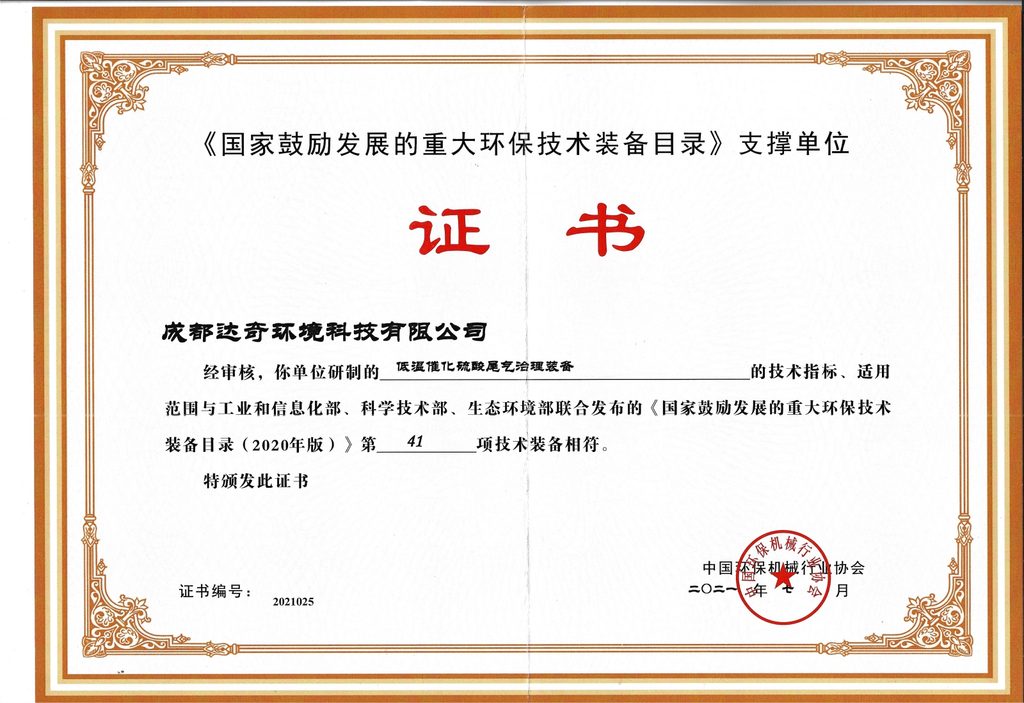
DAQI’s low-temperature catalytic sulfuric acid tail-gas treatment equipment has also appeared in national environmental technology and equipment promotion materials.
In 2024, Novel Catalytic Flue Gas Desulfurization Equipment from Chengdu DAQI Technology Co., Ltd. was included in the Recommended Catalogue of Advanced and Applicable Green and Low-Carbon Technologies and Equipment for the Industrial Sector in Sichuan Province (2024 Edition).
The catalogue describes key technical features including:
- operation at approximately 40–180°C;
- carbon-based catalytic materials;
- conversion of SO₂ into sulfuric acid using O₂ and H₂O in the flue gas;
- catalyst regeneration through washing;
- development of carbon catalysts from bamboo and bamboo-processing residues;
- application potential in steel, non-ferrous metals, petrochemical, chemical and building-material industries.
Note: The 2024 catalogue recorded an operating range of approximately 40–150°C. Following subsequent catalyst and process optimization, the current applicable range has been extended to approximately 40–180°C.
These research and industrialization activities provide a technical basis for continued optimization of catalyst formulation, reactor design, regeneration and industrial operating performance.
9. Current R&D Directions
Industrial flue gas conditions vary significantly from one plant to another.
A single catalyst formulation or operating parameter cannot simply be copied across every project.
DAQI Technology is continuing development in several areas.
Application-Specific Catalysts
Catalyst pore structure, surface chemistry, mechanical strength and active components are being optimized for different SO₂ concentrations, temperatures, moisture levels, dust loads and co-existing contaminants.
Lower-Carbon Catalyst Materials
Renewable bamboo and bamboo processing residues are being further developed as feedstocks for carbon-based catalytic materials, with the aim of reducing dependence on conventional fossil-derived carbon sources.
Reactor and Regeneration Optimization
Research continues on gas-solid mass transfer, pressure drop, catalyst loading, reactor configuration, washing regeneration and sulfuric acid recovery.
Intelligent Process Control
Operating data such as inlet SO₂ concentration, temperature, pressure drop and outlet emissions can be used to improve catalyst condition monitoring and regeneration scheduling.
Multi-Pollutant Treatment
Based on existing catalytic desulfurization research, further work is being carried out on catalyst and process combinations for the coordinated treatment of sulfur oxides, nitrogen oxides and other industrial flue gas pollutants.
10. Frequently Asked Questions
What is catalytic flue gas desulfurization?
Catalytic flue gas desulfurization is a process that uses a carbon-based catalyst to adsorb SO₂ and catalytically convert it into sulfuric acid at relatively low temperatures. Once sulfuric acid accumulates inside the catalyst, water washing is used to regenerate the catalyst for reuse.
What temperature does catalytic FGD operate at?
The typical operating range is approximately 40–180°C. The final acceptable temperature window depends on inlet SO₂ concentration, moisture, oxygen content, gas flow rate and other contaminants.
What SO₂ removal efficiency can catalytic FGD achieve?
Under suitable operating conditions and system design, SO₂ removal efficiency can typically reach 95% or higher. Deeper outlet concentrations can be targeted by adjusting catalyst loading, gas velocity, bed configuration and other operating parameters.
Why are carbon-based catalysts effective for SO₂ removal?
Carbon-based catalysts combine a porous internal structure with chemically active surface sites. SO₂, O₂ and H₂O are adsorbed inside the pores, where catalytic sites promote the oxidation of SO₂ and its conversion into sulfuric acid.
How is catalytic FGD different from ordinary activated carbon adsorption?
Ordinary activated carbon treatment mainly relies on adsorption.
Catalytic FGD combines adsorption with catalytic oxidation. SO₂ is not only trapped inside the carbon material but is chemically converted into sulfuric acid.
Can the desulfurization catalyst be regenerated?
Yes.
When sulfuric acid accumulates in the catalyst pores, water washing can remove the acid and restore active sites.
The regenerated catalyst can then be returned to service.
What happens to the removed SO₂?
SO₂ is catalytically oxidized and converted into H₂SO₄.
The sulfuric acid remains inside the catalyst until regeneration, when it is washed out as a dilute sulfuric acid solution.
Where suitable process conditions exist, this sulfuric acid can be recovered and reused.
Which industries can use catalytic FGD?
Potential applications include sulfuric acid production, non-ferrous metal smelting, coking, steel production, industrial boilers, industrial furnaces, petrochemical processes and selected chemical plants.
The final suitability of the technology should always be assessed against the actual flue gas conditions.
Can bamboo-derived carbon be used in desulfurization catalysts?
Bamboo-derived carbon can be developed into an adsorption or catalyst-support material after carbonization, activation, pore structure adjustment and functional modification.
The material still needs to be engineered for the required catalytic activity, pore structure, strength and operating conditions rather than being used as untreated bamboo charcoal.
What information is required to evaluate a catalytic FGD project?
For an initial technical assessment, the following information is recommended:
- flue gas flow rate;
- inlet SO₂ concentration;
- required outlet SO₂ concentration;
- flue gas temperature;
- moisture content;
- O₂ concentration;
- particulate concentration;
- sulfuric acid mist concentration;
- other major contaminants;
- annual operating hours.
These parameters are used to evaluate catalyst selection, catalyst loading, reactor configuration and regeneration requirements.
Technical Evaluation for Your Flue Gas
Catalytic flue gas desulfurization should be designed around the actual operating conditions of each plant.
If your project involves SO₂ treatment for sulfuric acid tail gas, coking, non-ferrous smelting, steel production, industrial boilers or furnaces, DAQI Technology can evaluate the application based on your gas composition and emission requirements.
Recommended data for initial evaluation:
Flue gas flow / inlet SO₂ / required outlet SO₂ / temperature / moisture / O₂ / dust / sulfuric acid mist / annual operating hours
Related Product:
Comments