


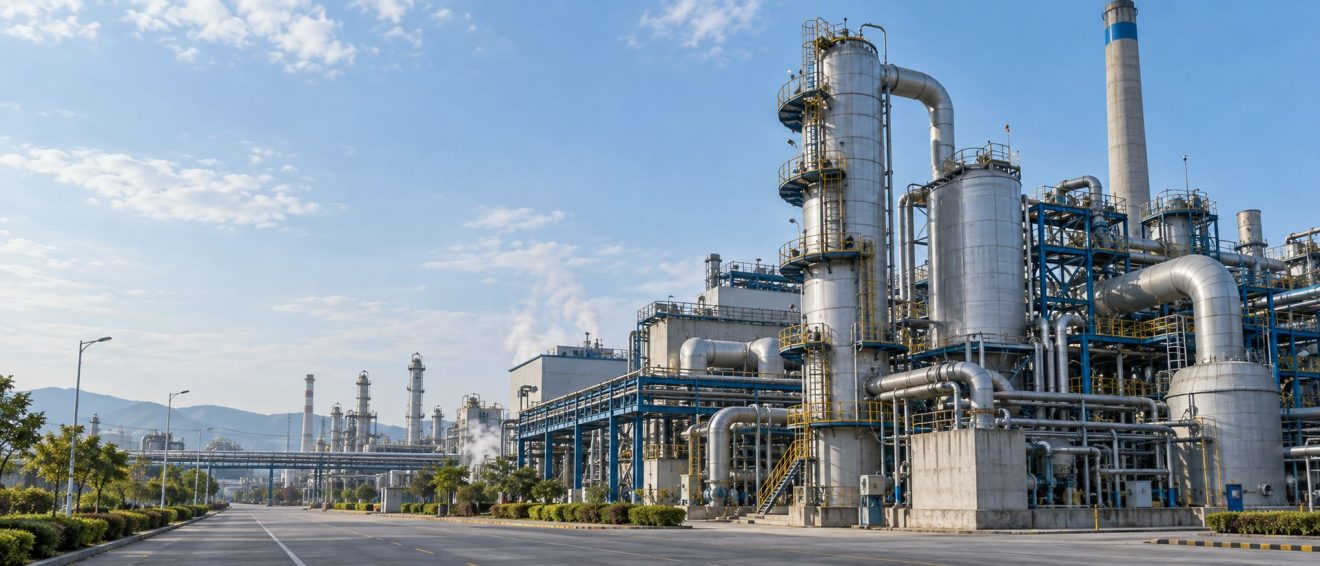
Sulfuric acid production is itself a sulfur-conversion process, but the final tail gas from an acid plant is not automatically free of SO2. Whether the plant is based on elemental sulfur, pyrite or sulfur-bearing metallurgical gas, a certain amount of residual SO2 may remain downstream of the conversion and absorption sections. Sulfuric acid mist may also be present.
For this reason, sulfuric acid plant tail gas desulfurization is not a repetition of the acid-making process. It is a polishing step used to control the remaining sulfur pollutants after the main production process. Sulfuric acid plants also have a particular advantage that many other industries do not: the sulfur removed from the tail gas may potentially be recovered again as sulfuric acid and integrated with the plant’s existing acid system.
Why Does a Sulfuric Acid Plant Still Have SO2 in Its Tail Gas?
In the contact process, SO2 is catalytically oxidized to SO3 before the SO3 is absorbed to produce sulfuric acid. In an industrial converter, however, this reaction should not be treated as an ideal 100% conversion process.
The U.S. EPA’s AP-42 background document for sulfuric acid production notes that SO2 emissions are closely related to sulfur conversion efficiency. Conversion is influenced by factors such as the number of converter stages, catalyst quantity, temperature, pressure and the concentrations of SO2 and oxygen.
Actual acid plants also operate under changing production loads. Gas composition, temperature and catalyst condition may vary over time. As a result, residual SO2 can remain in the gas leaving the conversion and absorption sections, making a downstream SO2 removal system necessary where deeper emission control is required.
SO2 and sulfuric acid mist are recognized as relevant emissions from sulfuric acid production facilities. The U.S. EPA New Source Performance Standards for sulfuric acid plants, for example, specifically address emissions including sulfur dioxide and sulfuric acid mist.
How Is Sulfuric Acid Tail Gas Different from Ordinary Flue Gas Desulfurization?
In a boiler, kiln or other combustion process, the primary purpose of flue gas desulfurization is usually to remove SO2 before discharge. Depending on the process selected, the captured sulfur may leave the system as gypsum, sulfite, sulfate or another by-product.
A sulfuric acid plant presents a different material balance.
The SO2 being removed from the tail gas is itself part of the sulfur stream used to manufacture sulfuric acid. If the residual SO2 can be catalytically converted into sulfuric acid and subsequently washed from the catalyst, the recovered acid may potentially be routed back into a compatible section of the plant’s acid production or acid handling system.
The engineering question therefore becomes more than simply “How do we remove the remaining SO2?” It also becomes “Can the recovered sulfur be returned to the existing acid system?”
This connection between emission control and sulfur recovery is one of the reasons catalytic desulfurization can be particularly relevant to sulfuric acid plants.
Typical Catalytic Desulfurization and Acid Recovery Process
A typical process arrangement for deep SO2 removal from sulfuric acid plant tail gas can be summarized as follows:
Sulfuric acid plant tail gas → Catalytic desulfurization unit → SO2 adsorption and catalytic conversion → Water washing / regeneration → Dilute sulfuric acid recovery → Acid plant or acid handling system
Gas side: Treated gas → Mist control or other polishing stage where required → Stack
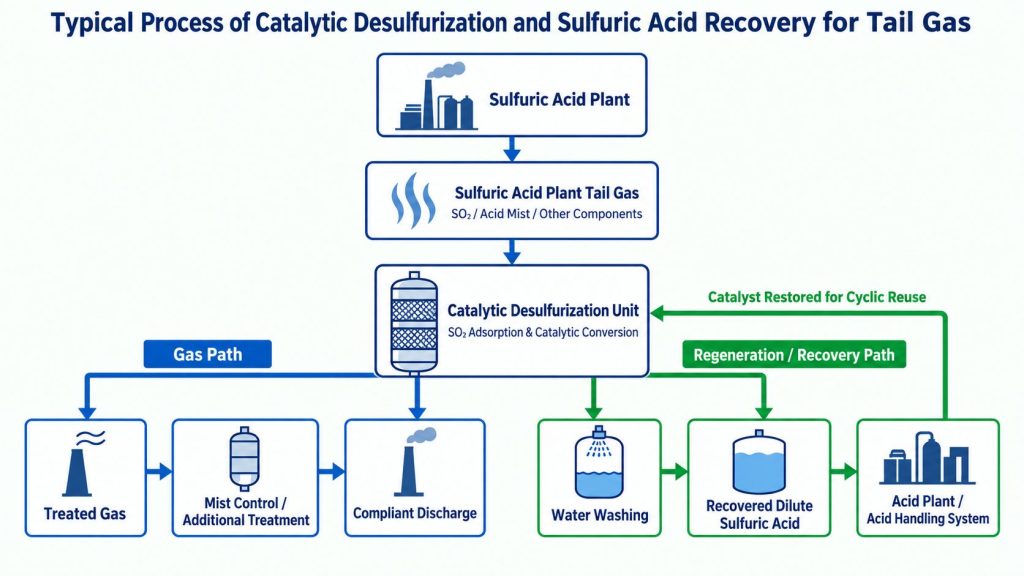
Inside the catalytic desulfurization system, the carbon-based catalyst provides active sites for SO2 removal and catalytic conversion in the presence of oxygen and moisture. Sulfuric acid gradually accumulates within the catalyst pores. Water washing removes the accumulated acid and reopens available active sites so that the catalyst can return to service.
This article focuses on the sulfuric acid plant application rather than the fundamental reaction mechanism. For a detailed explanation of catalyst chemistry, SO2 conversion and regeneration, see DAQI Technology’s technical overview: Catalytic Flue Gas Desulfurization Technology: Low-Temperature SO2 Removal and Sulfur Recovery.
The recovered stream is generally a dilute sulfuric acid solution. It should not be assumed that this acid can always be sent directly into the finished-acid system. Acid concentration, impurity levels, plant water balance and the configuration of the existing acid plant all need to be evaluated before determining the recovery route.
Why Can This Route Fit Certain Sulfuric Acid Plants?
For sulfuric acid plants requiring deeper tail gas SO2 control, the value of catalytic desulfurization is not limited to low-temperature operation. Its main advantage is the potential compatibility between the desulfurization product and the plant’s existing sulfur and acid system.
- Deep SO2 removal. The system can be installed downstream of the main conversion and absorption process to polish residual SO2.
- Potential acid recovery. Sulfur captured from the tail gas is ultimately converted into sulfuric acid, which can be recovered by water washing and potentially reused where plant conditions allow.
- Reduced dependence on additional desulfurization by-products. Compared with processes that continuously consume alkaline reagents and generate additional salt or solid streams, acid recovery may simplify sulfur by-product management in suitable projects.
- Regenerable catalyst operation. Accumulated sulfuric acid can be removed by washing so that the catalyst can be returned to the desulfurization cycle.
- Suitability for certain low- and medium-temperature tail gas conditions. The process can provide an SO2 polishing route without reheating the tail gas to conventional high-temperature sulfur conversion conditions.
This does not mean that catalytic desulfurization is automatically the preferred solution for every sulfuric acid plant. Existing equipment, gas composition, available plot space, water balance, acid recovery infrastructure and lifecycle operating cost all need to be considered during process selection.
Why Sulfuric Acid Mist Must Be Considered Separately
SO2 concentration alone does not fully describe sulfuric acid plant tail gas.
SO2 is a gaseous pollutant, while sulfuric acid mist consists of fine acidic droplets or aerosols. Their formation mechanisms and removal behavior are different. Good SO2 removal therefore does not automatically demonstrate that sulfuric acid mist has also been controlled to the required level.
China has a dedicated national method, GB/T 38685-2020, Determination of Sulphuric Acid Mist in Tail Gas for Sulphuric Acid Industry, specifically for measuring sulfuric acid mist in sulfuric acid industry tail gas.
In practical system design, SO2, acid mist, particulate matter, moisture and temperature should therefore be evaluated together. Mist removal, pretreatment or downstream polishing stages may need to be configured according to the actual gas composition rather than relying on a single SO2 performance value.
What Data Are Required Before Designing a Tail Gas Treatment System?
Catalytic SO2 removal is strongly dependent on actual operating conditions. Before catalyst selection or process design, the following information should normally be established:
- normal, maximum and variable tail gas flow;
- inlet temperature and operating temperature range;
- inlet SO2 concentration and required outlet target;
- sulfuric acid mist concentration and variation;
- gas moisture content;
- oxygen concentration;
- particulate matter and other relevant gas components;
- normal and maximum plant load;
- annual operating hours and continuous operating requirements;
- availability of an existing system for handling, concentrating or reusing recovered dilute sulfuric acid.
For retrofit projects, available pressure, duct arrangement, equipment footprint and tie-in points with the existing acid plant are equally important. In many projects, these site conditions influence the final process configuration as much as the catalyst itself.
DAQI Technology’s Approach to Sulfuric Acid Plant Tail Gas
DAQI Technology develops carbon-based catalytic materials and process solutions for industrial SO2 control. Its current catalytic desulfurization technology can be applied over an industrial gas temperature range of approximately 40–180°C, providing a potential route for deep SO2 removal from certain low- and medium-temperature sulfuric acid plant tail gas streams.
The 40–180°C range represents the current overall application capability of DAQI’s catalytic desulfurization technology rather than a fixed operating window for every installation. Actual operating temperature, space velocity, catalyst configuration, washing cycle and process arrangement must be determined from the specific gas composition, pollutant loading and system design.
DAQI Technology has applied sulfuric acid tail gas treatment systems under different production conditions. Relevant project references include the Hubei Shilong Chemical 300,000 t/y pyrite-based sulfuric acid tail gas treatment project, the Hubei Fengli Chemical 220,000 t/y sulfuric acid plant tail gas desulfurization upgrade, and the Longbai Sichuan Titanium 200,000 t/y sulfuric acid plant tail gas deep desulfurization project.
These projects involve different feedstocks, gas conditions and retrofit requirements. They also illustrate why sulfuric acid plant tail gas treatment should be designed around actual operating conditions rather than a single standardized set of parameters.
Where acid recovery infrastructure is available, the engineering assessment can also consider how dilute sulfuric acid recovered during catalyst regeneration can be integrated with the existing acid system. This allows tail gas treatment to move beyond simple end-of-pipe SO2 removal toward sulfur recovery within the production process.
FAQ
Why is SO2 still present in sulfuric acid plant tail gas?
Industrial conversion of SO2 to SO3 is not an absolute 100% process. Converter configuration, catalyst condition, temperature, pressure, production load and reactant concentrations can all affect conversion, leaving residual SO2 in the tail gas.
Can recovered dilute sulfuric acid be sent directly back to the acid plant?
It depends on the plant. Acid concentration, impurities, water balance and the configuration of the existing sulfuric acid system need to be evaluated. Some installations can integrate the recovered acid into an existing process stream, while others may require additional treatment or concentration.
Does controlling SO2 also solve the sulfuric acid mist problem?
Not necessarily. SO2 and sulfuric acid mist are different pollutants and should be evaluated separately. Tail gas treatment design should consider both parameters, together with particulate matter, moisture, temperature and other relevant operating conditions.