


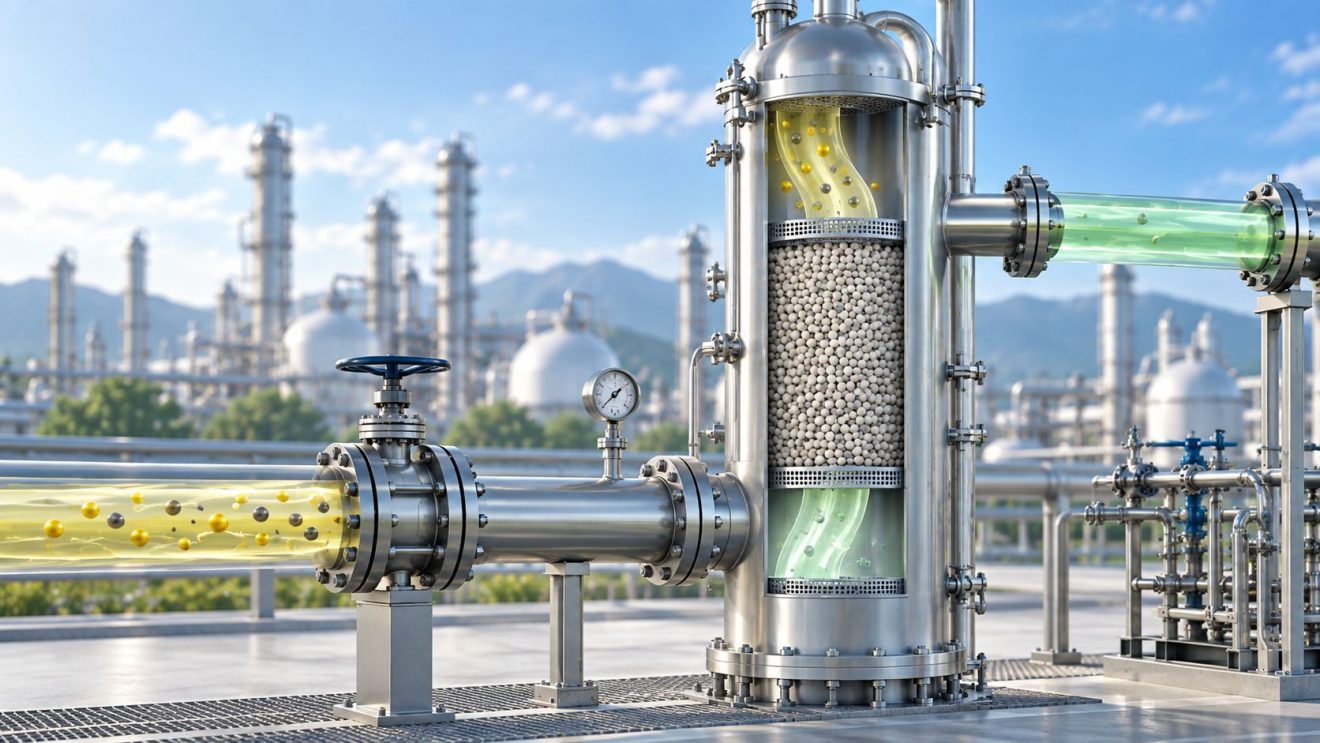
Selecting a natural gas desulfurization catalyst should not start with removal efficiency alone. For a fixed-bed H₂S removal system, the parameters that determine media consumption, bed size and replacement interval are the inlet H₂S concentration, gas flow, sulfur mass load, breakthrough sulfur capacity, GHSV and required outlet specification.
If the process route has not yet been selected, see our earlier guide, How Is H₂S Removed from Natural Gas? Desulfurization Catalysts, Sulfur Capacity and Fixed-Bed Selection. This article starts one step later: once a fixed bed is being considered, how do you determine whether a specific H₂S removal catalyst is suitable for the duty?
Start with sulfur load, not H₂S concentration alone
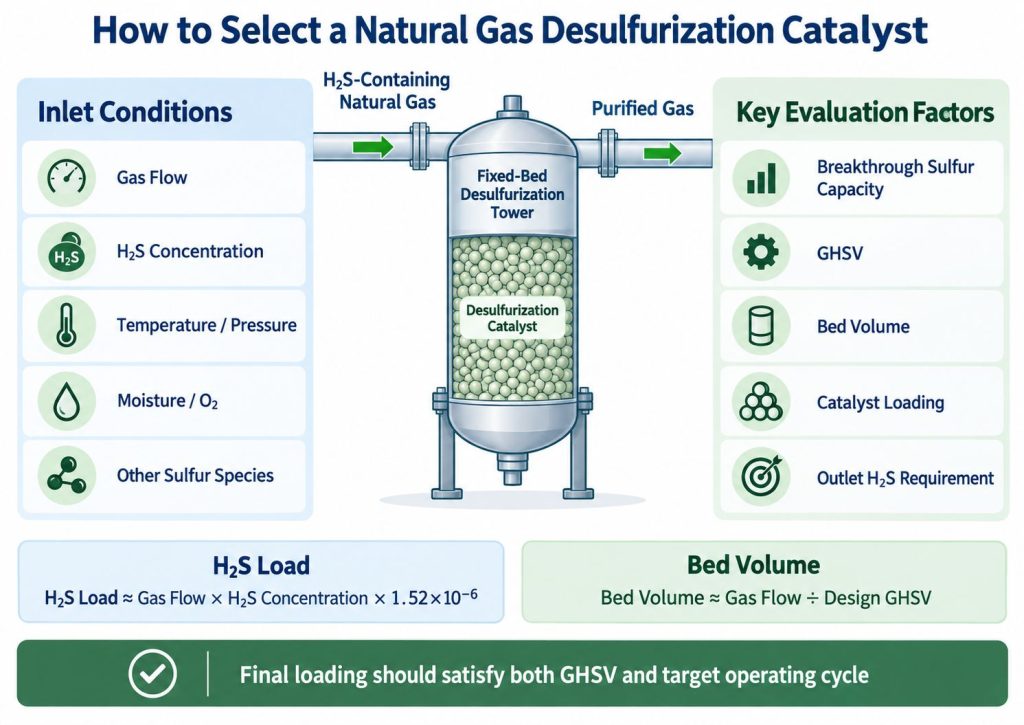
Inlet H₂S concentration is important, but it does not define the desulfurization duty by itself. A 500 ppmv stream at 10,000 Nm³/h can impose a much larger sulfur load than a 2,000 ppmv stream at only 100 Nm³/h.
For preliminary calculations, when gas flow is expressed in Nm³/h and H₂S in ppmv:
H₂S load (kg/h) ≈ Gas flow (Nm³/h) × H₂S (ppmv) × 1.52 × 10⁻⁶
The factor is based on an approximate H₂S density of 1.52 kg/Nm³ at standard conditions. For detailed design, the project must use a consistent definition of normal conditions and verify actual temperature, pressure and gas composition.
This is why an RFQ that provides only “1,000 ppm H₂S” is incomplete. Gas flow, operating hours and the required outlet concentration are needed before media consumption or bed life can be estimated with any confidence.
Breakthrough sulfur capacity matters more than initial removal efficiency
Many fresh H₂S adsorbents or catalytic media can show high initial removal efficiency. The more useful commercial question is:
How much sulfur can the bed retain before the outlet H₂S reaches the specified breakthrough limit?
This is described by breakthrough sulfur capacity. It should always be read together with the test conditions, especially inlet H₂S, GHSV, temperature, moisture and the breakthrough definition. Capacity values obtained under different conditions are not directly comparable.
For example, published data for DAQI HST-1 Bamboo-Based Hydrogen Sulfide Desulfurization Catalyst include:
| Parameter | Published HST-1 Data | Why It Matters |
|---|---|---|
| H₂S removal efficiency | ≥99.5% | Indicates purification performance before breakthrough |
| Breakthrough sulfur capacity at 1,000 h⁻¹ | >700 mg/g | Useful for bed-life evaluation at lower GHSV |
| Breakthrough sulfur capacity at 3,000 h⁻¹ | >300 mg/g | Shows the effect of higher throughput on usable capacity |
| Outlet H₂S | As low as ≤0.01 ppm | Relevant to deep polishing and downstream protection |
The important point is not simply the headline figure of 700 mg/g. The same media shows a lower published breakthrough capacity at 3,000 h⁻¹. This illustrates why sulfur capacity should never be separated from GHSV when comparing natural gas desulfurization media.
GHSV controls both bed volume and media utilization
Gas hourly space velocity is commonly expressed as:
GHSV (h⁻¹) = Gas volumetric flow rate / Catalyst bed volume
On a consistent flow basis, the preliminary bed volume can therefore be estimated as:
Bed volume ≈ Gas flow / Design GHSV
| Gas Flow | Design GHSV | Indicative Bed Volume |
|---|---|---|
| 1,000 Nm³/h | 1,000 h⁻¹ | Approx. 1.0 m³ |
| 1,000 Nm³/h | 2,000 h⁻¹ | Approx. 0.5 m³ |
| 1,000 Nm³/h | 3,000 h⁻¹ | Approx. 0.33 m³ |
These values are for preliminary media sizing only. They are not pressure-vessel dimensions. Actual gas velocity, pressure drop, vessel diameter, distributor design and mechanical requirements must be checked at operating temperature and pressure.
A higher GHSV can reduce vessel size, but it also reduces contact time and may shorten breakthrough time. A lower GHSV can improve utilization of the media, but requires a larger bed and higher capital cost.
The design objective is therefore not simply “the lowest possible GHSV.” It is a balance between media utilization, vessel size, pressure drop, replacement interval and total operating cost.
Fixed-bed sizing requires two separate checks
1. Bed volume based on GHSV
The first calculation determines how much catalyst volume is needed to keep the gas throughput within the selected operating space velocity.
2. Media mass based on sulfur load and target cycle
The second calculation starts with the sulfur mass entering the unit, the desired operating period and the usable breakthrough capacity of the selected media.
Laboratory sulfur capacity should not automatically be treated as 100% usable field capacity. Real installations are affected by concentration swings, gas distribution, mass-transfer-zone length, moisture, competing species, shutdowns and operating safety margins.
The final catalyst loading should satisfy both the hydraulic/GHSV requirement and the sulfur-capacity requirement, followed by checks for bed height, vessel diameter and pressure drop.
Five operating conditions that can change catalyst performance
Temperature
Different H₂S removal media use different reaction mechanisms, so higher temperature should not automatically be assumed to improve performance. The published recommended temperature range for HST-1 is 10–35°C.
Pressure
Natural gas treatment frequently takes place under pressure. Pressure affects actual volumetric flow, superficial gas velocity and vessel design. HST-1 is currently specified for 0.1–10 MPa, while the pressure vessel itself must be engineered separately for the project.
Moisture
Moisture can be important to catalytic H₂S oxidation, but free liquid water entering a packed bed is a different issue. Liquid carryover may affect pressure drop, gas distribution and media condition. Effective gas-liquid separation should therefore be considered upstream of the bed.
Oxygen availability
HST-1 removes H₂S through a catalytic oxidation pathway and its published operating data specify an O₂/H₂S molar ratio of ≥1. In hydrocarbon gas service, however, oxygen must never be added simply to meet a catalyst ratio without a full process and safety review. Gas composition, flammability limits, hazardous-area requirements and the overall process design must be evaluated by qualified engineers.
Other sulfur compounds and contaminants
COS, mercaptans, other organic sulfur compounds, oil mist and particulates can affect actual bed performance. If the project specification is based on total sulfur rather than H₂S alone, the complete sulfur analysis should be provided during catalyst selection.
Fixed bed or bulk sweetening plus polishing?
Fixed-bed systems are compact and operationally simple, and they can be particularly attractive where a very low outlet H₂S concentration is required. They are not necessarily the lowest-cost route for every sulfur load.
| Process Situation | Route to Evaluate |
|---|---|
| Low to moderate sulfur load and decentralized gas source | Fixed-bed H₂S removal |
| Low inlet H₂S but very stringent outlet specification | Fixed-bed polishing |
| Large gas flow and continuously high acid-gas load | Compare regenerative bulk-removal processes such as amine sweetening |
| Existing bulk sweetening unit | Evaluate a downstream polishing bed |
| Highly variable inlet H₂S | Size against peak load and required operating cycle |
The U.S. Environmental Protection Agency lists amine absorption, solid-bed absorbents and physical absorption among the approaches used for natural gas sweetening in its AP-42 Natural Gas Processing guidance. The appropriate process depends on sulfur load and the required duty rather than on one preferred technology for every gas stream.
Where does HST-1 fit?
DAQI HST-1 is a bamboo-based H₂S desulfurization catalyst developed for fixed-bed purification of natural gas, biogas and industrial feed gases. It is primarily relevant where the sulfur load can reasonably be handled by a packed bed and a low H₂S outlet is required.
| Recommended temperature | 10–35°C |
| Pressure range | 0.1–10 MPa |
| GHSV | 500–3,000 h⁻¹ |
| Breakthrough sulfur capacity at 1,000 h⁻¹ | >700 mg/g |
| Breakthrough sulfur capacity at 3,000 h⁻¹ | >300 mg/g |
| H₂S removal efficiency | ≥99.5% |
| Outlet H₂S | As low as ≤0.01 ppm |
| Recommended bed height-to-diameter ratio | ≥3 |
These figures provide a basis for screening the product against a process duty. They should not be treated as an unconditional bed-life guarantee. Actual performance depends on inlet H₂S, flow rate, moisture, oxygen availability, competing compounds and bed design.
What data should be included in a catalyst RFQ?
| Required Data | Why It Matters |
|---|---|
| Gas flow, Nm³/h | Defines throughput, sulfur load and bed volume |
| Inlet H₂S, ppmv or mg/Nm³ | Defines incoming H₂S load |
| Required outlet H₂S | Defines purification target and breakthrough point |
| Temperature | Confirms reaction-condition compatibility |
| Pressure | Required for actual-flow and vessel calculations |
| Moisture or relative humidity | Affects reaction conditions and liquid-water risk |
| O₂ concentration | Determines whether catalytic oxidation conditions are available |
| COS, mercaptans and other sulfur species | Needed when total sulfur must be controlled |
| CO₂, oil mist, dust and other contaminants | Helps identify pretreatment and competing-adsorption risks |
| Target operating cycle | Used to estimate required usable sulfur capacity |
For replacement projects, also provide the existing media type, loading quantity, inlet and outlet H₂S concentrations and actual replacement interval. Field operating history often provides a better basis for comparison than design concentration alone.
Frequently asked questions
Is sulfur capacity the most important specification for a natural gas desulfurization catalyst?
It is one of the most important specifications, but only when the test conditions are known. Inlet H₂S, GHSV, temperature, moisture and the breakthrough definition must be considered before two sulfur-capacity values can be compared.
Is a lower GHSV always better?
No. Lower GHSV generally provides more contact time but requires more catalyst volume and a larger vessel. The optimum value depends on the trade-off between media utilization, capital cost and target bed life.
Can the 700 mg/g HST-1 capacity be used directly to predict bed life?
It can be used as an input to preliminary calculations, but not as a direct field-life guarantee. The published value applies at 1,000 h⁻¹ and actual bed life will also depend on inlet H₂S, moisture, oxygen, competing compounds, gas distribution and the usable fraction of the bed.
Can a fixed bed replace an amine sweetening unit?
Not in every case. Regenerative processes such as amine sweetening are often more appropriate for large, continuous acid-gas loads. Fixed beds are particularly useful for lower sulfur loads, decentralized streams and polishing service where a very low outlet H₂S concentration is required.
Is GB/T 47594-2026 an HST-1 product standard?
No. GB/T 47594-2026, Carbon-based catalytic desulfurization method for sulfur-containing waste gas, is a national method standard for carbon-based catalytic treatment of sulfur-containing waste gas. Chengdu Daqi Technology Joint Stock Co., Ltd. is listed among its main drafting organizations. It reflects the company’s technical participation in carbon-based desulfurization, but it should not be presented as a product certification for HST-1. See DAQI Technology’s GB/T 47594-2026 standard update for details.
Compare cost per unit of sulfur removed, not price per tonne of media
For a natural gas desulfurization project, the lowest catalyst price per tonne is not necessarily the lowest operating cost. A more useful comparison considers usable breakthrough sulfur capacity, catalyst loading, expected replacement interval, shutdown and changeout cost, pressure drop and the required outlet H₂S concentration.
For a new project or replacement of an existing H₂S media, provide DAQI Technology with the gas flow, inlet H₂S, target outlet, temperature, pressure, moisture, oxygen concentration and other sulfur species. These data can be used to evaluate HST-1 catalyst selection, sample testing and preliminary loading requirements.
References and further reading
- Natural Gas H₂S Removal: Desulfurization Catalysts, Sulfur Capacity & Fixed-Bed Selection
- HST-1 Bamboo-Based Hydrogen Sulfide Desulfurization Catalyst
- U.S. EPA — AP-42 Section 5.3, Natural Gas Processing
- CDC/NIOSH — Hydrogen Sulfide Safety Information
- National Public Service Platform for Standards Information — GB/T 47594-2026