


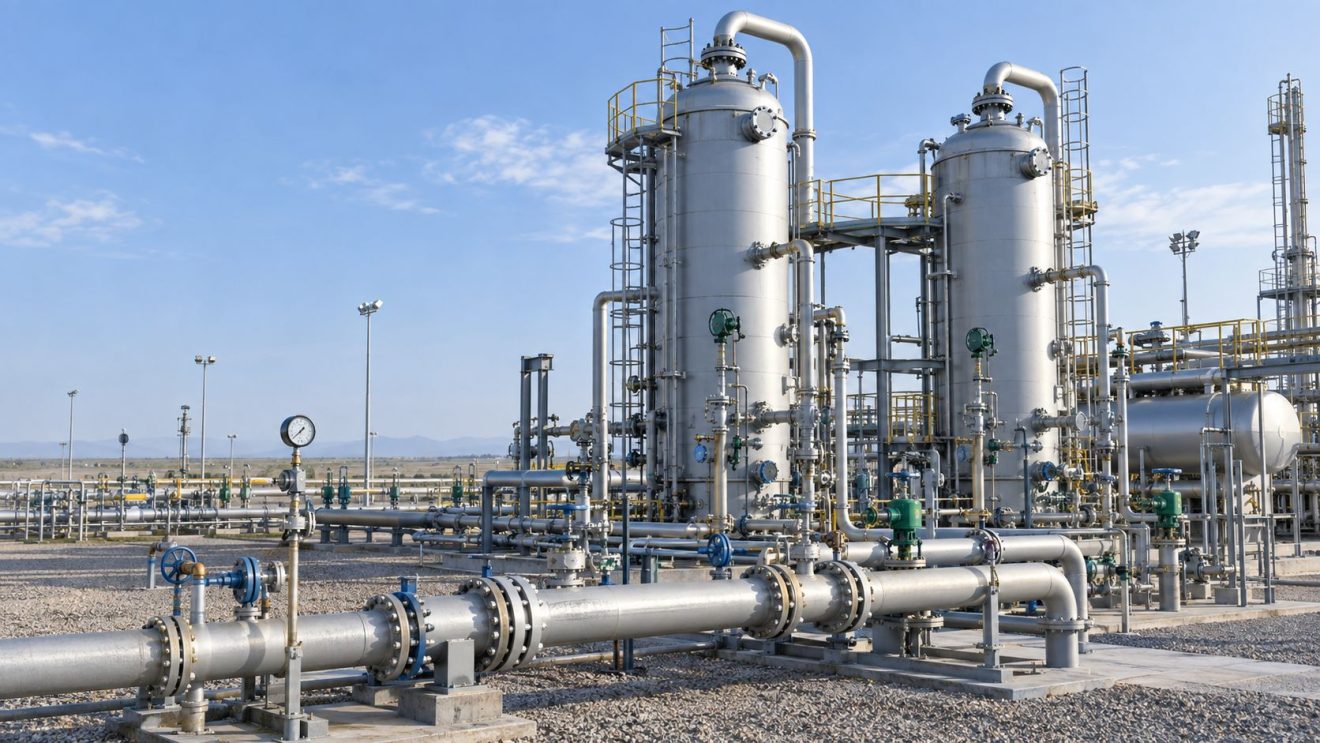
Natural gas H₂S removal should be selected around sulfur load, gas flow and the required outlet specification. Amine sweetening is commonly used where large gas volumes and substantial acid-gas loads must be handled continuously. Fixed-bed media are often a better fit for lower sulfur loads, decentralized gas streams, intermittent operation or polishing duties where very low outlet H₂S is required. For a natural gas desulfurization catalyst, removal efficiency alone is not enough: breakthrough sulfur capacity, outlet H₂S, space velocity, moisture and competing gas components determine how the bed will perform in service.
This article deals with H₂S in natural gas and industrial feed gas rather than SO₂ in combustion flue gas. For post-combustion sulfur dioxide treatment, see DAQI Technology’s catalytic flue gas desulfurization technology.
What Does a Natural Gas H₂S Removal System Actually Need to Achieve?
The first design question is not which adsorbent to buy. It is what the treated gas must meet downstream.
Natural gas may be treated before pipeline delivery, compression, fuel use, liquefaction or use as a chemical feedstock. Each service can impose a different sulfur specification. H₂S can also create corrosion, safety and downstream process problems, while sulfur-sensitive catalysts and other process equipment may require a much tighter outlet limit than a general fuel-gas application.
The sulfur load must therefore be calculated from inlet H₂S concentration, gas flow and operating time. Two plants reporting the same H₂S removal percentage can consume very different amounts of desulfurization media if their sulfur throughput is different.
The US EPA AP-42 Section 5.3 on Natural Gas Processing describes H₂S removal as gas sweetening and identifies amine absorption, solid-bed absorbents and physical absorption among the available approaches. In practical selection, the key distinction is often whether the system must remove a large bulk sulfur load or provide a final deep-desulfurization step.
How Should a Natural Gas Desulfurization Process Be Selected?
No single process should be treated as the default for every sour-gas stream. Gas volume, inlet sulfur concentration, operating pattern, outlet requirement and available plant utilities normally determine which route is more practical.
Amine Sweetening
Amine systems use a circulating solvent to absorb acid gases and then regenerate the solvent for reuse. They are widely applied to continuous, relatively high-throughput natural gas treatment where the incoming H₂S load is too large for frequent replacement of disposable solid media to be economical.
The trade-off is a more complete process system: absorber, regeneration section, circulation equipment and management of the recovered acid-gas stream. Solvent condition, corrosion, foaming and regeneration duty also become part of plant operation.
Solid Desulfurization Media and Fixed Beds
Fixed beds can use iron-based media, activated or modified carbon, catalytic carbon and other reactive sorbents. Sour gas passes through a packed vessel where H₂S is adsorbed, chemically reacted or catalytically converted, depending on the media chemistry.
The equipment is comparatively compact and straightforward to operate. Fixed beds are commonly considered for moderate or low sulfur loads, smaller gas streams, remote installations, intermittent service and polishing stages. Their economics depend heavily on working sulfur capacity, pressure drop and the interval between media change-outs.
Bulk Removal and Polishing Can Be Used Together
Amine treatment and fixed-bed desulfurization are not necessarily competing options. A plant with a high inlet sulfur load may use a bulk acid-gas removal step upstream and a fixed bed downstream to protect a tighter final H₂S specification.
Where the total sulfur load is already low, installing a complete solvent regeneration system may be unnecessary, and a fixed-bed arrangement can be simpler. The comparison should be based on annual sulfur throughput and operating cost rather than vessel count alone.
| Process Route | Typical Fit | Main Design Considerations |
|---|---|---|
| Amine sweetening | Large gas flow, higher acid-gas load, continuous operation | Solvent regeneration, energy demand, corrosion, foaming and acid-gas handling |
| Solid fixed bed | Low to moderate sulfur load, decentralized or intermittent streams, polishing | Breakthrough capacity, pressure drop, bed life and media replacement |
| Bulk removal + fixed-bed polishing | High inlet load with a stringent final H₂S specification | Load split between stages and protection of the polishing bed |
When Does Fixed-Bed H₂S Removal Make Sense?
A fixed bed becomes particularly attractive when the required outlet H₂S is low but the total sulfur load remains manageable. It is also useful where operators want a simple process train without solvent circulation and regeneration equipment.
Typical duties include final gas polishing, protection of downstream catalysts or sensitive equipment, treatment of smaller natural gas streams and industrial feed-gas purification. A duty/standby twin-bed arrangement can be used where continuous gas supply is required during media replacement.
Fixed-bed selection becomes less straightforward as the incoming sulfur load increases. Before specifying vessel size, the designer should estimate how much sulfur enters the system per hour or per day and how much of the media’s measured capacity is realistically usable before the outlet reaches the specified breakthrough limit.
Upstream liquid and particulate control also matters. Free liquid entering a packed bed can interfere with gas distribution and increase pressure-drop problems, while solids or oil contamination can block accessible pore structure or create channeling. Pretreatment should therefore be matched to both the feed gas and the requirements of the selected desulfurization media.
Why Removal Efficiency Is Not Enough to Compare H₂S Desulfurization Media
A removal efficiency value describes inlet-versus-outlet performance at a particular point in a test. It does not tell a buyer how long a bed will maintain the required outlet specification. A useful comparison needs several parameters under clearly defined test conditions.
Breakthrough Sulfur Capacity
Breakthrough sulfur capacity describes the amount of sulfur retained by a given mass of media before the outlet reaches a defined breakthrough concentration. It is commonly expressed in mg/g.
The number should never be compared without its test conditions. Inlet H₂S, gas hourly space velocity, temperature, humidity and the chosen breakthrough endpoint can materially change the reported result. Two suppliers can therefore report different sulfur capacities for similar materials simply because their test protocols are different.
Outlet H₂S and Purification Depth
High sulfur capacity and low outlet H₂S are related but they are not the same property. A media grade may store a substantial amount of sulfur while still being unsuitable for a process that requires an extremely low H₂S slip concentration.
For polishing service, the buyer should specify the required outlet concentration and the point at which the bed is considered spent.
Space Velocity and Gas Contact Time
Gas hourly space velocity (GHSV) relates gas volumetric flow to packed-bed volume. Increasing space velocity reduces gas residence time in the bed and can change both outlet performance and breakthrough behavior.
A sulfur-capacity figure measured at 1000 h⁻¹ should therefore not be assumed to apply unchanged at 3000 h⁻¹. Gas-flow data should also state whether the flow is reported as Nm³/h, standard volume or actual operating volume, particularly for pressurized natural gas systems.
Moisture and Gas Composition
H₂S removal on porous materials depends on more than nominal surface area. Pore accessibility, surface chemistry and active sites all affect adsorption and reaction behavior. The review of H₂S removal using porous materials published in Industrial & Engineering Chemistry Research discusses the role of porosity, surface functionality and moisture in H₂S removal performance.
For a real natural gas stream, CO₂, oxygen, water vapor, organic sulfur compounds, heavy hydrocarbons, oil mist and particulates may also affect media selection. Suppliers should therefore receive a gas composition rather than H₂S concentration alone.
For background on how pore structure develops in bamboo-derived carbon materials, see how bamboo activated carbon is made through carbonization and activation.
Typical Fixed-Bed Process for Deep H₂S Removal from Natural Gas
A practical fixed-bed train is usually simple: sour natural gas passes through the required gas-liquid separation or filtration stage, enters the desulfurization bed, then passes an H₂S monitoring point before being released to the downstream process.
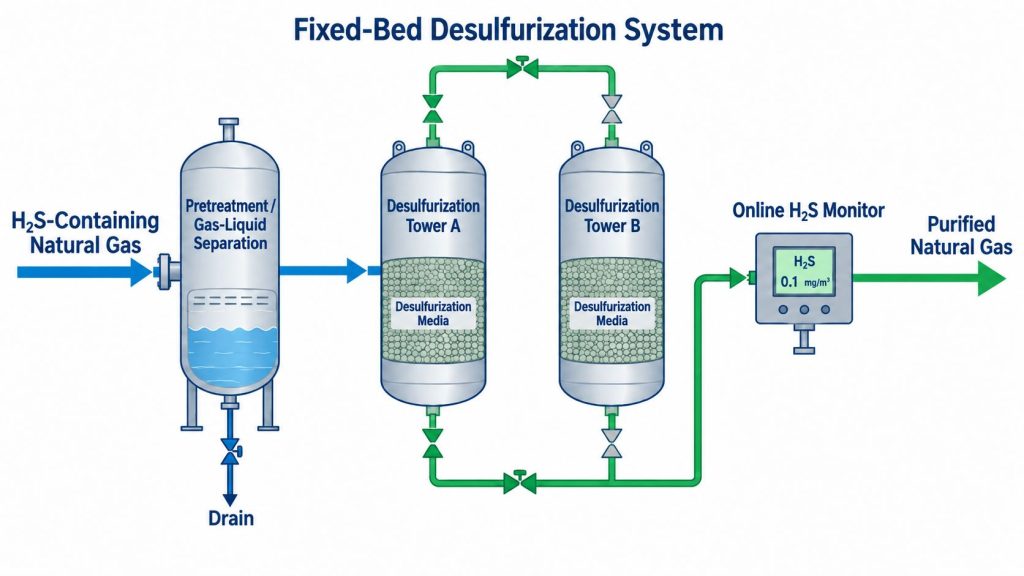
For continuous service, two vessels can be arranged so that one bed remains in operation while the second is on standby or being replaced. Other projects may operate the beds in series, using the second vessel as a polishing or guard bed.
The correct arrangement depends on inlet H₂S, expected breakthrough profile, required outlet concentration, allowable pressure drop and the operating window available for change-out. A twin-vessel layout should not automatically be interpreted as one fixed operating philosophy for every project.
Selecting DAQI HST-1 for Natural Gas Deep Desulfurization
DAQI HST-1 is a bamboo-based H₂S desulfurization catalyst intended for fixed-bed purification of biogas, natural gas and industrial sulfur-containing gas streams. It is primarily relevant where the sulfur load can reasonably be handled by a packed bed and a low outlet H₂S concentration is required.
| Performance Parameter | Confirmed HST-1 Data |
|---|---|
| H₂S removal efficiency | ≥99.5% |
| Breakthrough sulfur capacity | ≥700 mg/g at 1000 h⁻¹ |
| Purification level | Outlet H₂S ≤0.01 ppm |
| Other sulfur compounds | Partial removal of organic sulfur compounds |
These figures should be treated as performance data under defined conditions, not as unconditional guarantees for every gas stream. Actual bed performance depends on inlet H₂S, flow rate, temperature, pressure, humidity, oxygen availability, other sulfur compounds and bed design.
When replacing an existing H₂S adsorbent or catalyst, comparison testing should use the same inlet concentration, space velocity and breakthrough definition whenever possible. This provides a more useful basis for estimating bed life than comparing headline removal percentages.
Product specifications and application information are available on the HST-1 Bamboo-Based Hydrogen Sulfide Desulfurization Catalyst page.
What Operating Data Should Be Provided Before Requesting a Quote?
A useful quotation for natural gas desulfurization should be based on process conditions rather than required media quantity alone. The information below allows the supplier to estimate whether a fixed bed is appropriate and to begin evaluating bed volume, loading and expected operating cycle.
| Operating Data | Why It Matters |
|---|---|
| Inlet H₂S concentration | Defines incoming sulfur load and influences estimated bed life |
| Gas flow rate | Used to determine bed volume, space velocity and vessel sizing |
| Temperature | Confirms whether the media and reaction conditions are suitable |
| Pressure | Required for flow conversion and pressure-vessel/process evaluation |
| Moisture or relative humidity | Can affect adsorption, reaction behavior and bed operation |
| Other sulfur compounds | Shows whether COS, mercaptans or other sulfur species must also be considered |
| Required outlet H₂S | Defines the purification target and breakthrough criterion |
| Continuous or intermittent operation | Affects bed configuration, standby requirements and replacement planning |
Where available, also provide CO₂, O₂, hydrocarbon composition, free-liquid content, oil mist and particulate information. For high-flow or high-H₂S applications, the first step should be to determine whether bulk acid-gas removal is required. For polishing duties, the evaluation should focus more closely on breakthrough sulfur capacity, outlet specification and achievable space velocity.
Available media for sulfur-containing gas streams can also be reviewed through DAQI Technology’s Gas Purification product category before detailed operating conditions are submitted for selection.
ENGLISH TAGS
Natural Gas Desulfurization
H₂S Removal
Gas Purification
Desulfurization Catalyst
Fixed-Bed Desulfurization
IMAGE FILE / ALT RECOMMENDATIONS
Featured image file:
natural-gas-h2s-removal-fixed-bed-desulfurization.jpg
Featured image ALT:
Natural gas H2S removal and fixed-bed desulfurization system
Process diagram file:
natural-gas-h2s-fixed-bed-desulfurization-process-en.png
Process diagram ALT:
Typical fixed-bed H2S removal process for natural gas
Process diagram caption:
Typical fixed-bed H₂S removal train for natural gas. Pretreatment, vessel configuration and bed switching should be determined from the actual gas composition, sulfur load and required outlet H₂S specification.