


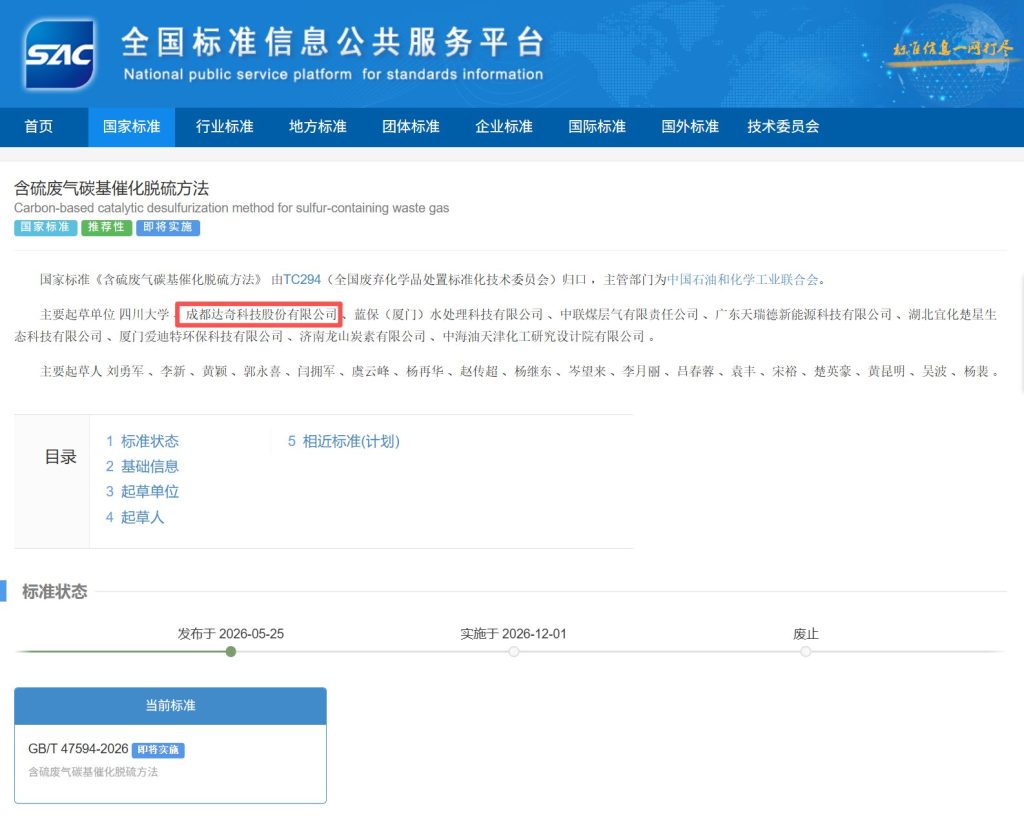
China has officially published GB/T 47594-2026, Carbon-based catalytic desulfurization method for sulfur-containing waste gas. The national standard was released on May 25, 2026 and will take effect on December 1, 2026.
According to China’s National Public Service Platform for Standards Information, the standard is administered by the National Technical Committee on Disposal of Waste Chemicals of Standardization Administration of China (TC294), under the China Petroleum and Chemical Industry Federation.
Sichuan University and Chengdu Daqi Technology Joint Stock Co., Ltd. are listed among the main drafting organizations, together with several engineering, energy, environmental technology and carbon-material companies.
What Does GB/T 47594-2026 Cover?
GB/T 47594-2026 is a method standard for the treatment of sulfur-containing waste gas using carbon-based catalytic desulfurization. It should not be confused with a product specification for a single catalyst or a specific piece of desulfurization equipment.
According to an official report from the College of Carbon Neutrality Future Technology at Sichuan University, the standard establishes common requirements covering the process method, technical requirements, operating control, testing and performance evaluation of carbon-based catalytic desulfurization.
This provides a more consistent technical reference for engineering design, equipment manufacturing, project acceptance and industrial deployment of the technology.
For an environmental technology that has already moved into commercial-scale operation, standardization is an important step. It converts accumulated engineering experience into a technical framework that can be more consistently understood by plant owners, engineering companies, equipment suppliers and technology providers.
More Than 100 Industrial Installations
The carbon-based catalytic desulfurization technology behind this work has already progressed well beyond laboratory development.
Sichuan University reports that technology jointly developed with DAQI Technology has been deployed in more than 100 industrial installations in China and overseas, including more than 100 domestic installations and two overseas projects.
According to the same source, these installations collectively reduce approximately 170,000 tonnes of SO₂ per year and recover approximately 1.05 million tonnes of dilute sulfuric acid annually.
Applications include sulfuric acid production, coking and steel operations, non-ferrous metallurgy and industrial boilers. Sichuan University also reports that the technology has achieved a market share of more than 65% in newly built sulfuric acid projects in China.
The technology was included in China’s National Catalogue of Advanced Pollution Prevention and Control Technologies in 2018, the Catalogue of Major Environmental Protection Technologies and Equipment Encouraged by the State in 2020, and the Ministry of Industry and Information Technology’s “Top 20” Advanced and Applicable Low-Carbon Technologies for the Raw Materials Industry in 2024.
How Carbon-Based Catalytic Desulfurization Works
Carbon-based catalytic desulfurization does more than physically adsorb sulfur dioxide onto activated carbon.
In DAQI Technology’s catalytic flue gas desulfurization process, SO₂, O₂ and H₂O from the flue gas are adsorbed within the porous carbon catalyst. Catalytically active sites promote the oxidation of SO₂ and its subsequent conversion into sulfuric acid.
As sulfuric acid accumulates inside the catalyst pores, the catalyst can be regenerated by water washing. The accumulated acid is removed, catalytic sites are reopened, and the catalyst can be returned to service.
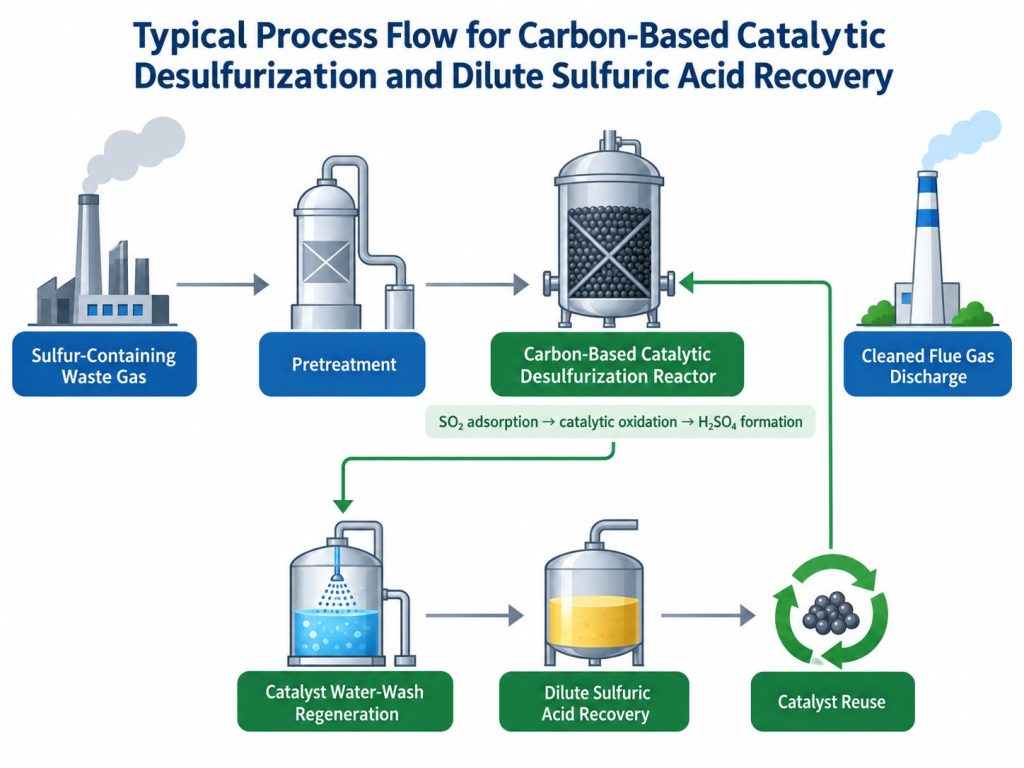
SO₂ adsorption → catalytic oxidation → H₂SO₄ formation → water-washing regeneration → sulfuric acid recovery
This approach allows SO₂ control to be combined with sulfur-resource recovery rather than treating sulfur exclusively as a waste stream.
DAQI Technology’s current catalytic desulfurization platform can be evaluated for industrial flue gas at approximately 40–180°C, depending on gas composition and process conditions. Final design should always consider inlet SO₂, gas flow, oxygen, moisture, particulate loading, sulfuric acid mist, space velocity and the required outlet concentration.
How Does the Standard Relate to Desulfurization Catalysts?
GB/T 47594-2026 is a process-method standard. It is not a product standard for one particular carbon-based catalyst.
The catalyst is a central part of the process because it provides the porous structure and catalytic sites required for SO₂ adsorption and oxidation. Industrial performance, however, also depends on reactor configuration, catalyst loading, gas pretreatment, bed operation, regeneration, sulfuric acid recovery and process monitoring.
DAQI Technology’s S-1-111 Bamboo-Based Activated Carbon Desulfurization Catalyst, for example, is designed for low- to medium-temperature industrial flue gas and can be matched to different SO₂ treatment conditions.
DAQI Technology’s participation in drafting GB/T 47594-2026 therefore reflects its involvement in the broader development, industrial application and standardization of carbon-based catalytic desulfurization technology. It should not be interpreted as a national-standard certification of a single commercial catalyst product.
Industrial Applications
Carbon-based catalytic desulfurization has been applied across several industrial sectors where sulfur-containing gas must be controlled under relatively low- or medium-temperature conditions.
For sulfuric acid plants, catalytic desulfurization can be used as a polishing stage downstream of the main conversion and absorption sections. Because the recovered sulfur is already converted into dilute sulfuric acid, these projects can provide favorable conditions for sulfur-resource recycling. See SO₂ Removal from Sulfuric Acid Plant Tail Gas by Catalytic Desulfurization and Acid Recovery.
For coking and other multi-pollutant flue gas applications, process design must also consider NOx, sulfur loading and the available temperature window for downstream SCR. More information is available in Desulfurization and Low-Temperature SCR DeNOx for Coke Oven Flue Gas and Ultra-Low-Temperature SO₂ and NOx Removal Using Catalytic FGD and SCR.
Because industrial gas conditions vary significantly between plants, carbon-based catalytic desulfurization should not be treated as a fixed equipment package. Catalyst formulation, reactor sizing, regeneration strategy and operating conditions need to be matched to the actual gas stream.
What Does the New Standard Mean for Industrial Deployment?
GB/T 47594-2026 is a recommended national standard and will take effect on December 1, 2026.
For carbon-based catalytic desulfurization, the publication of a national method standard provides a more consistent technical basis for process design, operating control, testing and evaluation. It can also reduce uncertainty when the technology is evaluated for new plants, retrofit projects or applications in different industrial sectors.
For DAQI Technology, participation in the drafting of GB/T 47594-2026 is a continuation of its long-term work in carbon-based catalytic materials, industrial flue gas desulfurization and sulfur-resource recovery.
DAQI Technology will continue developing catalytic materials, low-temperature flue gas treatment processes, catalyst regeneration technologies and industrial sulfur-recovery solutions for different operating conditions.
Frequently Asked Questions
When will GB/T 47594-2026 take effect?
The standard was published on May 25, 2026 and will take effect on December 1, 2026.
Is GB/T 47594-2026 a mandatory national standard?
No. It is classified as a recommended national standard (GB/T) in China’s National Public Service Platform for Standards Information.
Did DAQI Technology participate in drafting the standard?
Yes. Chengdu Daqi Technology Joint Stock Co., Ltd. is officially listed among the main drafting organizations of GB/T 47594-2026.
Is GB/T 47594-2026 a product standard for S-1-111?
No. GB/T 47594-2026 covers the carbon-based catalytic desulfurization method for sulfur-containing waste gas. S-1-111 is a commercial catalytic material developed by DAQI Technology for industrial SO₂ removal and represents one component within a complete catalytic desulfurization system.
Official Sources
National Public Service Platform for Standards Information:
GB/T 47594-2026 — Carbon-based catalytic desulfurization method for sulfur-containing waste gas
College of Carbon Neutrality Future Technology, Sichuan University:
Official report on the publication of GB/T 47594-2026