


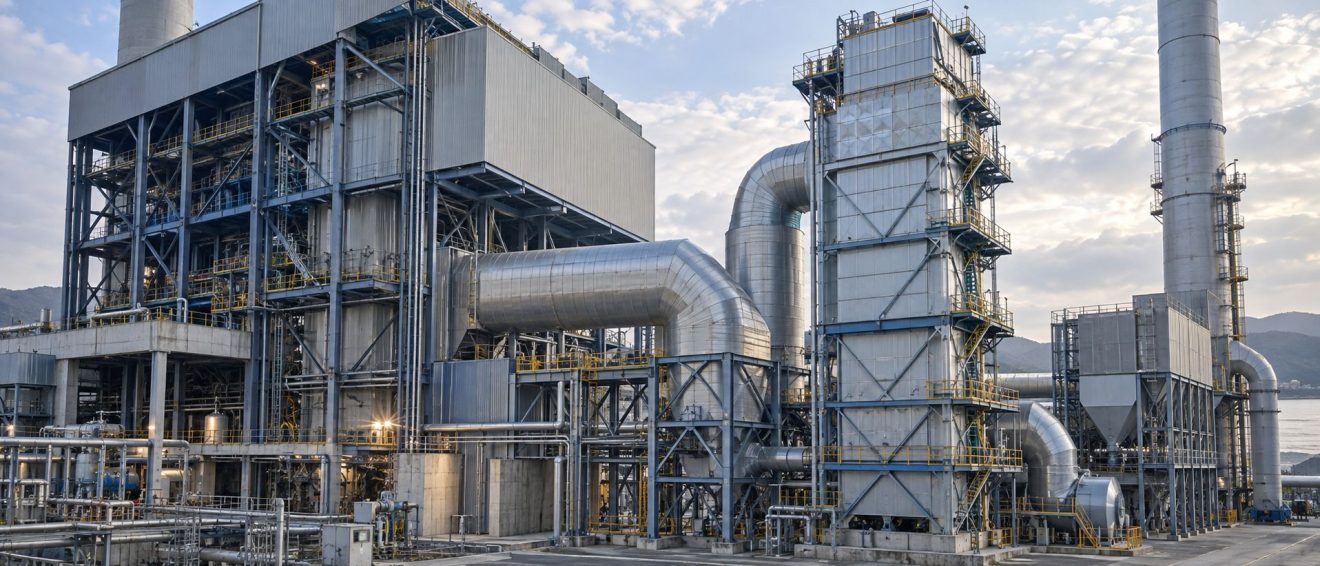
Designing a boiler SCR system starts with a practical question: where can the reactor be installed without compromising boiler operation?
The answer depends on more than NOx concentration. Flue gas temperature, fuel composition, particulate loading, sulfur content and the existing heat-recovery equipment all influence reactor placement and catalyst selection.
For an existing industrial boiler, the design must also account for changing operating loads, available installation space, additional pressure drop and the temperature available at the proposed SCR inlet.
This guide examines the engineering decisions involved in boiler SCR design, from reactor location and catalyst temperature windows to gas conditioning, ammonia injection and retrofit requirements.
What Does a Boiler SCR System Include?
Selective catalytic reduction (SCR) is a post-combustion NOx control process. Ammonia reacts with nitrogen oxides over a catalyst, converting them primarily into nitrogen and water.
In an industrial boiler application, the catalyst is only one part of the system. Effective operation requires several components to work together:
- SCR reactor: Provides the required catalyst volume, gas-flow distribution and access for maintenance.
- Catalyst modules: Selected according to operating temperature, NOx loading, sulfur exposure, particulate concentration and required conversion.
- Ammonia supply and injection system: Delivers the reducing agent at a controlled rate and distributes it across the flue gas stream.
- Mixing and flow-conditioning equipment: Helps maintain suitable velocity, temperature and NH₃/NOx distribution at the catalyst inlet.
- Instrumentation and controls: Coordinates ammonia dosing with boiler load, NOx concentration, gas temperature and other operating parameters.
Depending on the boiler configuration, the installation may also require flue gas reheating, catalyst cleaning equipment, additional ductwork or fan upgrades.
Where Should the SCR Reactor Be Installed?
Reactor location determines the temperature and gas composition the catalyst will encounter throughout its operating life.
Placing the SCR reactor in a hotter section of the boiler exhaust system can provide suitable reaction temperatures without substantial reheating. However, the catalyst may then be exposed to higher particulate loading and fuel-derived contaminants.
Moving the reactor downstream of particulate and sulfur control can provide cleaner flue gas, but the available temperature may be significantly lower.
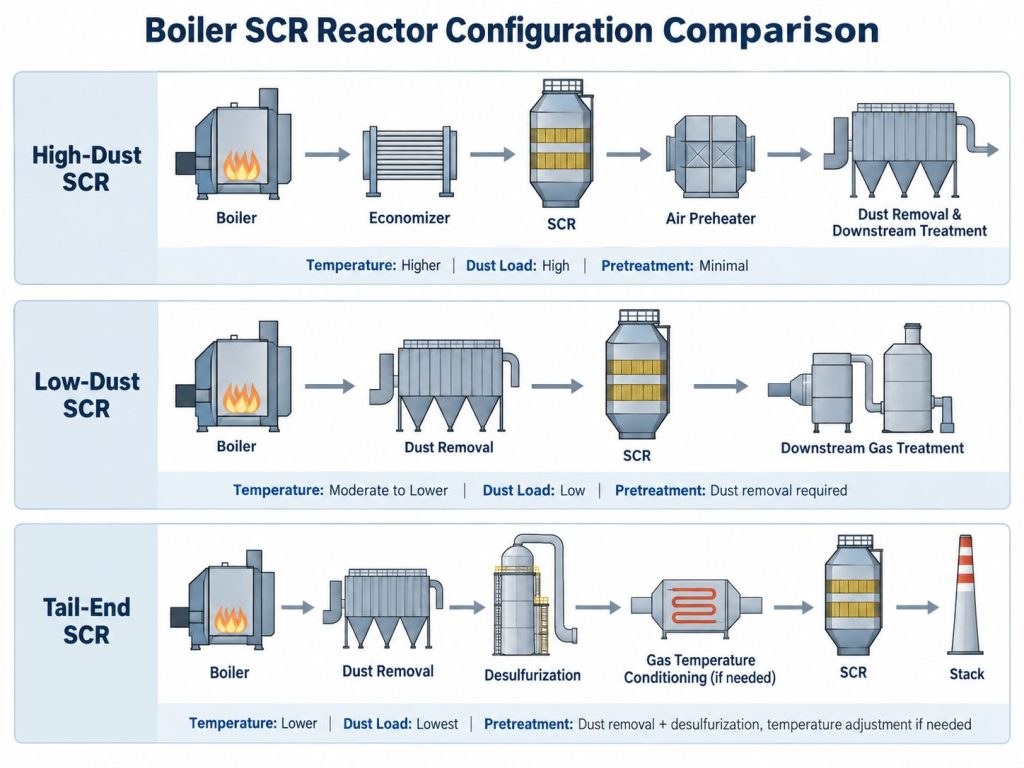
The U.S. Environmental Protection Agency discusses these arrangements in its SCR technical guidance, including high-dust, low-dust and tail-end configurations.
High-Dust SCR: Using Available Boiler Exhaust Heat
In some coal-fired boiler installations, the SCR reactor is positioned downstream of the economizer and upstream of the air preheater.
This location can provide an operating temperature suitable for conventional SCR catalysts. Since the flue gas has not yet passed through the main particulate-control equipment, however, the catalyst must operate under relatively high dust loading.
Fly ash can cause catalyst erosion, deposition and plugging. High-dust reactor design therefore requires particular attention to catalyst channel geometry, gas velocity, ash distribution and cleaning arrangements.
Low-Dust SCR: Reducing Particulate Exposure
A low-dust SCR configuration places the reactor downstream of particulate removal.
Lower particulate loading can reduce the risk of catalyst fouling and erosion. The design challenge is maintaining a suitable catalyst inlet temperature after the upstream treatment equipment.
Low particulate concentration also does not guarantee low sulfur exposure. Residual SO₂ and SO₃ must still be considered when evaluating catalyst performance and downstream deposit formation.
Tail-End SCR: An Option for Existing Boiler Retrofits
Tail-end SCR is generally installed after the main particulate and sulfur-control stages. It can be an attractive layout for existing plants where the upstream flue gas treatment equipment is already in place.
The catalyst receives a cleaner gas stream, but the temperature available after heat recovery and desulfurization may be too low for a conventional SCR catalyst.
In such cases, the project must evaluate flue gas reheating or a catalyst specifically developed for lower-temperature operation.
Low-temperature SCR may reduce the amount of reheating required when the actual tail-end gas conditions fall within the catalyst’s effective operating range. It does not eliminate the need for temperature control in every application.
For a fuel-specific discussion, see Low-Temperature SCR DeNOx for Natural Gas and Biomass Boilers.
How Should the SCR Temperature Window Be Determined?
The temperature used for catalyst selection should be the actual flue gas temperature at the proposed SCR inlet, not the furnace outlet temperature or a nominal boiler design value.
A boiler may operate at several different loads during a normal production cycle. Its exhaust temperature can change with fuel input, heat demand, heat-recovery operation and startup or shutdown conditions.
The SCR design must therefore account for the normal operating temperature, minimum sustained temperature, maximum temperature and the duration of off-design conditions.
Conventional SCR Versus Low-Temperature SCR
Conventional metal-oxide SCR catalysts generally operate at relatively elevated temperatures, with the applicable range depending on catalyst formulation and flue gas composition.
For boilers with a suitable high-temperature exhaust location, a conventional SCR configuration may utilize available heat without substantial additional fuel consumption.
Industrial boilers with extensive heat recovery present a different design challenge. By the time the flue gas reaches the downstream emission-control section, its temperature may be around 100–180°C or lower, depending on the installation.
Installing a conventional SCR catalyst at this location may require reheating a large volume of flue gas.
A dedicated low-temperature SCR catalyst can provide an alternative where the actual gas composition and operating temperature are suitable for catalytic NOx reduction.
DAQI Technology’s current low- and ultra-low-temperature SCR technology platform can be evaluated across an overall DeNOx temperature range of approximately 90–180°C.
This describes the broader technology platform rather than a guaranteed operating range for every catalyst grade or flue gas composition.
Within DAQI’s current catalyst portfolio, N-101 has a recommended operating range of approximately 120–180°C, while N-201 is recommended for approximately 120–240°C. Actual catalyst selection and achievable NOx conversion depend on the complete operating conditions.
Further technical information is available in Low-Temperature SCR DeNOx Technology for Industrial NOx Control.
Why Minimum-Load Temperature Matters
A catalyst selected only for full-load operation may not provide the required NOx conversion when the boiler operates at a lower load for extended periods.
Consider a hypothetical boiler delivering 150°C flue gas to the SCR reactor at full load, with the temperature falling to 105°C during sustained low-load operation.
If the selected catalyst cannot maintain the required activity at 105°C, the system may need supplemental heating, a different operating strategy or a revised catalyst and reactor configuration.
Minimum sustained temperature should therefore be treated as a design constraint rather than an occasional operating detail.
Which Flue Gas Conditions Affect Boiler SCR Performance?
Two boilers operating at the same SCR inlet temperature may require different catalysts and reactor configurations.
The determining factors include gas flow, inlet NOx, sulfur species, moisture, particulate loading and contaminants associated with the fuel.
Flue Gas Flow and NOx Loading
Gas flow determines the volume of exhaust the reactor must handle. Inlet NOx concentration and the required outlet level determine the reduction duty.
Design calculations should account for normal, maximum and minimum gas flow, as well as variations in inlet NOx concentration.
Gas hourly space velocity (GHSV) is commonly used to describe the gas-processing load relative to catalyst volume. When calculating GHSV, the gas-flow basis must be consistent with the definition used for the selected catalyst and its performance data.
Standard-volume flow and actual operating-volume flow should not be treated as interchangeable without the appropriate conversion.
SO₂, SO₃ and Moisture
Sulfur-containing flue gas requires additional attention, particularly when SCR operates at relatively low temperatures.
Under unfavorable temperature and gas-composition conditions, reactions involving ammonia and sulfur oxides can contribute to ammonium sulfate salt deposits.
These deposits may affect catalyst gas passages, downstream heat-transfer surfaces and overall system pressure drop.
Where sulfur loading is significant, the design should evaluate whether upstream desulfurization is required and whether the residual sulfur concentration is compatible with the selected SCR catalyst.
For applications requiring both SO₂ and NOx control, see Ultra-Low-Temperature SO₂ and NOx Removal Using Catalytic FGD and SCR.
Particulate Matter and Fuel-Derived Contaminants
Particulate concentration and ash composition influence catalyst fouling, erosion and pressure drop.
Coal- and biomass-fired boilers may expose the SCR system to substantial ash loading. Depending on the fuel, inorganic constituents can also affect catalyst activity.
Potassium, sodium and other alkali species associated with certain biomass fuels deserve particular attention during catalyst selection.
Consequently, the catalyst and gas-conditioning requirements for a biomass boiler should not be assumed to be identical to those for a natural gas boiler, even when both operate at the same exhaust temperature.
How Are the Catalyst and SCR Reactor Sized?
Once the reactor location and design gas conditions are established, the next step is to determine the catalyst requirement and associated reactor configuration.
The design must satisfy the required outlet NOx concentration while accounting for ammonia slip, catalyst activity, pressure drop and operating flexibility.
Catalyst Volume and Space Velocity
Catalyst volume depends on gas flow, inlet NOx loading, target conversion, temperature, catalyst activity and the selected design space velocity.
There is no single GHSV value suitable for every boiler SCR installation. A catalyst operating at lower temperatures may require a different loading or residence-time allowance than a conventional high-temperature catalyst.
For an actual project, catalyst loading should be established using performance data relevant to the expected flue gas composition and operating range.
Ammonia Injection and Gas Distribution
Uniform ammonia distribution is essential for effective SCR operation.
Insufficient ammonia in one section of the reactor can limit NOx conversion, while excessive local dosing can increase ammonia slip.
Increasing the total ammonia injection rate is therefore not a substitute for proper mixing and gas-flow distribution.
Ammonia injection grids, mixing distance, turning vanes and inlet flow-conditioning equipment should be designed together with the reactor. Flow modeling and commissioning measurements may be used where necessary to improve distribution.
Pressure Drop and Maintenance Access
An SCR retrofit adds resistance to the existing flue gas system. The combined pressure drop across the reactor, catalyst layers, connecting ducts and flow-conditioning equipment must remain compatible with the available fan capacity.
Reactor design must also provide practical access for catalyst installation, inspection, cleaning and replacement.
For high-dust applications, the design may require additional catalyst-cleaning provisions. These requirements should be evaluated before the reactor layout and installation footprint are finalized.
What Data Are Needed for a Boiler SCR Retrofit?
For an existing boiler, the most useful starting point is the current flue gas process diagram together with operating data from the proposed SCR installation location.
| Design Parameter | Required Information |
|---|---|
| Boiler and fuel | Boiler type, fuel composition, rated capacity and actual operating range |
| Flue gas flow | Normal, maximum and minimum flow, including the dry/wet and volume reference basis |
| SCR inlet temperature | Normal, minimum and maximum values, corresponding loads and operating duration |
| NOx concentration | Average and peak inlet values, required outlet level and oxygen reference basis |
| SO₂ / SO₃ | Current concentrations and residual levels after existing sulfur control |
| Particulate matter | Concentration, particle-size distribution and relevant ash composition |
| Moisture and other components | Water content, O₂, CO and potential catalyst poisons |
| Existing gas-treatment train | Economizer, air preheater, particulate control, desulfurization and heat recovery |
| Retrofit constraints | Available space, fan capacity, heating options and maintenance access |
These data allow the proposed reactor location, temperature window, catalyst loading and auxiliary equipment requirements to be evaluated before detailed engineering begins.
DAQI Technology’s Low-Temperature SCR Materials for Industrial Boilers
Chengdu Daqi Technology Joint Stock Co., Ltd. develops low-temperature SCR catalytic materials and process solutions for industrial NOx control, including boiler applications where downstream exhaust temperatures are difficult to match with conventional SCR operating requirements.
DAQI’s current low- and ultra-low-temperature SCR technology platform can be evaluated across an overall DeNOx temperature range of approximately 90–180°C. Individual catalyst grades have their own recommended operating ranges and must be matched to the actual gas conditions.
For a boiler SCR project, catalyst selection should consider NOx loading, SO₂/SO₃, moisture, particulate concentration, oxygen content, temperature variation, design space velocity and ammonia slip requirements.
Where necessary, representative operating-condition tests can support catalyst selection and the subsequent determination of catalyst loading and reactor design parameters.
For an initial technical assessment, submit your boiler operating conditions, flue gas composition, existing process layout and required outlet NOx level through the DAQI Technology contact page.
Frequently Asked Questions
Where is SCR installed on a boiler?
Some boilers use an SCR reactor between the economizer and air preheater. Other installations use low-dust or tail-end configurations, depending on available temperature, fuel-related contaminants and the existing gas-treatment system.
Can a boiler SCR system operate at 150°C?
A dedicated low-temperature SCR catalyst may be suitable for evaluation at 150°C. Final suitability depends on flue gas composition, NOx loading, sulfur content, moisture, particulates, space velocity and the catalyst’s verified performance under the required operating conditions.
Does a boiler SCR retrofit always require flue gas reheating?
No. Reheating requirements depend on the available gas temperature and the selected catalyst’s stable operating window. Low-temperature SCR may reduce or avoid substantial reheating in suitable applications, but supplemental heat may still be necessary during low-temperature operation.