


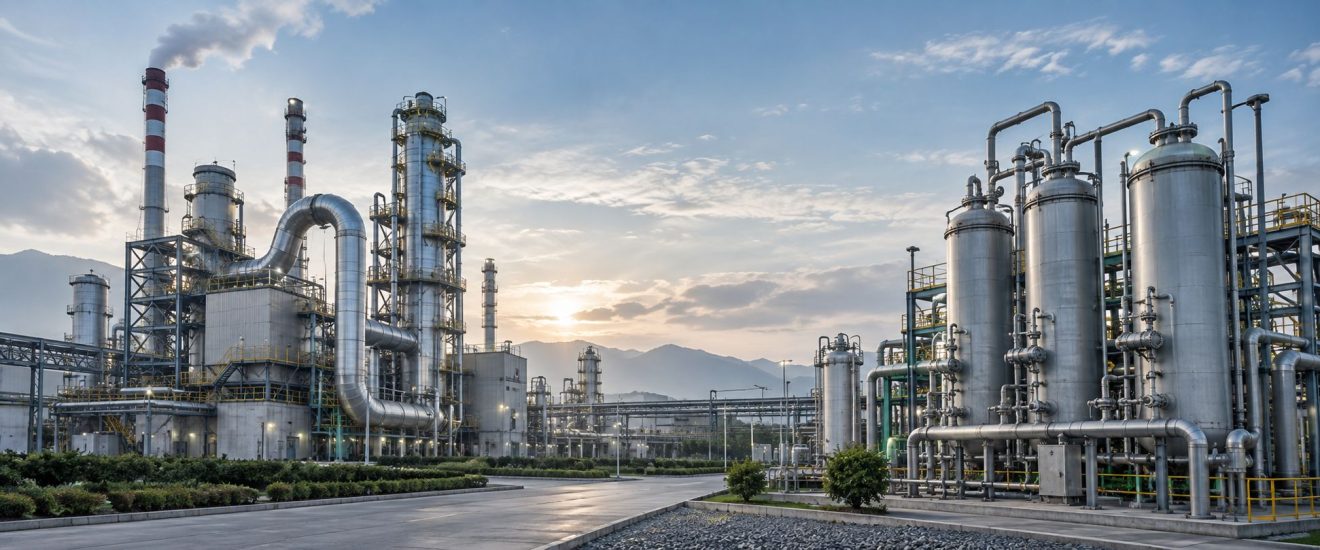
Choosing an industrial desulfurization catalyst starts with identifying the sulfur compounds in the gas stream. A catalyst designed for SO₂ removal from combustion flue gas is not automatically suitable for removing H₂S from natural gas or biogas.
SO₂, H₂S, carbonyl sulfide (COS) and mercaptans require different treatment conditions. Their removal also serves different purposes: meeting stack emission limits, protecting downstream equipment, preparing fuel gas or meeting a chemical feedstock specification.
The selection sequence is straightforward: identify the sulfur species, establish the required outlet specification, select the treatment process and then qualify the catalyst against the actual operating conditions.
1. Why Does the Sulfur Species Determine Catalyst Selection?
Industrial sulfur-containing gases differ substantially in composition, temperature, pressure and treatment requirements.
SO₂ is commonly associated with combustion flue gas and certain oxidizing process streams. H₂S is encountered in natural gas, biogas, refinery streams and chemical feed gases. COS, mercaptans and other organic sulfur compounds may also be present in petroleum and chemical processing streams.
These compounds cannot be treated as interchangeable contaminants. A high removal efficiency for one sulfur species does not establish a material’s performance against another.
| Sulfur Species | Typical Gas Streams | Treatment Options | Key Selection Criteria |
|---|---|---|---|
| SO₂ | Boiler and kiln flue gas, steel sintering gas, sulfuric acid plant tail gas | Wet and dry FGD, semi-dry systems, carbon-based catalytic desulfurization | SO₂ removal, temperature, oxygen, moisture and regeneration performance |
| H₂S | Natural gas, biogas, refinery and chemical feed gases | Amine treating, solid desulfurization media, catalytic oxidation and fixed-bed polishing | Breakthrough sulfur capacity, outlet H₂S, GHSV and operating cycle |
| COS and mercaptans | Petrochemical and complex process gases | Dedicated adsorption, catalytic conversion and combined treatment | Individual sulfur species, conversion conditions and total sulfur specification |
| Mixed sulfur compounds | Complex chemical and industrial waste gases | Multi-stage or combined treatment | Full sulfur analysis, interactions between contaminants and stage-specific outlet targets |
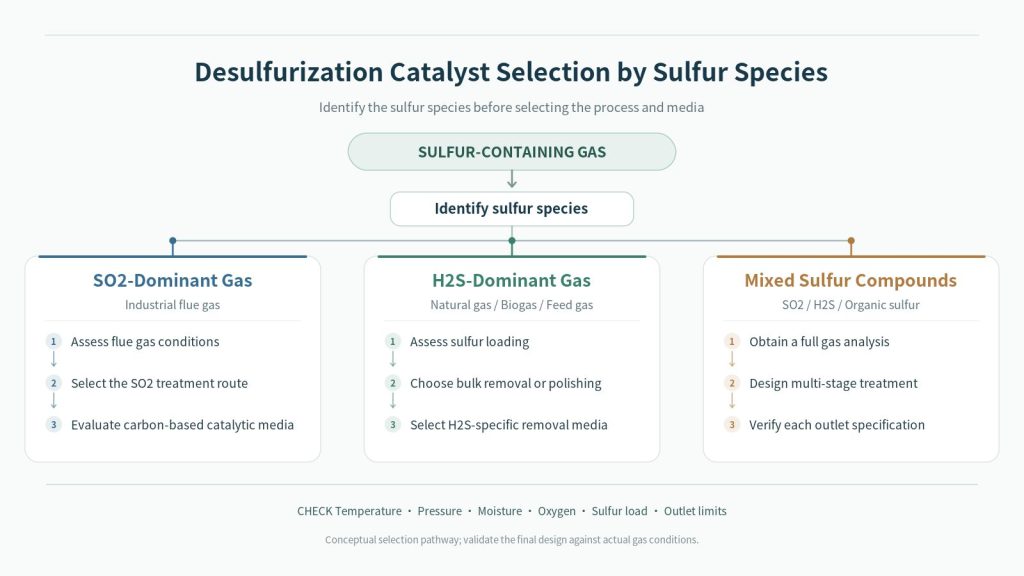
For SO₂-dominant flue gas, temperature, oxygen availability, moisture and gas cleanliness are important operating variables. For H₂S removal, sulfur loading, usable breakthrough capacity and the required outlet concentration are central to fixed-bed design.
If the product specification includes total sulfur, the gas analysis must also identify relevant organic sulfur compounds. An H₂S-only performance test is not sufficient to establish compliance with a total sulfur limit.
2. Selecting a Catalyst for SO₂ Removal from Industrial Flue Gas
SO₂ removal from industrial flue gas can be achieved through several process routes, including wet flue gas desulfurization (FGD), dry and semi-dry systems, and carbon-based catalytic desulfurization.
Conventional wet and dry FGD systems use alkaline reagents to capture and react with SO₂. Carbon-based catalytic desulfurization uses a different mechanism, combining gas adsorption, catalytic conversion and, where the process is designed accordingly, catalyst regeneration and sulfur recovery.
Process selection depends on inlet sulfur loading, gas temperature, required outlet concentration, available utilities, existing equipment and by-product management. A catalyst should be evaluated within the proposed treatment system rather than as a standalone material.
Carbon-Based Catalytic Desulfurization for Low- and Medium-Temperature Gas
Carbon-based catalytic desulfurization can be considered for suitable industrial flue gas streams where SO₂ must be removed at relatively low or medium temperatures.
Under suitable oxygen and moisture conditions, the carbon-based catalyst promotes SO₂ adsorption and oxidation. The resulting sulfur-containing species can form sulfuric acid within the catalyst pores. A compatible regeneration process removes the accumulated acid and restores available catalytic sites.
The recovered stream is generally dilute sulfuric acid, which may be integrated into an existing acid-handling or recovery system where the plant configuration permits.
For a detailed discussion of the reaction mechanism, catalyst regeneration and sulfur recovery, see Catalytic Flue Gas Desulfurization Technology: Low-Temperature SO₂ Removal and Sulfur Recovery.
Which Operating Conditions Must Be Verified?
SO₂ removal efficiency alone does not establish whether a catalyst is suitable for an industrial installation. The assessment should include inlet SO₂ concentration, gas flow, temperature, oxygen, moisture, particulate matter, tar, gas hourly space velocity and the required outlet concentration.
Particulate matter and tar can foul the catalyst bed. Gas flow and space velocity influence contact time, while oxygen and moisture affect the catalytic reaction conditions. For regenerable media, mechanical strength after regeneration, pressure drop and regeneration frequency also matter.
DAQI Technology’s S-1-111 Bamboo-Based Activated Carbon Desulfurization Catalyst is designed for industrial flue gas within a recommended operating temperature range of 40–180°C.
Its published specifications include SO₂ removal efficiency of ≥95%, sulfuric acid mist removal efficiency of ≥90%, and support for in-situ regeneration. The recommended operating conditions also specify oxygen content above 3%, water vapor content above 3%, and inlet SO₂ below 6,000 mg/m³.
These figures describe the published operating and performance conditions of S-1-111. They should not be applied to other carbon-based catalysts without product-specific verification.
Sulfuric Acid Plant Tail Gas Requires Additional Assessment
Sulfuric acid plant tail gas may contain residual SO₂ together with sulfuric acid mist. The two pollutants have different physical forms and must be evaluated separately.
Where an existing acid recovery system is available, carbon-based catalytic desulfurization may offer an opportunity to recover sulfur from the tail gas. However, the recovered acid cannot automatically be returned to the production process without checking its concentration, impurities, water balance and compatibility with the existing plant.
See SO₂ Removal from Sulfuric Acid Plant Tail Gas by Catalytic Desulfurization and Acid Recovery for application-specific process considerations.
3. How to Select an H₂S Removal Catalyst for Natural Gas and Biogas
H₂S removal from natural gas, biogas and industrial feed gas involves a different set of process requirements from post-combustion SO₂ removal.
The treated gas may be used as fuel, delivered to a pipeline or supplied to sulfur-sensitive downstream equipment. The required outlet H₂S concentration and total sulfur specification must therefore be established before selecting the removal process.
Amine treating is commonly considered for larger, continuous gas streams with substantial acid-gas loads. Solid desulfurization media and fixed-bed catalysts can be evaluated for lower sulfur loads, decentralized applications and polishing duties requiring very low outlet H₂S concentrations.
The U.S. Environmental Protection Agency’s technical material on natural gas processing identifies amine treatment, physical absorption and solid-bed sweetening among the available approaches. The appropriate process depends on the characteristics of the gas stream and its intended use.
Breakthrough Sulfur Capacity and Bed Life
Initial H₂S removal efficiency is only one part of a fixed-bed performance assessment. The practical question is how long the bed can maintain the required outlet concentration before breakthrough.
Breakthrough sulfur capacity, usually expressed in mg/g, represents the amount of sulfur retained per unit mass of media before a defined outlet concentration is reached.
Capacity values should be compared only when the relevant test conditions are available. Inlet H₂S concentration, gas hourly space velocity, temperature, humidity and the breakthrough endpoint can materially affect the reported capacity.
A catalyst offering high initial removal efficiency may still require frequent replacement if the usable sulfur capacity is insufficient for the actual gas load.
Where Does HST-1 Fit?
DAQI Technology’s HST-1 Bamboo-Based Hydrogen Sulfide Desulfurization Catalyst is developed for fixed-bed H₂S removal from natural gas, biogas and industrial feed gases.
Published performance data include H₂S removal efficiency of ≥99.5%, breakthrough sulfur capacity above 700 mg/g at 1,000 h⁻¹ and above 300 mg/g at 3,000 h⁻¹. An outlet H₂S concentration as low as ≤0.01 ppm can be achieved under the relevant test and operating conditions.
The recommended operating temperature is 10–35°C, with a specified gas hourly space velocity range of 500–3,000 h⁻¹.
Suitable humidity and oxygen availability are relevant to the catalytic oxidation mechanism. Free liquid water should not enter the catalyst bed.
For natural gas and other flammable gas streams, oxygen must not be introduced solely to satisfy a catalyst specification without a complete process and safety assessment. Gas composition, oxygen limits, hazardous-area requirements and the overall system design must be evaluated by qualified engineers.
For fixed-bed sizing, catalyst loading, breakthrough capacity and replacement-cycle calculations, see How to Select a Natural Gas Desulfurization Catalyst: H₂S Load, Sulfur Capacity, GHSV and Fixed-Bed Sizing.
4. What If the Gas Contains COS, Mercaptans or Other Organic Sulfur Compounds?
Natural gas and industrial feed gas may contain organic sulfur compounds in addition to H₂S. Carbonyl sulfide (COS), mercaptans and other sulfur species can require different adsorption or conversion conditions.
A high H₂S removal efficiency does not demonstrate equivalent performance against organic sulfur compounds. Where the downstream specification is based on total sulfur, individual sulfur species should be identified and evaluated.
Depending on the gas composition, treatment may involve dedicated adsorption, catalytic conversion or a combination of processes. If an organic sulfur compound is converted into another sulfur species, the downstream removal requirement must also be considered.
HST-1 can provide partial removal of certain organic sulfur compounds. However, its published H₂S performance figures should not be interpreted as guaranteed COS or mercaptan removal efficiency. Product suitability must be verified for the actual gas composition and outlet specification.
5. Mixed Sulfur-Containing Gases: Select the Process Before the Catalyst
When several sulfur compounds are present, catalyst selection should begin with a full gas analysis and a clear definition of the treatment objective.
Consider a fuel gas containing H₂S. Desulfurization before combustion is designed around the composition and use of the fuel gas. If the combustion process subsequently produces flue gas containing SO₂, that stream requires a separate post-combustion treatment assessment.
Pre-combustion H₂S removal and post-combustion SO₂ removal are different process duties. The catalyst operating conditions and performance data for one should not be transferred directly to the other.
For complex chemical gases containing SO₂, H₂S and organic sulfur compounds, the process design must also consider interactions between contaminants, competing adsorption and potential reaction by-products.
Multi-stage treatment may be required. Simply combining different catalysts in one vessel does not establish that all sulfur species will be removed to the required specifications.
Biogas upgrading provides a practical example of this broader treatment approach. The U.S. EPA’s overview of renewable natural gas production describes gas conditioning and upgrading steps that address moisture, hydrogen sulfide, siloxanes and other contaminants according to the intended gas use.
6. What Information Should Be Included in a Desulfurization Catalyst RFQ?
An RFQ stating only “SO₂ removal” or “1,000 ppm H₂S” is not sufficient for reliable catalyst selection.
The supplier needs enough information to evaluate sulfur loading, gas–solid contact conditions, operating temperature, competing contaminants and the required outlet specification.
| Required Information | SO₂ Flue Gas Treatment | H₂S Gas Purification |
|---|---|---|
| Gas source and application | Boiler, kiln, sulfuric acid plant or other industrial process | Natural gas, biogas, chemical feed gas or other gas service |
| Gas flow | Normal, maximum and variable flow rates | Normal, maximum and variable flow rates |
| Inlet sulfur concentration | SO₂ and other relevant sulfur species | H₂S, COS, mercaptans and total sulfur |
| Outlet specification | SO₂ emission target and relevant co-pollutant limits | Outlet H₂S, total sulfur and downstream equipment requirements |
| Temperature and pressure | Operating range and expected fluctuations | Operating range and expected fluctuations |
| Moisture and oxygen | Water vapor, O₂ and condensation risk | Humidity, O₂ and liquid-water carryover |
| Other contaminants | Particulates, tar and sulfuric acid mist | CO₂, oil mist, particulates and organic sulfur compounds |
| Operating requirements | Annual operating hours, pressure drop and regeneration conditions | Target operating cycle, GHSV and media replacement requirements |
For an existing installation, include the current treatment process, media type, loading quantity, operating cycle, pressure drop and available inlet and outlet measurements.
Final material qualification should be based on representative gas conditions and, where necessary, laboratory testing, pilot evaluation or engineering validation.
7. How Does GB/T 47594-2026 Relate to Catalyst Selection?
China’s recommended national standard GB/T 47594-2026, Carbon-based Catalytic Desulfurization Method for Sulfur-Containing Waste Gas, was published on May 25, 2026 and is scheduled to take effect on December 1, 2026.
The National Public Service Platform for Standards Information lists Sichuan University and Chengdu Daqi Technology Joint Stock Co., Ltd. among the standard’s main drafting organizations.
GB/T 47594-2026 is a process-method standard rather than a product standard for an individual commercial catalyst. Participation in drafting the standard should not be interpreted as national-standard product certification for S-1-111, HST-1 or any other specific material.
Industrial desulfurization performance depends on more than catalyst composition. Reactor design, gas pretreatment, operating controls, regeneration and sulfur-product handling must also be considered during process qualification.
For further information, see GB/T 47594-2026 Carbon-Based Catalytic Desulfurization Standard: DAQI Technology’s Participation.
Frequently Asked Questions
Can the same catalyst remove both SO₂ and H₂S?
Not without application-specific qualification. SO₂ and H₂S removal involve different gas compositions, operating conditions and performance criteria. A catalyst developed for one duty should not be assumed suitable for the other.
Is a dedicated desulfurization catalyst different from ordinary activated carbon?
Dedicated desulfurization catalysts are designed around specific sulfur-removal mechanisms and operating conditions. Pore structure, surface chemistry and catalytic activity may be tailored to the target application. Suitability must still be established under the actual process conditions.
Can a fixed-bed catalyst handle high H₂S concentrations?
Suitability depends on gas flow, sulfur mass loading, outlet specification and the required operating cycle. For large, continuous sulfur loads, bulk removal followed by fixed-bed polishing may warrant evaluation against direct fixed-bed treatment.
Which performance specifications matter most when comparing desulfurization catalysts?
For SO₂ treatment, assess removal efficiency, temperature range, oxygen and moisture requirements, GHSV and regeneration performance. For fixed-bed H₂S removal, assess breakthrough sulfur capacity, outlet H₂S, GHSV and expected operating cycle. Mechanical strength, pressure drop and contaminant tolerance are relevant to both applications.
Technical Support for Industrial Desulfurization Catalyst Selection
Chengdu Daqi Technology Joint Stock Co., Ltd. develops carbon-based catalytic materials for industrial sulfur-containing gas treatment, including S-1-111 for industrial SO₂ removal and HST-1 for H₂S gas purification.
For a new gas treatment project, catalyst replacement or process upgrade, provide the gas source, sulfur composition, flow rate, inlet and required outlet concentrations, temperature, pressure and operating requirements.
These data provide the basis for preliminary material screening, sample testing and application-specific technical evaluation.
Technical inquiries: [email protected]