


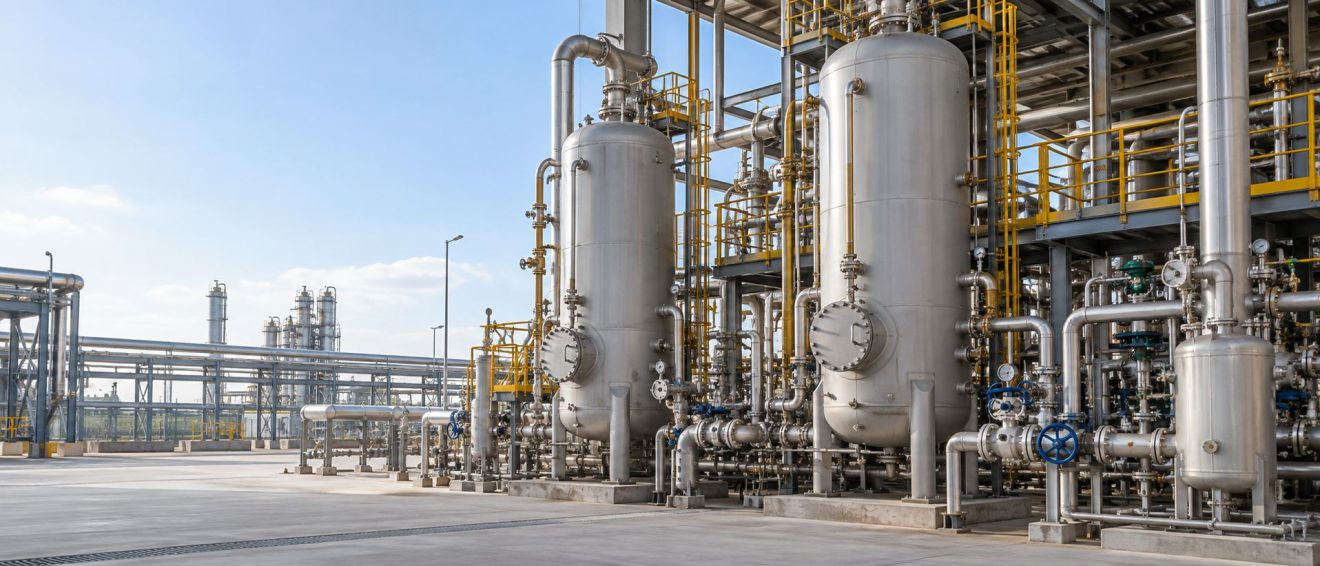
Two H2S removal catalysts may deliver similar outlet gas quality when first installed, yet require replacement at very different intervals. The difference is not necessarily explained by their initial removal efficiency. In a fixed-bed system, usable sulfur capacity, gas throughput and operating conditions determine how much hydrogen sulfide the bed can handle before breakthrough.
Sulfur capacity is therefore one of the most important specifications to examine when selecting an H2S removal catalyst. However, a capacity value expressed in mg/g has limited engineering value unless the test conditions and breakthrough endpoint are also known.
This guide explains what sulfur capacity means, how breakthrough capacity differs from saturation capacity, why gas hourly space velocity affects bed performance, and how sulfur loading can be used to estimate catalyst service life.
What Is H2S Sulfur Capacity?
H2S sulfur capacity describes the amount of sulfur that a desulfurization material can retain or chemically bind per unit mass of media under specified conditions.
In a fixed-bed H2S removal system, hydrogen sulfide is removed through adsorption, chemical reaction, catalytic conversion or a combination of these mechanisms. Sulfur-containing products accumulate within or on the surface of the media as the process continues.
For a catalytic oxidation medium that primarily produces elemental sulfur, capacity reflects the amount of sulfur the material can accommodate under the specified reaction and test conditions. Other desulfurization materials may retain sulfur in different chemical forms.
Consequently, sulfur capacity depends on more than surface area. Pore structure, surface chemistry, active components, mass transfer and reaction conditions all influence the usable performance of an H2S adsorbent or catalyst.
What Does a Sulfur Capacity of 700 mg/g Mean?
If a material has a measured sulfur capacity of 700 mg S/g media, each gram of fresh media corresponds to 700 mg of sulfur loading under the specified test conditions.
This is equivalent to 0.7 g of sulfur per gram of initial media, or 70% when expressed as the ratio of sulfur mass to initial media mass.
That percentage should not be confused with the sulfur mass fraction of the final spent material.
It is also important to establish whether a supplier reports capacity as elemental sulfur or as the mass of H2S removed. These are different mass bases. A capacity of 700 mg S/g media corresponds to approximately 744 mg H2S/g media.
For reliable product comparisons, confirm the reporting basis, test procedure and breakthrough definition before interpreting a published sulfur capacity value.
Breakthrough Capacity vs. Saturation Capacity
A fixed-bed catalyst does not necessarily reach complete saturation when the treated gas first exceeds its required H2S specification.
For this reason, breakthrough sulfur capacity and saturation sulfur capacity should be treated as separate performance indicators.
Breakthrough Sulfur Capacity
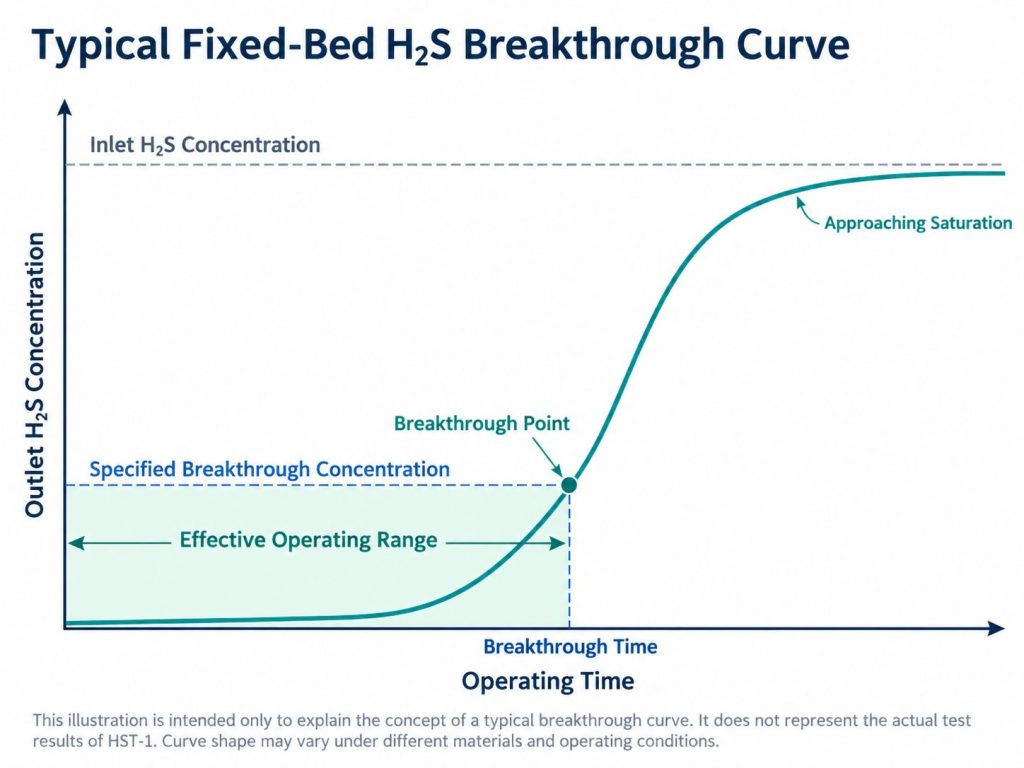
Breakthrough sulfur capacity is the amount of sulfur retained per unit mass of media before the outlet H2S concentration reaches a predefined breakthrough limit.
During initial operation, the bed may maintain a very low outlet H2S concentration. As sulfur accumulates, the active mass-transfer zone progresses through the bed. When the outlet concentration reaches the specified breakthrough value, the bed has reached the endpoint defined for that test or operating duty.
The sulfur loading accumulated up to this point is the breakthrough sulfur capacity.
The breakthrough criterion matters. A test using an outlet limit of 0.1 ppm H2S may produce a different capacity value from one using 10 ppm, even when the same media is tested under otherwise similar conditions.
For deep-desulfurization applications, the test endpoint should reflect the actual outlet requirement rather than an arbitrary percentage of the inlet concentration.
A published study in Energy & Fuels on long-term H2S breakthrough using ZnO-based adsorbents defines sulfur capacity in relation to the amount of sulfur captured before a specified outlet breakthrough concentration is reached.
This provides an important basis for comparing industrial desulfurization media: the stated capacity must be read together with the breakthrough criterion and operating conditions.
Saturation Sulfur Capacity
Saturation sulfur capacity generally refers to the sulfur loading achieved when a material approaches saturation under a defined test procedure.
After breakthrough, part of the bed may still retain some ability to remove H2S. Continued operation, however, allows the outlet concentration to rise beyond the initial breakthrough threshold.
For an industrial system that must maintain a strict outlet specification, saturation capacity cannot be used as a direct substitute for usable breakthrough capacity.
When reviewing an H2S catalyst datasheet, determine whether the reported sulfur capacity represents performance at a specified breakthrough point or a later stage approaching saturation.
How Does Gas Hourly Space Velocity Affect H2S Sulfur Capacity?
Gas hourly space velocity, commonly abbreviated as GHSV, relates the volumetric gas flow rate to the packed catalyst bed volume.
GHSV (h⁻¹) = Gas volumetric flow rate (m³/h) ÷ Packed bed volume (m³)
The temperature and pressure basis used for the gas flow must be clearly defined. Standard volumetric flow and actual operating volumetric flow are not interchangeable, particularly in pressurized gas treatment systems.
Higher GHSV Reduces Gas Contact Time
Consider a packed bed with a catalyst volume of 1 m³. At an actual operating gas flow rate of 1,000 m³/h, the GHSV is 1,000 h⁻¹ and the nominal empty-bed contact time is approximately 3.6 seconds.
If the operating gas flow doubles while the bed volume remains unchanged, the GHSV increases to 2,000 h⁻¹ and the nominal contact time decreases to approximately 1.8 seconds.
Shorter contact time can limit gas-to-solid mass transfer and reaction within the bed. Depending on the material and operating conditions, the outlet H2S concentration may reach the breakthrough threshold before the available sulfur capacity has been fully utilized.
This is why the breakthrough sulfur capacity of a particular H2S removal catalyst may change with space velocity.
Lower GHSV is not automatically the most economical operating choice. Bed size, pressure drop, gas throughput, capital cost and the required operating cycle must also be considered.
HST-1 Sulfur Capacity at Different Space Velocities
DAQI Technology’s HST-1 Bamboo-Based Hydrogen Sulfide Desulfurization Catalyst is developed for fixed-bed gas purification applications involving biogas, natural gas and industrial feed gases.
Its published technical specifications include breakthrough sulfur capacity values at two different gas hourly space velocities.
| Parameter | Published HST-1 Specification |
|---|---|
| H2S removal efficiency | ≥99.5% |
| Breakthrough sulfur capacity at 1,000 h⁻¹ | >700 mg/g |
| Breakthrough sulfur capacity at 3,000 h⁻¹ | >300 mg/g |
| Recommended operating temperature | 10–35°C |
| Specified GHSV range | 500–3,000 h⁻¹ |
The different reported capacity values illustrate why GHSV must be considered when assessing catalyst performance.
The published values should not be interpreted as unconditional performance guarantees for all gas streams. Inlet H2S concentration, moisture, oxygen availability, temperature and the selected breakthrough limit can all influence the usable capacity.
Capacity at other space velocities should be established through relevant test data rather than extrapolated directly from the two published values.
How to Estimate H2S Removal Catalyst Life
For a fixed-bed H2S removal system, a preliminary operating-cycle estimate can be developed from the sulfur mass loading, catalyst quantity and expected usable breakthrough capacity.
The first step is to determine how much sulfur enters the system per hour.
Step 1: Calculate the Inlet Sulfur Load
For a gas flow expressed in Nm³/h and an H2S concentration expressed in ppmv, the following approximation can be used when the normal reference conditions are 0°C and 101.325 kPa:
Inlet sulfur load (kg S/h) ≈ Gas flow (Nm³/h) × H2S concentration (ppmv) × 1.43 × 10⁻⁶
This expression gives the elemental sulfur mass entering the system. If the calculation is based on the mass of H2S rather than elemental sulfur, the corresponding conversion factor is approximately 1.52 × 10⁻⁶.
For detailed engineering, verify the specified normal reference conditions, dry or wet gas basis, gas composition and flow measurement method.
Step 2: Calculate the Usable Sulfur Loading
Once the catalyst loading and representative breakthrough capacity have been established, the usable sulfur loading can be estimated as follows:
Usable sulfur loading (kg S) ≈ Media mass (kg) × Usable sulfur capacity (mg S/g) ÷ 1,000
The capacity used in this calculation should reflect the actual gas composition, operating conditions and required breakthrough endpoint.
Step 3: Estimate the Theoretical Operating Time
Under simplified conditions with relatively constant flow, inlet concentration and high H2S removal:
Theoretical operating time (h) ≈ Usable sulfur loading (kg S) ÷ Average sulfur removal load (kg S/h)
Consider a hypothetical gas treatment system operating at 1,000 Nm³/h with an inlet H2S concentration of 500 ppmv.
Its inlet sulfur load is approximately 0.715 kg S/h.
Assume that 1,000 kg of desulfurization media has been installed and that representative testing has established a usable breakthrough capacity of 200 mg S/g media under the relevant operating conditions.
The calculated usable sulfur loading is 200 kg S.
Assuming the outlet sulfur load remains small relative to the inlet and operating conditions remain stable:
Theoretical operating time ≈ 200 ÷ 0.715 ≈ 280 hours, or approximately 11.7 days.
This example is intended only to demonstrate the calculation. The assumed 200 mg/g capacity is not an HST-1 performance specification, and the calculated operating time is not a guaranteed service interval for any commercial product.
Actual bed life may differ because of fluctuating sulfur loading, uneven gas distribution, water carryover, competing contaminants, pressure-drop changes and other operating factors.
Where inlet H2S concentration varies significantly, cumulative sulfur loading should be calculated from operating data rather than from a single concentration measurement.
Why Laboratory Sulfur Capacity Does Not Guarantee Field Service Life
Laboratory breakthrough tests are normally performed under controlled conditions. An industrial installation may experience substantial variation in gas flow, contaminant concentration, moisture and other operating parameters.
These differences can affect both the rate of sulfur accumulation and the proportion of the bed that remains effectively available before breakthrough.
Inlet H2S Concentration and Gas Flow
An increase in inlet H2S concentration or gas throughput raises the incoming sulfur mass load. With the same catalyst inventory, the bed may reach breakthrough sooner.
Biogas and fermentation gas systems can experience variable sulfur concentrations. For these applications, operating-cycle estimates should account for high-load periods rather than relying exclusively on average inlet conditions.
Moisture and Oxygen Availability
Moisture and oxygen requirements vary among H2S removal technologies.
For catalytic oxidation media, suitable oxygen and humidity conditions may be necessary to support the intended reaction. However, liquid-water carryover can interfere with gas distribution and effective contact within the packed bed.
The published operating conditions for HST-1 specify that liquid water must not enter the catalyst bed and include an oxygen-to-H2S requirement for the intended catalytic oxidation mechanism.
For natural gas and other flammable streams, oxygen must not be introduced solely to meet a catalyst specification. Oxygen availability, allowable gas composition and the overall process safety requirements must be assessed by qualified engineers before selecting a treatment route.
Competing Contaminants and Bed Condition
Oil mist, particulates, tar and other contaminants can reduce access to active sites, obstruct pores or increase bed pressure drop.
Gas streams containing carbonyl sulfide, mercaptans or other organic sulfur compounds may require additional treatment. High H2S removal efficiency alone does not demonstrate compliance with a total sulfur specification.
For an overview of process options, see How Is H2S Removed from Natural Gas? Desulfurization Catalysts, Sulfur Capacity and Fixed-Bed Selection.
When Should an H2S Removal Catalyst Be Replaced?
A fixed-bed catalyst should not be replaced solely because a predetermined number of operating days has elapsed. The outlet H2S concentration, accumulated sulfur loading and condition of the treatment system provide a more useful basis for evaluating the remaining operating cycle.
Depending on the process design, continuous gas treatment installations may use lead-lag beds, standby vessels or other arrangements that allow operators to identify breakthrough and maintain the required outlet specification.
If the outlet H2S concentration begins to rise, review the inlet sulfur load, gas flow, analyzer performance, bed pressure drop and potential liquid-water carryover before concluding that the catalyst has reached the end of its usable life.
Regeneration options depend on the media chemistry and the manufacturer’s approved procedure. A regeneration method intended for another desulfurization material should not be assumed suitable for HST-1.
Hydrogen sulfide is toxic and flammable. Vessel inspection and media replacement may also involve residual hazardous gas and confined-space risks. The U.S. Occupational Safety and Health Administration’s hydrogen sulfide safety guidance describes the associated exposure and workplace hazards. Appropriate isolation, gas testing, purging and work-permit procedures are necessary during maintenance.
What Should Buyers Check When Comparing H2S Removal Catalysts?
When comparing sulfur capacity values from different suppliers, request enough information to establish whether the test results are relevant to the intended operating duty.
| Required Information | Why It Matters |
|---|---|
| Sulfur capacity reporting basis | Distinguishes elemental sulfur loading from H2S mass removed |
| Breakthrough criterion | Defines the outlet H2S concentration used as the test endpoint |
| Inlet H2S concentration | Establishes the test sulfur load |
| Gas hourly space velocity | Defines the gas throughput relative to bed volume |
| Temperature, humidity and oxygen | Establishes the relevant reaction and operating conditions |
| Gas composition | Identifies competing contaminants and other sulfur species |
| Breakthrough curve and test method | Supports comparison of usable capacity and breakthrough behavior |
| Bulk density and pressure drop | Supports media loading and equipment design assessment |
For a new installation, the catalyst evaluation should begin with the required gas quality, normal and maximum flow rates, inlet H2S concentration, temperature, pressure, moisture, oxygen availability and target operating cycle.
For an existing desulfurization vessel, historical operating data can be particularly useful. Current media loading, replacement frequency, inlet and outlet H2S measurements and pressure-drop trends help establish a practical basis for comparing alternative materials.
For further guidance on fixed-bed sizing and media selection, see How to Select a Natural Gas Desulfurization Catalyst: H2S Load, Sulfur Capacity, GHSV and Fixed-Bed Sizing.
Frequently Asked Questions
Does higher sulfur capacity always mean longer catalyst life?
Not necessarily. Higher usable breakthrough capacity can support longer operation when gas loading, breakthrough criteria and other conditions are comparable. Actual bed life also depends on inlet sulfur load, GHSV, bed design and operating stability. Capacity values measured under different test conditions should not be used for direct service-life comparisons.
What is the difference between H2S removal efficiency and sulfur capacity?
Removal efficiency describes the reduction in H2S concentration at a particular operating point or over a specified period. Breakthrough sulfur capacity describes the cumulative sulfur loading retained per unit mass of media before a defined outlet concentration is reached. High initial removal efficiency does not necessarily indicate a long operating cycle.
Why does sulfur capacity change with GHSV?
Changing GHSV affects gas contact conditions and mass transfer within the packed bed. At higher space velocities, the outlet H2S concentration may reach the breakthrough limit before the media’s available sulfur capacity has been fully utilized. The magnitude of this effect depends on the material and operating conditions.
Does a higher iodine number indicate better H2S removal performance?
No direct relationship should be assumed. Iodine number is an activated carbon adsorption test, while H2S removal may also depend on surface chemistry, catalytic activity, pore accessibility and reaction conditions. Application-specific H2S breakthrough data are more relevant when selecting a dedicated desulfurization material.
H2S Removal Catalyst Selection and Technical Support
Chengdu Daqi Technology Joint Stock Co., Ltd. develops bamboo-based activated carbon and functional catalytic materials for industrial gas purification. Its HST-1 catalyst is designed for fixed-bed H2S removal from biogas, natural gas and selected industrial feed gas streams.
For a new gas treatment project or replacement of existing desulfurization media, provide the inlet H2S concentration, normal and maximum gas flow, temperature, pressure, moisture, oxygen availability, required outlet concentration and target operating cycle.
These parameters provide a basis for preliminary material screening, sample testing and application-specific technical evaluation.
Review the HST-1 Hydrogen Sulfide Desulfurization Catalyst technical specifications or contact DAQI Technology to discuss catalyst selection, technical data and sample testing for your application.