



China officially published GB/T 48061-2026, Bamboo-based Activated Carbon, on August 28, 2026. The new national standard will take effect on March 1, 2027, with DAQI Technology listed among its principal drafting organizations.
According to China’s National Public Service Platform for Standards Information, the standard is administered and implemented by the National Technical Committee on Bamboo and Rattan and supervised by the National Forestry and Grassland Administration.
The official list of drafters also includes Huang Kunming, Li Xin and Li Jiangrong.
Official source: National Public Service Platform for Standards Information — GB/T 48061-2026
A National Standard for Bamboo-Based Activated Carbon
Bamboo-based activated carbon is a porous carbon material produced from bamboo through carbonization, activation and subsequent processing. By adjusting pore structure, physical form and surface properties, the material can be developed for water treatment, gas purification, decolorization, industrial emission control and other functional carbon applications.
As the bamboo-based activated carbon industry develops, consistent specifications and test methods become increasingly important. Differences in raw materials, manufacturing processes and testing conditions can otherwise make it difficult for manufacturers, laboratories and industrial buyers to evaluate products on the same basis.
GB/T 48061-2026 establishes a national technical framework for the production, testing, quality evaluation and commercial use of bamboo-based activated carbon in China.
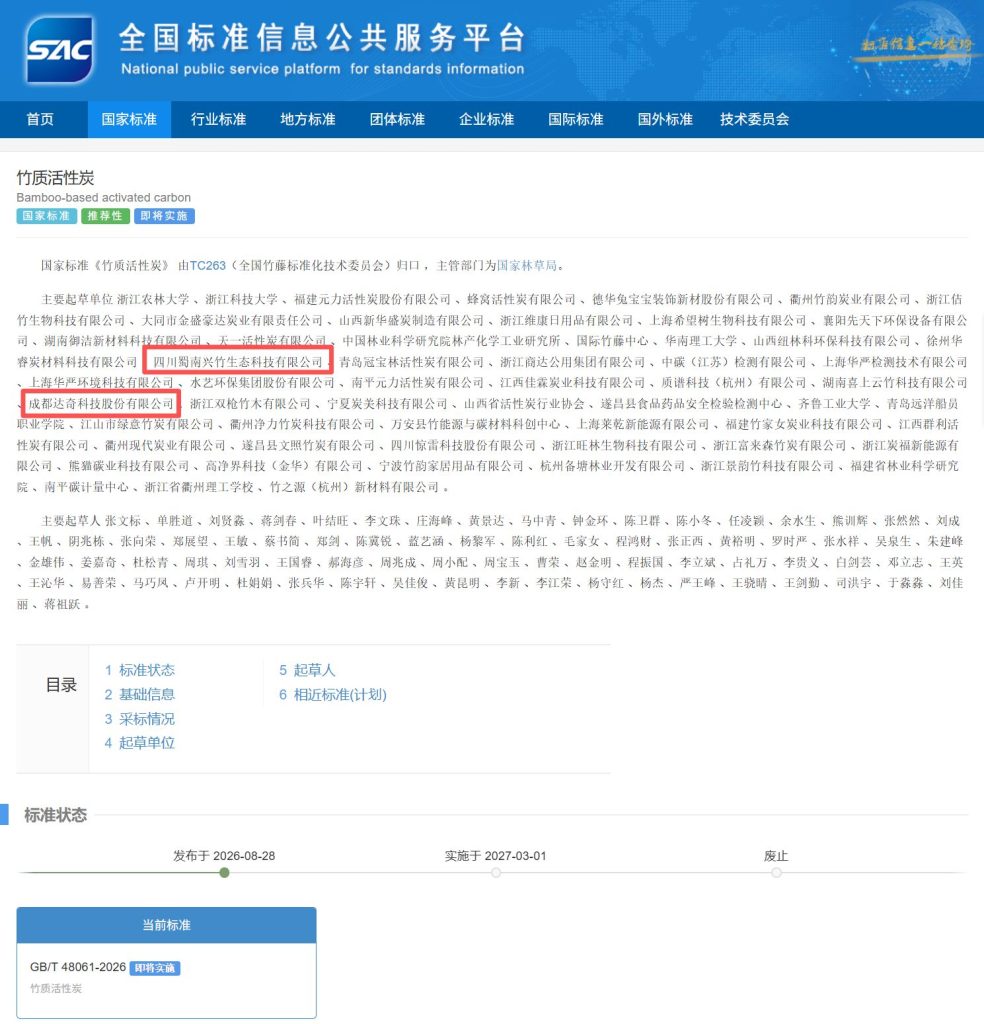
DAQI Technology Listed as a Principal Drafting Organization
The official drafting list brings together universities, research institutes, activated carbon manufacturers, testing organizations and companies across the bamboo and carbon-material value chain. Chengdu DAQI Technology is listed among the principal drafting organizations for GB/T 48061-2026.
DAQI Technology involvement reflects its continuing work in bamboo-based activated carbon, modified activated carbon and catalytic carbon materials, from material development and product manufacturing to application testing under industrial operating conditions.
For activated carbon manufacturers, standardization is closely connected with practical production and quality control. Feedstock selection, carbonization and activation conditions, pore-size distribution, ash, moisture, mechanical strength, surface chemistry and test methods can all influence how an activated carbon performs in a real treatment system.
How GB/T 48061-2026 Relates to ISO 5946:2022
According to China’s official standards database, GB/T 48061-2026 is a modified adoption of ISO 5946:2022.
ISO 5946:2022 is titled Bamboo-based activated carbon — General specifications. The International Organization for Standardization states that the document specifies general requirements and test methods for bamboo-based activated carbon.
This relationship gives manufacturers and industrial buyers a clearer technical reference between China’s national standard and the international framework for bamboo-based activated carbon.
International reference: ISO 5946:2022 — Bamboo-based activated carbon — General specifications
What Does the New Standard Mean for Industrial Buyers?
For industrial buyers, the value of a national standard goes beyond the standard number itself. It provides a more consistent technical basis for evaluating products and comparing suppliers.
- More consistent product comparison: buyers can evaluate bamboo-based activated carbon within a common technical framework.
- More standardized testing: defined test methods help reduce differences caused by inconsistent testing conditions.
- Clearer quality-control references: manufacturers can incorporate standardized requirements into raw-material, process and finished-product quality control.
- Better international alignment: the modified adoption of ISO 5946:2022 provides overseas customers with a clearer reference when evaluating Chinese bamboo-based activated carbon.
A general product standard, however, does not replace application-specific material selection. For water treatment, industrial gas purification, VOC control, decolorization or other contaminant-specific applications, the carbon should still be evaluated against actual operating conditions, including contaminant type and concentration, temperature, humidity, flow rate, contact time, particle size, mechanical strength, pore structure and system configuration.
For a closer look at how bamboo becomes an industrial adsorbent and why pore structure matters, see What Is Bamboo Activated Carbon? From Bamboo to an Adsorbent Material.
From Bamboo Resources to Higher-Value Carbon Materials
Bamboo can serve as more than a feedstock for conventional charcoal. Through controlled carbonization, activation, surface modification and functionalization, bamboo biomass can be converted into porous carbon materials with different pore structures and surface properties.
The development path now extends from general-purpose bamboo-based activated carbon to modified adsorbents for water and gas treatment, and further to functional and catalytic carbon materials designed for more demanding industrial purification processes.
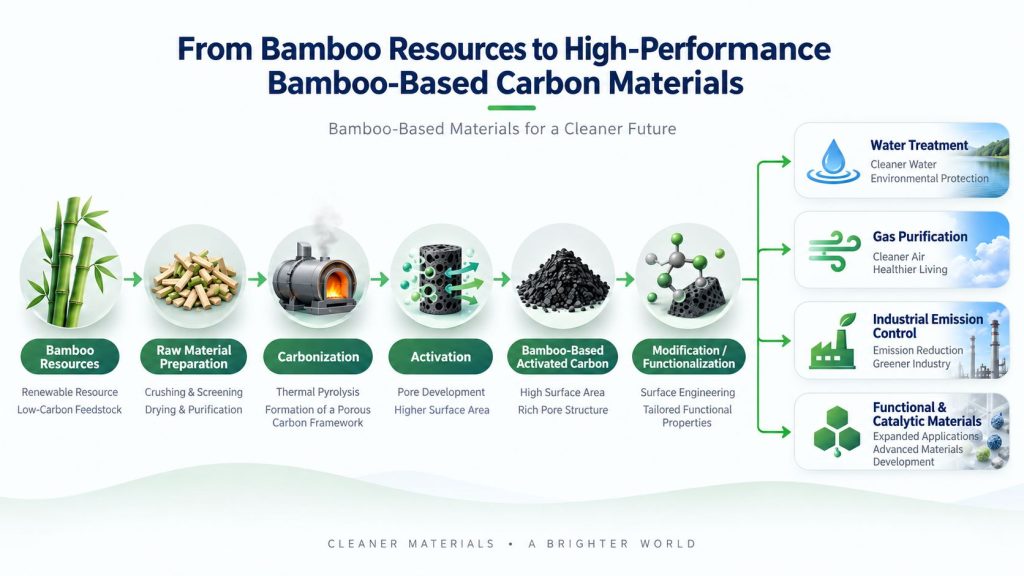
DAQI Continues to Develop Bamboo-Based Carbon Materials for Industrial Applications
As one of the principal drafting organizations for GB/T 48061-2026, DAQI Technology will continue to develop bamboo-based activated carbon, modified activated carbon and catalytic carbon materials for industrial purification applications.
For customer projects, DAQI provides material selection, sample evaluation and technical support based on the target contaminant and actual operating conditions. The goal is not simply to supply a generic activated carbon grade, but to match pore structure, product form and surface functionality with the treatment requirement.
Key Facts About GB/T 48061-2026
When does GB/T 48061-2026 take effect?
The standard was published on August 28, 2026 and will take effect on March 1, 2027.
What role did DAQI Technology have in the standard?
China’s National Public Service Platform for Standards Information lists Chengdu DAQI Technology among the principal drafting organizations for GB/T 48061-2026.
How is GB/T 48061-2026 related to ISO 5946:2022?
GB/T 48061-2026 is a modified adoption of ISO 5946:2022, the international standard covering general requirements and test methods for bamboo-based activated carbon.
Official References
- National Public Service Platform for Standards Information — GB/T 48061-2026 Bamboo-based Activated Carbon
- International Organization for Standardization — ISO 5946:2022, Bamboo-based activated carbon — General specifications